
AI art is imagery produced by machine learning systems—generative adversarial networks, diffusion models, and transformer-based text-to-image systems—trained on vast datasets of existing pictures. Instead of a brush or camera, the working tool is a text prompt or set of reference images fed into a trained model, which generates a new image by sampling and refining noise through learned patterns of color, form, and composition. Early systems pitted two networks against each other to sharpen realism; diffusion models, dominant since the early 2020s, start from random noise and gradually denoise it into a coherent picture guided by the prompt. Output arrives as a digital file, often printed on paper or canvas for gallery display. The look varies by model and prompt but often shows hyperreal detail mixed with subtle anatomical or textual errors, dreamlike blending of unrelated elements, and a smooth, painterly finish uncommon in camera-based images.
What defines the medium
Prompt writing
The primary input is a written text prompt describing subject, style, lighting, and medium. Small wording changes shift composition and mood significantly, so prompt phrasing functions like a recipe the model interprets.
Iteration and curation
Generators produce many variations from one prompt or seed. Practitioners run repeated batches, discard weak results, and select or refine the strongest image, treating curation as much of the work as the initial prompt.
Seed and reproducibility
Each generation starts from a random seed number; keeping that seed fixed while changing other settings lets a maker compare variations precisely, while a new seed produces an entirely different starting point.
Model and training data choice
Different models, trained on different datasets and architectures, produce distinct visual signatures, from photorealistic renders to painterly or anime-influenced styles, so choosing a model shapes the outcome as much as wording.
Inpainting and outpainting
Generated images can be edited by masking a region and regenerating just that area, or extending the canvas outward, letting makers fix errors, swap details, or expand a scene beyond its original frame.
Upscaling and post-processing
Raw output is often low resolution; separate upscaling models sharpen detail and enlarge the file for print, while further edits in image software adjust color, crop, or blend AI output with traditional media.
Materials decoder
The toolkit of ai art
- text prompt
- → the written instruction—subject, style, lighting—that a model translates into an image, functioning as the work's primary creative input
- latent noise field
- → the random starting values a diffusion model gradually refines into a recognizable image through repeated denoising steps
- GAN artifact
- → warped hands, extra fingers, or melted edges left when a generative adversarial network fails to resolve fine anatomical detail
- diffusion smoothness
- → an unusually even, painterly gradient across skin or sky with no visible brushstroke or camera grain, typical of denoised output
- seed number
- → a numeric value that fixes the random starting point, letting a generation be reproduced exactly or varied deliberately
- upscale grain
- → a soft, uniform sharpening texture added by AI upscaling tools, distinct from natural film or sensor noise
The story
Computer-generated imagery dates to early plotter drawings in the 1960s and Harold Cohen's AARON program, which began producing original drawings in 1973. Neural network research matured through the 1980s and 1990s, and in 2014 the generative adversarial network, or GAN, introduced a way to train two competing networks to produce increasingly convincing images. Google's 2015 DeepDream project popularized psychedelic neural-network visualizations. In 2018 a GAN-generated portrait sold at Christie's auction house for $432,500, marking the first major auction sale of AI art. Diffusion models, refined through the early 2020s, enabled text-to-image systems capable of rendering detailed scenes from short written prompts, triggering rapid adoption, museum exhibitions, and ongoing debates over training data, authorship, and copyright that continue to shape the field.
Masterpieces of the medium
| Work | Artist | Date | Why it matters |
|---|---|---|---|
| Portrait of Edmond de Belamy | Unknown | 2018 | GAN-generated portrait that became the first AI artwork sold at a major auction house, Christie's |
| AARON generative drawings | Unknown | 1973-1990s | early rule-based computer program generating original drawings, exhibited internationally |
| DeepDream imagery | Unknown | 2015 | neural network visualization project that popularized swirling, dreamlike AI imagery online |
| AI: More than Human exhibition | Unknown | 2019 | major museum survey at London's Barbican Centre covering AI-related art and design |
| Faceless Portraits Transcending Time | Unknown | 2019 | GAN-generated painting series exhibited at a Danish museum, blending old-master style with AI output |
 AI-generated
Try the medium
Try ai art with AI
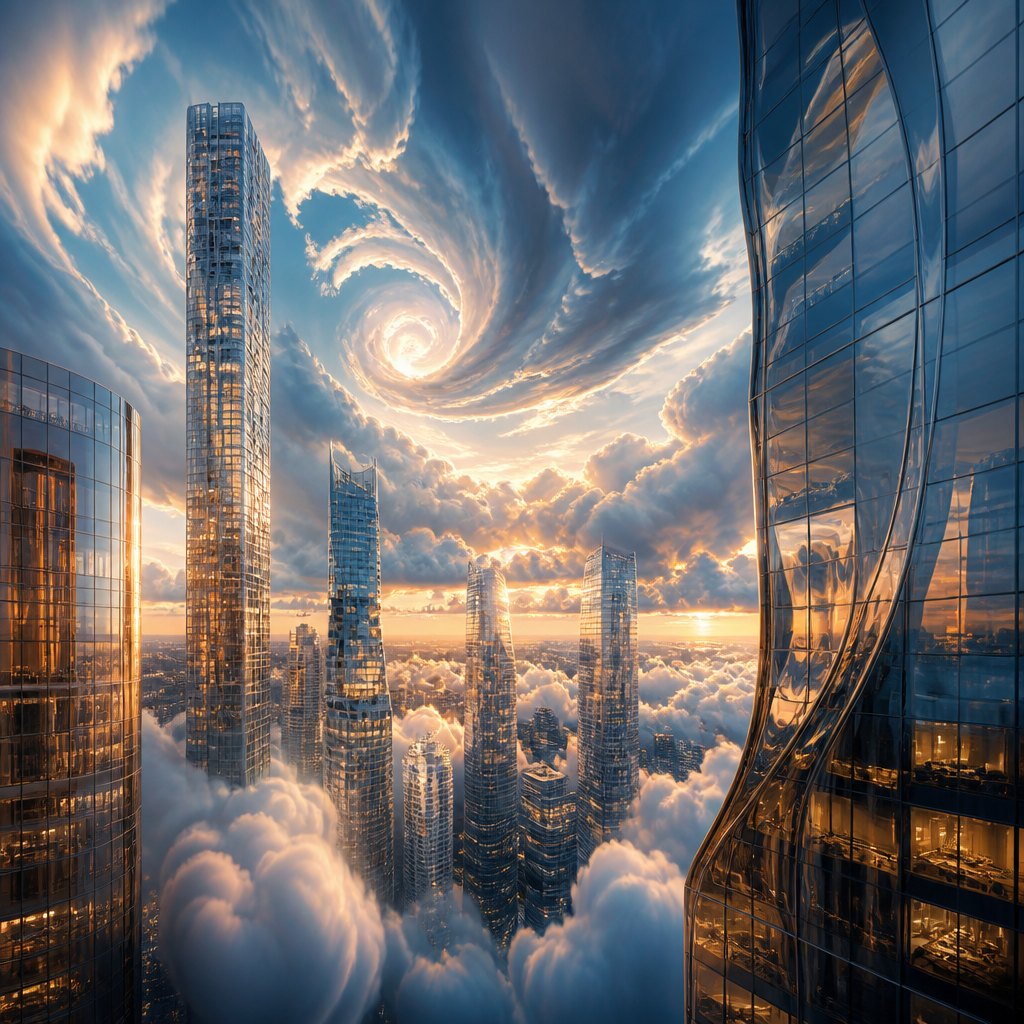
This example was generated from a prompt like: “A luminous cityscape rendered in AI-generated style, hyperreal architecture blending into dreamlike swirling clouds, smooth denoised gradients, subtle surreal distortions in window patterns, digital art finish.”
Open the AI Art Style generator →The medium today
AI image generation is now widely accessible through consumer apps and browser tools, letting anyone produce finished images from a short text description in seconds. Museums and galleries have begun acquiring and exhibiting AI-generated work, while stock image libraries and print-on-demand shops carry AI output alongside traditional photography and illustration. Ongoing debate centers on the copyrighted material used to train models, the copyright status of AI output itself, and how to credit the artists whose work appeared in training datasets.
Compose your own
Starting requires no traditional drawing skill—just access to a text-to-image tool, many of which are free or low-cost online. Begin with a clear prompt naming subject, setting, lighting, and a specific medium or art style, since vague prompts produce generic results. Generate several variations from the same prompt, then adjust wording, add negative prompts to exclude unwanted elements, or lock a seed to fine-tune one version. Use inpainting to fix errors like malformed hands, and upscaling tools to raise resolution for printing. Building a personal prompt library speeds progress more than any single tutorial.
Frequently asked questions
What's the difference between GANs and diffusion models?
GANs pit two networks against each other, one generating images and one judging them, until output looks convincing. Diffusion models instead start from random noise and gradually remove it in steps, guided by a text prompt, and now produce most mainstream AI art.
Does AI art use copyrighted images?
Most AI image models are trained on large datasets scraped from the internet, which typically include copyrighted images alongside public-domain and licensed material, a practice that has prompted ongoing lawsuits and licensing debates.
Can AI-generated images be copyrighted?
Copyright offices in several countries have ruled that images generated purely by AI, without substantial human creative input, cannot be copyrighted, though rulings and policies continue to vary and evolve by jurisdiction.
Why do AI images sometimes have distorted hands or text?
Hands and text involve fine, variable detail that models struggle to learn reliably from training data, so generators often produce extra fingers, fused digits, or garbled lettering even in otherwise convincing images.