
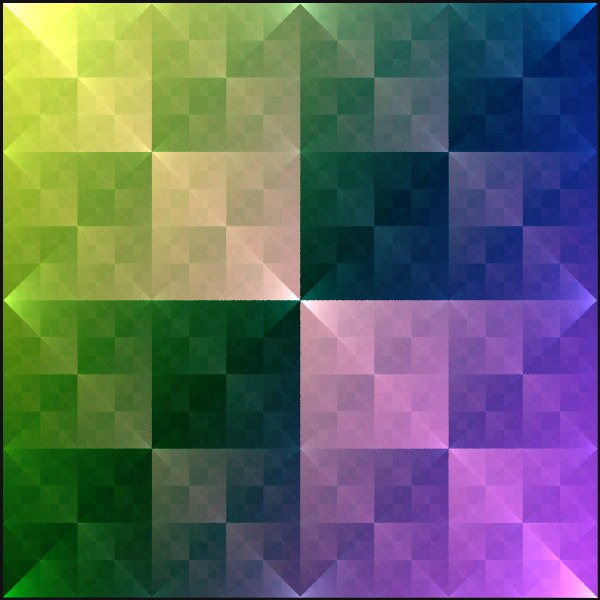
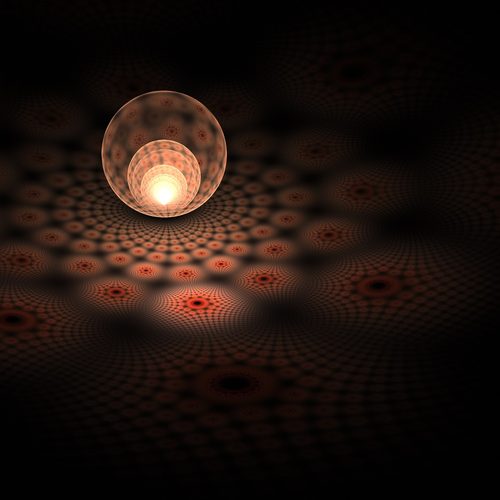
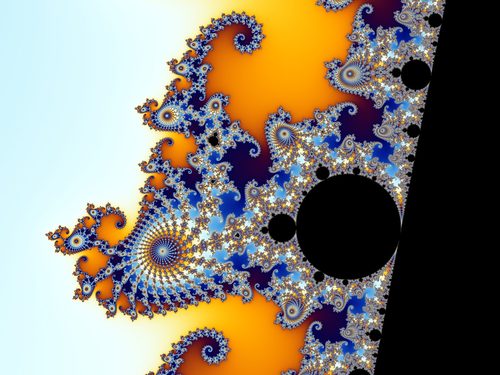
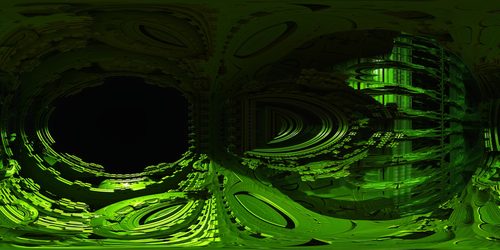
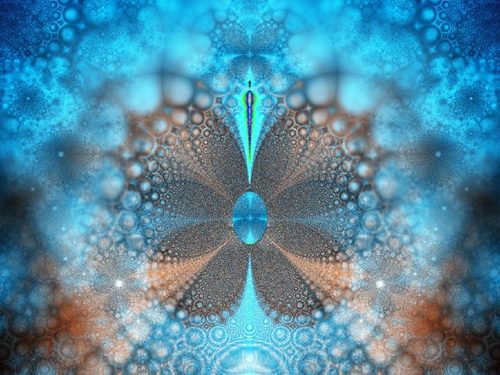
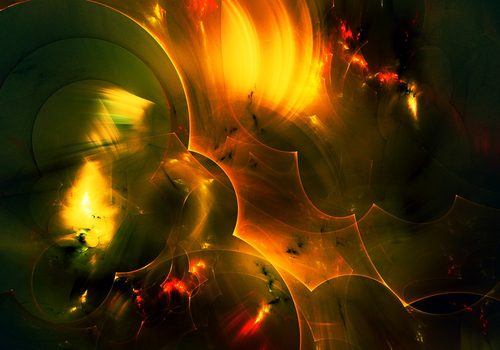
Fractal art is imagery generated by iterating a mathematical formula over a grid of points and coloring each point according to how the formula behaves—whether it escapes toward infinity, cycles, or stays bounded. The most familiar examples come from the complex plane: the Mandelbrot set and its related Julia sets, produced by repeatedly squaring and adding a complex number and counting how many iterations it takes to escape a threshold. Other fractal art uses iterated function systems, which apply simple geometric transformations repeatedly to build swirling, flame-like forms. The defining visual trait is self-similarity: zooming into any region reveals smaller structures echoing the whole, often to arbitrary depth. Software such as Fractint, Ultra Fractal, Apophysis, and Mandelbulb 3D handles the calculation and lets makers choose formulas, adjust parameters and zoom, and apply color gradients, turning raw mathematics into vividly colored digital images.
What defines the medium
Escape-time coloring
Most fractal images color each pixel by how many iterations a formula takes to exceed a threshold value, mapping that count to a gradient so smooth color bands trace the boundary between stable and escaping regions.
Zoom and iteration depth
Because fractals are self-similar at every scale, makers zoom into small regions to reveal new detail, increasing iteration count and calculation precision to keep the image sharp as magnification grows.
Parameter tweaking
Small changes to a formula's constants—the seed value in a Julia set, or transformation weights in a flame fractal—produce dramatically different shapes, so much of the practice is exploring parameter space by trial and adjustment.
Color mapping
Raw fractal data is grayscale iteration counts until a color gradient or palette is applied; choosing and cycling that gradient is often the main creative decision, since underlying geometry is fixed by the formula.
Escape-time versus iterated-function fractals
Escape-time fractals like the Mandelbrot set test each point against a formula independently, while iterated function systems, or fractal flames, apply repeated random transformations to build organic, flame-like density fields.
Rendering time and resolution
High-resolution, deeply zoomed, or high-iteration fractal images can take significant computing time to render, so makers often preview at low resolution before committing to a final high-quality render for print.
Materials decoder
The toolkit of fractal art
- Mandelbrot silhouette
- → the black, bulbous cardioid-and-circle shape at the heart of the Mandelbrot set, the most recognized fractal outline
- Julia set fringe
- → delicate, often disconnected filigree patterns generated from a fixed complex constant, related to but distinct from the Mandelbrot set
- escape-time banding
- → smooth concentric color bands marking how quickly points near a fractal's edge diverge under iteration
- fractal flame swirl
- → dense, glowing, smoke-like swirling structures built from iterated function systems rather than escape-time formulas
- self-similar zoom
- → a deeply magnified region that reveals smaller copies of the overall fractal shape, the signature proof of fractal structure
- gradient palette cycling
- → a repeating color ramp applied to iteration counts, producing the vivid, often psychedelic coloring typical of fractal art
The story
The term fractal was coined in 1975 to describe shapes that are self-similar across scales. In 1978 and 1980, researchers at IBM produced some of the first computer-rendered images of the Mandelbrot set, and the 1982 book The Fractal Geometry of Nature brought the mathematics to a wide audience with striking illustrations. Personal computers of the 1980s made fractal rendering accessible outside research labs; the freeware program Fractint, released in 1988, let hobbyists explore the Mandelbrot and Julia sets on home machines. The 1990s saw dedicated fractal art software such as Ultra Fractal and Apophysis, which introduced iterated-function fractal flames and refined color-gradient tools. Online communities through the 2000s shared parameter files and renders, and 3D fractal formulas later extended the form into volumetric, sculptural imagery.
Masterpieces of the medium
| Work | Artist | Date | Why it matters |
|---|---|---|---|
| First computer visualization of the Mandelbrot set | Unknown | 1978-1980 | early IBM research renderings that first revealed the set's intricate boundary structure |
| The Fractal Geometry of Nature | Unknown | 1982 | widely circulated book of fractal illustrations that introduced the term and imagery to a broad public |
| Fractint software renders | Unknown | 1988 | freeware fractal generator that let home computer users produce Mandelbrot and Julia set images |
| Electric Sheep collaborative animation | Unknown | 1999 | distributed fractal flame screensaver project generating continuously evolving abstract animation |
| Ultra Fractal community renders | Unknown | 2001-2010s | widely used software that popularized layered, richly colored escape-time fractal art |
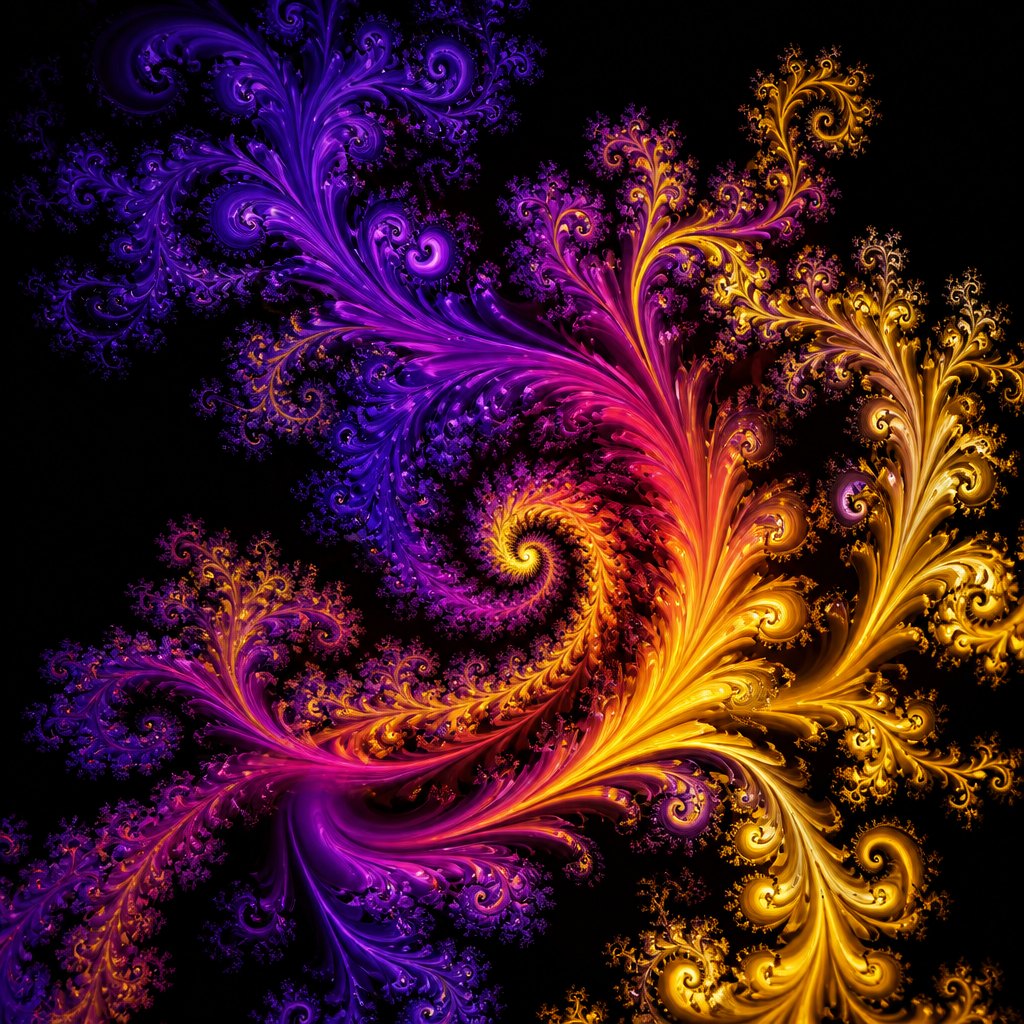 AI-generated
Try the medium
Try fractal art with AI
This example was generated from a prompt like: “A deeply zoomed fractal image with swirling self-similar spiral tendrils, vivid psychedelic gradient from violet to gold, intricate recursive detail at every scale, smooth digital rendering, black background.”
Open the Fractal Art Style generator →The medium today
Fractal art today is made mostly with dedicated software rather than general graphics programs, ranging from browser-based Mandelbrot explorers to advanced 3D fractal renderers used for sculptural, otherworldly landscapes. Online communities continue to trade parameter files, custom color gradients, and formula variations. Fractal imagery appears widely in digital wallpapers, album art, and screensavers, and fractal mathematics remains a research tool in fields from geology to computer graphics, feeding back into new generative techniques.
Compose your own
Beginners typically start with free fractal software such as a browser-based Mandelbrot viewer or a program like Apophysis for flame fractals. Pick a formula type, then explore by zooming into interesting regions and adjusting a handful of numeric parameters or seed constants, watching how small changes reshape the pattern. Apply a color gradient and experiment with cycling or stretching it across the iteration data, since coloring is where most personal style emerges. Save parameter files worth revisiting, and render a final image at high resolution and iteration depth once a composition is chosen.
Frequently asked questions
What is the Mandelbrot set?
It is a set of complex numbers defined by a simple iterative formula; points that stay bounded under repeated iteration belong to the set, and its boundary produces the endlessly detailed fractal shape most associated with fractal art.
Do I need to understand the math to make fractal art?
No—software handles the calculations, and most makers work by adjusting sliders, zooming, and choosing colors through trial and observation rather than solving equations directly, though some understanding helps with intentional control.
What's the difference between fractal art and generative art?
Fractal art is generated from a specific mathematical formula tested point by point, producing precise self-similar structure. Generative art is a broader category that can include randomness, rules, or code-based systems beyond fractal formulas.
Can fractals be rendered in 3D?
Yes—formulas extended into three dimensions, such as the Mandelbulb, produce volumetric fractal shapes that can be lit and rendered like sculptural objects, a technique developed through community experimentation in the 2000s.