
Installation art is a form that turns an entire room or site into the artwork, so a viewer walks into the piece rather than standing in front of it. Instead of a single discrete object, an installation arranges multiple elements — objects, projected light, sound, scent, temperature, even other people — across a defined space so that the experience of moving through it becomes the work itself. Many installations are site-specific, built for one particular room, building, or landscape and dismantled afterward, existing only in photographs and memory once the exhibition closes; others tour as modular kits reassembled differently each time. The form draws on sculpture's occupation of physical space, theater's staging of an experience, and architecture's control of a room, but it belongs to none of them exclusively. Because scale and immersion are central, installation art often invites participation — visitors triggering sensors, walking through fog, or physically altering the arrangement — collapsing the usual distance between artwork and audience into inhabited space.
What defines the medium
Site-Specificity
Many installations are conceived for one exact location — its architecture, light, and history become part of the work — so the piece cannot be relocated intact and often exists afterward only through documentation.
Immersive Environment
Rather than a discrete object seen from one vantage point, installation surrounds the viewer on multiple sides, using scale, darkness, or enclosure to replace the gallery's usual detached viewing distance with bodily presence.
Assemblage of Media
Installations freely combine sculpture, projection, sound, text, found objects, and architecture within a single piece, since the space itself — not any single material — is the unifying medium being worked with.
Viewer Participation
Many installations are activated by the visitor's movement, touch, or presence — motion sensors trigger sound, footsteps disturb material, or a crowd's body heat changes a room — making the audience a co-author of the experience.
Ephemerality
Installations are frequently temporary by design, built for an exhibition's run and then dismantled, so photographs, video documentation, and floor plans often become the lasting record of a piece that no longer physically exists.
Duration and Pacing
Because a viewer moves through an installation over time rather than glancing at it once, artists choreograph a path — an entrance, a climax, an exit — treating the room itself as a kind of narrative structure.
Materials decoder
The toolkit of installation art
- video projector
- → throws moving image across walls, floors, or suspended scrims to dissolve a room's architecture into shifting light
- motion sensor
- → detects a visitor's position or movement and triggers sound, light, or mechanical response, making the audience part of the circuit
- scrim and gauze
- → semi-transparent fabric hung in layers to catch projected light and create a sense of depth or fog within a room
- fog machine
- → fills a space with visible haze so light beams and projections become tangible volumes rather than flat images on a wall
- found and salvaged objects
- → everyday or discarded items assembled in quantity or arrangement, carrying their own history into the constructed environment
- mirrored surfaces
- → multiply and disorient a room's real dimensions, a favorite device for making a finite space feel infinite
- immersive sound system
- → multi-channel speakers placed around or above a room so audio surrounds the visitor rather than emanating from one direction
The story
Installation art grew out of several twentieth-century impulses at once: Dada and Surrealist exhibition designs that turned gallery rooms into disorienting environments, environmental and Happenings artists of the 1950s and 60s who staged events in constructed settings, and Minimalism's insistence that a viewer's physical experience of a space mattered as much as any object in it. By the 1970s, artists were routinely building entire rooms — filled with earth, light, mirrors, or sound — as the primary artwork rather than a backdrop for one. Site-specific land and environmental art extended the same logic outdoors, wrapping buildings or reshaping landscapes. Museums adapted by commissioning temporary, purpose-built rooms rather than acquiring permanent objects, and biennials became a major venue for large-scale immersive work. Digital projection and sensor technology from the 1990s onward expanded what an installation could respond to, folding video art and interactive media fully into the form.
Masterpieces of the medium
| Work | Artist | Date | Why it matters |
|---|---|---|---|
| The Weather Project | Olafur Eliasson | 2003 | a giant artificial sun and mirrored ceiling that turned a museum's turbine hall into a glowing indoor sky |
| Infinity Mirror Rooms | Yayoi Kusama | 1965-ongoing | mirrored chambers filled with lights or polka-dotted forms that make a small room feel endless |
| The Gates | Christo and Jeanne-Claude | 2005 | over seven thousand saffron fabric gates installed along New York's Central Park pathways for sixteen days |
| 7000 Oaks | Joseph Beuys | 1982 | an ongoing planting project pairing basalt stones with trees that treated an entire city as the installation site |
| Rain Room | Random International | 2012 | a chamber of continuous simulated rainfall that parts around visitors tracked by overhead sensors |
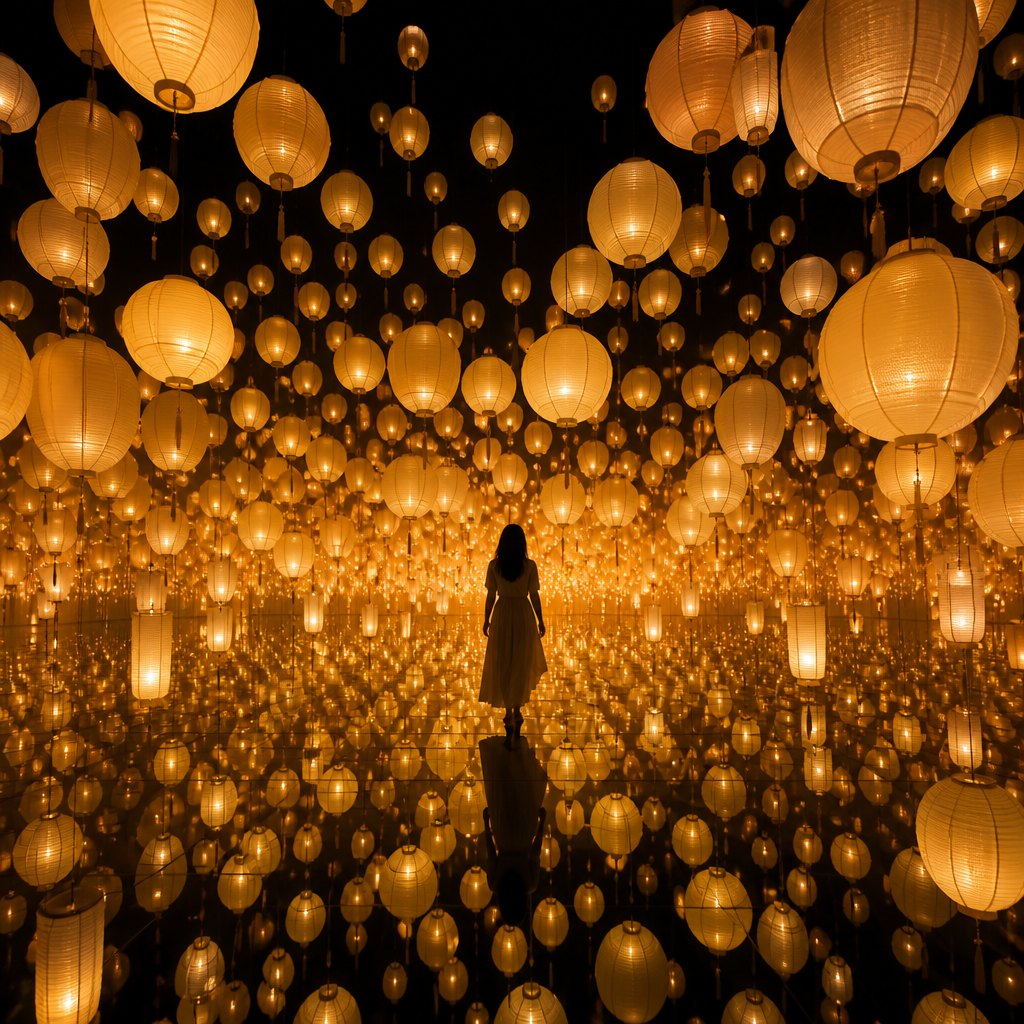 AI-generated
Try the medium
Try installation art with AI
This example was generated from a prompt like: “An immersive gallery installation of hundreds of suspended paper lanterns glowing warm amber, filling a dark room from floor to ceiling, a single visitor walking beneath them casting long shadows across a mirrored floor.”
Open the Installation Modern Art Style generator →The medium today
Contemporary installation art thrives in biennials, museum atriums, and immersive ticketed exhibitions, often built around a single striking, highly photographable environment designed for social sharing. Technology has expanded the toolkit considerably — responsive LED and projection mapping, generative visuals driven by real-time data, and augmented-reality layers overlaid on physical rooms. Large-scale commercial immersive experiences, separate from the museum world, now package similar techniques for a mass audience. Meanwhile smaller, artist-run spaces continue the form's original spirit of one-off, site-specific rooms built with modest, often reused materials.
Compose your own
To describe an installation art scene, specify the space first — a warehouse, a museum atrium, an outdoor plaza — since scale and architecture drive the whole composition. Name the sensory layers present: projected light on walls or fog, hanging or scattered objects, ambient sound, and how a visitor's body fits within the room. Describe sightlines from a human's eye-level walking through, not a single frozen frontal view, and note materials like mirror, fabric scrim, or salvaged debris. Lighting is often the dominant element, so specify color, direction, and whether it is projected, ambient, or programmed to shift over time.
Frequently asked questions
What makes something installation art instead of sculpture?
Sculpture is typically a discrete object viewed from outside it, while installation art arranges multiple elements to surround and immerse the viewer inside a constructed environment, often site-specific and temporary.
Why are so many installations temporary?
Many installations are built for one exhibition's duration and site, using materials or scale that aren't meant to be permanently maintained, so the piece is dismantled afterward and survives mainly through documentation.
Do you need special materials to make installation art?
No — installations use almost anything, from projected light and sound to found objects, fabric, or natural materials, since the defining feature is the arranged experience of the space rather than any specific material.
Can installation art be sold or collected?
Yes, though it's more complex than a painting — collectors and museums acquire detailed instructions, components, and reassembly rights so a work can be rebuilt faithfully in a new venue.