
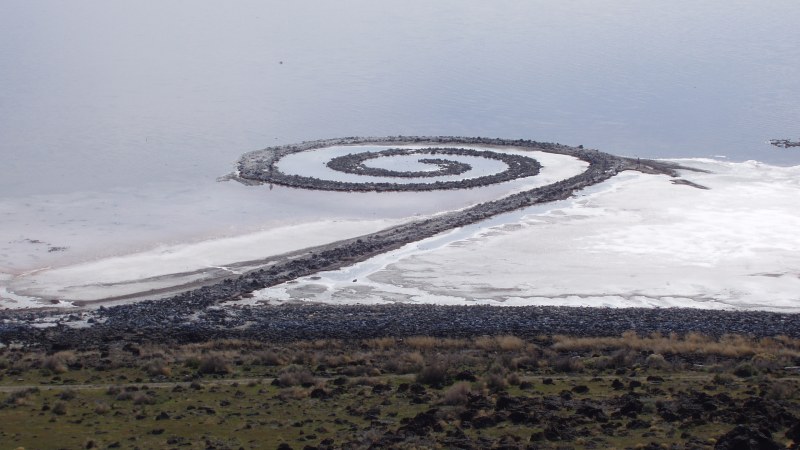
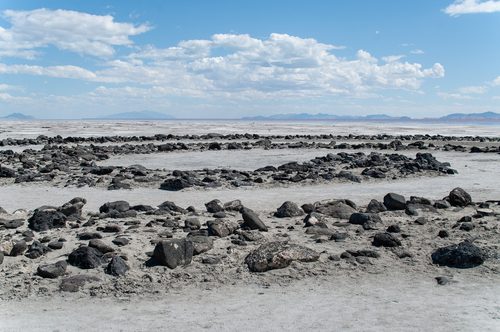
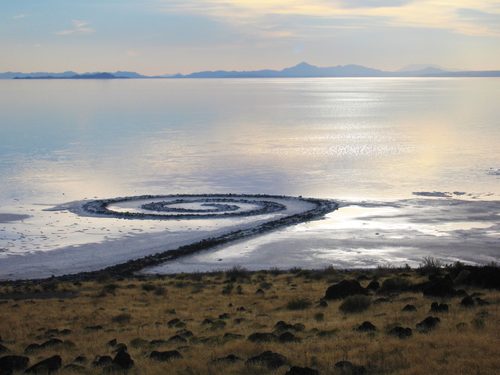
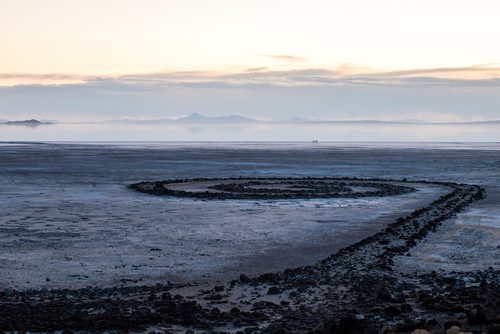
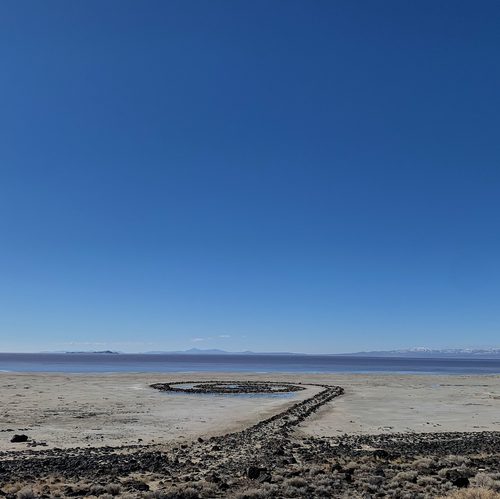
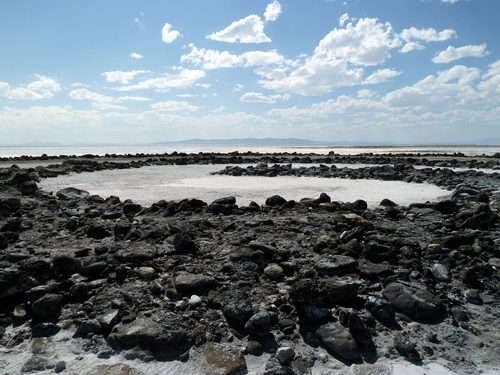
Land art, also called earthworks or environmental art, uses the earth itself—soil, rock, sand, water, ice—as both material and site, moving sculpture out of the gallery into open landscapes such as deserts, salt flats, and mesas. Artists shape terrain directly, cutting trenches, piling mounds, aligning structures with the sun or stars, or arranging rock and salt into geometric forms. Heavy equipment—bulldozers, dump trucks, backhoes—often does the moving, alongside surveying tools and simple hand implements. Because most works sit far from cities and are exposed to weather, few visitors see them in person; photographs, maps, and film usually carry the work to its audience. Scale runs from modest arrangements of stones to earthworks spanning acres, engineered to erode, flood, or shift with the seasons rather than resist time. The defining look is monumental, minimal, and inseparable from its specific ground.
What defines the medium
Site specificity
A land art piece is built from and for its exact location—desert mesa, salt flat, tidal shore—using material found on site. Moved to a museum or reproduced elsewhere, the work loses its meaning entirely.
Monumental, remote scale
Many earthworks span acres and sit hours from any city, reached by unpaved roads or by permit only. This remoteness is part of the work, demanding a deliberate pilgrimage rather than a casual gallery visit.
Built to change and erode
Tides submerge and reveal, wind scours edges, plants reclaim trenches. Rather than resisting decay, most land art is designed to register weather and time visibly, so no two visits show the same work.
Documentation stands in for the site
Since few people travel to the actual location, photographs, aerial shots, maps, and film function as the primary way the work circulates and enters art history, often shaping its reputation more than direct viewing.
Heavy machinery and earthmoving
Bulldozers, dump trucks, and excavators replace the chisel and brush, letting artists cut, pile, and relocate thousands of tons of earth or rock—work closer to construction and engineering than traditional sculpture.
Addition versus subtraction
Some works add material, piling rock, salt, or concrete into new forms; others cut negative space directly into existing ground, carving trenches or craters rather than building anything upward.
Materials decoder
The toolkit of land art
- bulldozer-cut trench
- → a straight or angular cut carved directly into earth or rock, the signature mark of large-scale excavation-based works
- basalt rock coil or mound
- → dark volcanic rock piled into geometric or spiral forms, a common raw material for earthworks built by hand or machine
- aerial documentation photo
- → a bird's-eye photograph or map that is often the only way most viewers ever see the completed work
- solar or celestial alignment
- → openings, tunnels, or markers positioned to frame sunrise, sunset, or solstice light, tying the work to astronomical time
- salt-crusted surface
- → a white mineral crust left where a work sits in or near a salt flat or lake, changing color and texture with water levels
- weathered, eroding edge
- → softened, crumbling, or overgrown boundaries that show a work has been left to decay naturally rather than maintained
The story
Land art emerged in the United States in the late 1960s, when artists rejected the gallery in favor of direct intervention in the landscape. The 1968 exhibition 'Earthworks' at the Dwan Gallery in New York helped name the movement. Working mostly in the American West, artists carved and built monumental pieces using earth, rock, and salt: a mile-long trench cut into a Nevada mesa in 1969-70, a coiled jetty of basalt built into Utah's Great Salt Lake in 1970, aligned concrete tunnels set in the Utah desert in 1976, and a grid of steel poles raised across a New Mexico plain in 1977. The Dia Art Foundation later helped fund, preserve, and grant public access to several of these sites. In Britain, related artists made smaller, temporary arrangements of stone, leaves, and ice directly in the countryside. Land art continues today through environmental and site-specific practice worldwide.
Masterpieces of the medium
| Work | Artist | Date | Why it matters |
|---|---|---|---|
| Spiral Jetty | Unknown | 1970 | a 1,500-foot coil of black basalt rock and earth built into Utah's Great Salt Lake, submerged and revealed as water levels shift |
| Double Negative | Unknown | 1969-1970 | two deep trenches cut into a Nevada mesa, removing roughly 240,000 tons of rhyolite and sandstone |
| Sun Tunnels | Unknown | 1976 | four large concrete cylinders in the Utah desert aligned to frame the sunrise and sunset of the summer and winter solstices |
| The Lightning Field | Unknown | 1977 | 400 polished stainless steel poles arranged in a precise grid across a New Mexico plain |
| Roden Crater | Unknown | in progress since the 1970s | an extinct volcanic crater in Arizona reshaped into chambers and openings for naked-eye observation of celestial light |
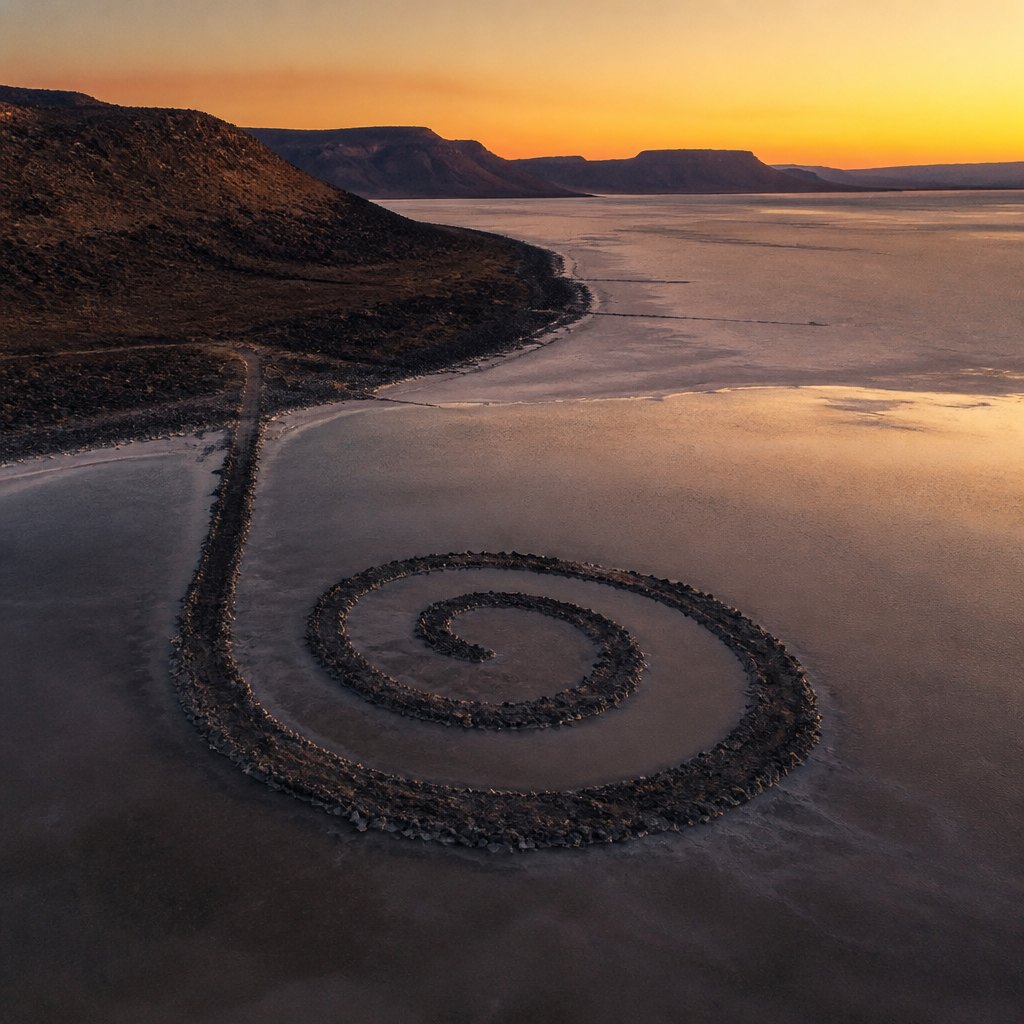 AI-generated
Try the medium
Try land art with AI
This example was generated from a prompt like: “A vast desert mesa at dusk with a spiral-shaped mound of dark basalt rock built into a still salt lake, long shadows, aerial wide-angle view, minimal color, documentary photograph style.”
Open the Land Art Style generator →The medium today
Land art today extends beyond the remote deserts of its 1960s origins into public parks, coastlines, and reclaimed industrial sites, often addressing erosion, sea level, and land use directly. Some organizations maintain and grant scheduled access to historic earthworks, while newer projects favor smaller, temporary interventions using stone, ice, or plant material that leave no lasting trace. Aerial and drone photography now documents sites more thoroughly than the ground-level images that once carried the movement, and environmental land art increasingly overlaps with ecological restoration and community land projects.
Compose your own
Land art does not require acres of desert to start. Beginners can work at a local beach, park, or backyard using materials already present—stones, driftwood, leaves, ice, or sand—arranged into a deliberate pattern, line, or spiral. Photograph the piece immediately, since most small-scale land art is left to weather, wash away, or be disturbed within hours or days. Consider how sunlight, tide, or wind will change the piece over time, and choose a site where that change is visible rather than a controlled interior. Sketch a plan first, note the exact location and time of day, and always leave the site undisturbed beyond the materials rearranged, avoiding protected land, restricted areas, or fragile ecosystems.
Frequently asked questions
Can I visit famous land art sites?
Some, like Sun Tunnels or The Lightning Field, are open with a permit, guided visit, or scheduled overnight stay; others sit on private or restricted land and are documented only through photographs.
Why do land artists use bulldozers instead of hand tools?
Moving thousands of tons of earth or rock at a monumental scale requires construction equipment; the machinery itself became part of how these works are made and understood.
Is land art meant to last forever?
No—most works are designed to weather, erode, flood, or be reclaimed by their surroundings over years or decades, treating change and decay as part of the piece rather than damage to prevent.
What's the difference between land art and a public sculpture park?
A sculpture park displays freestanding objects that could exist elsewhere; land art is built from and inseparable from its specific site, using the terrain itself as material.