
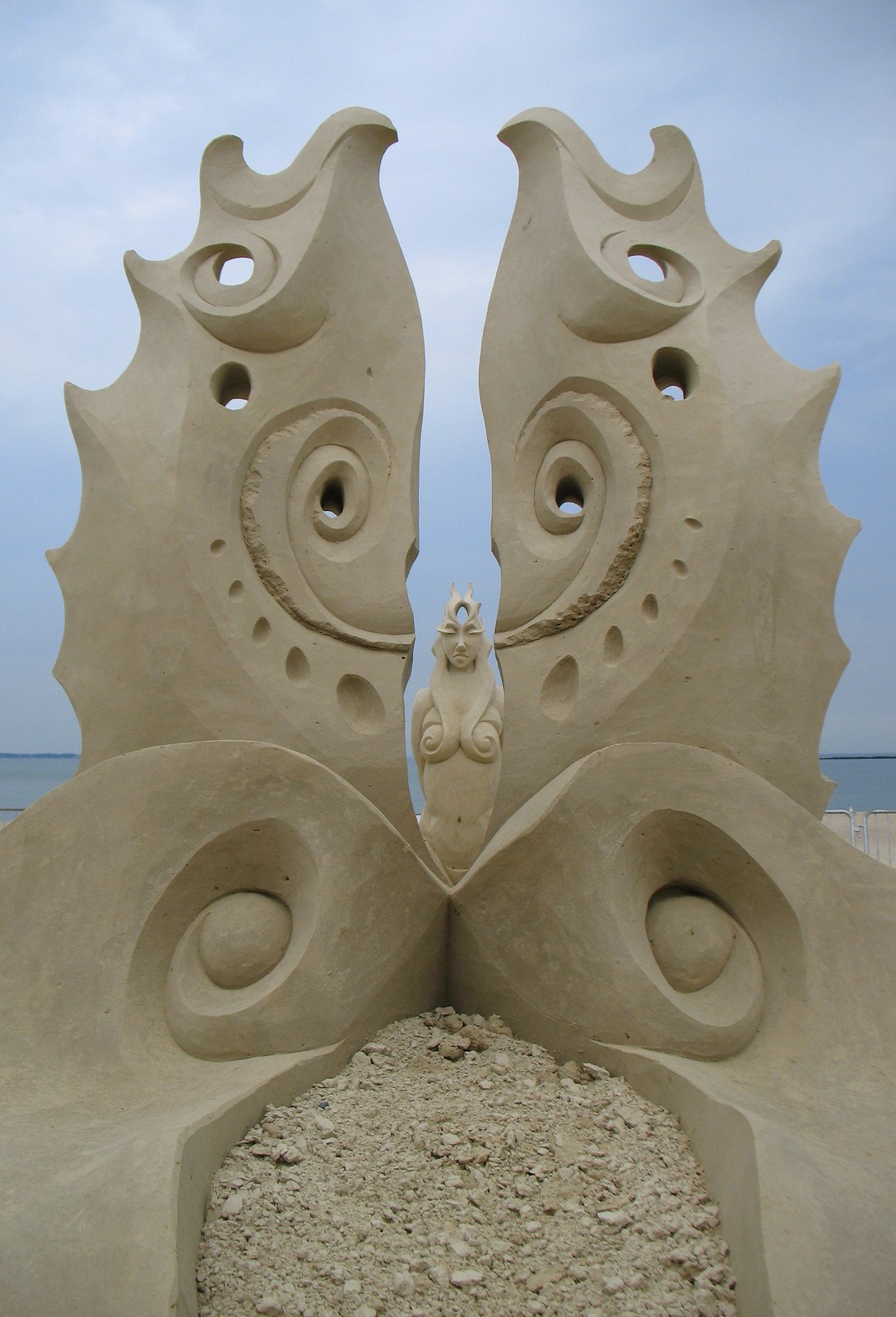
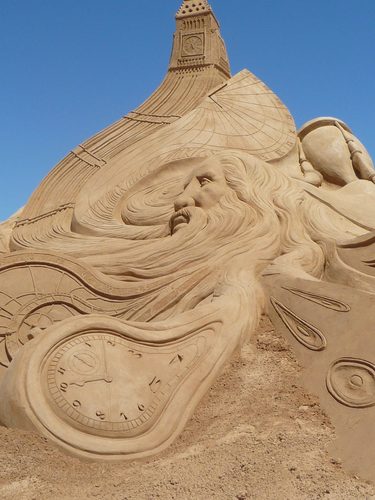
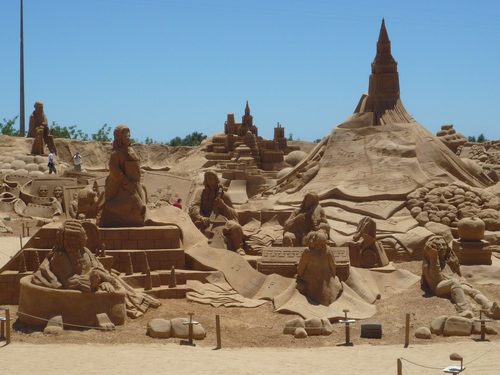
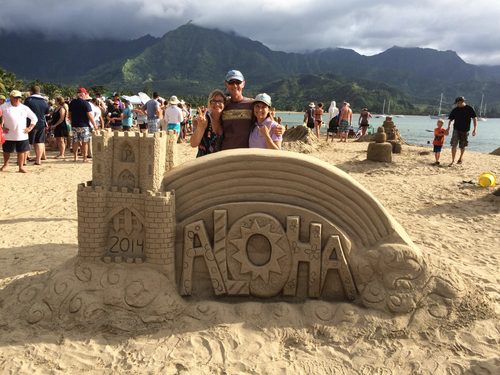
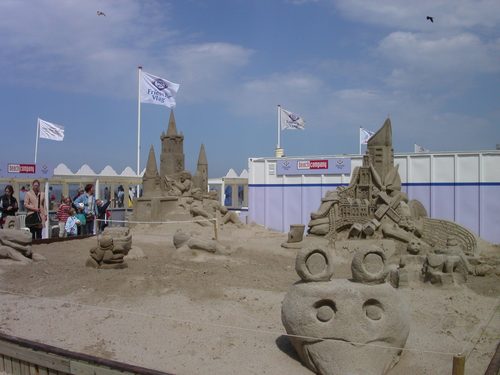
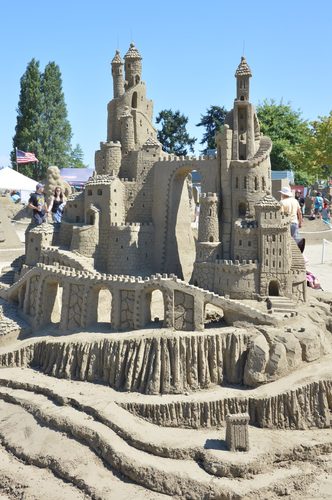
Sand sculpture starts with plain sand and water, compacted in layers or forms to remove air pockets and build a dense, carvable mass strong enough to hold fine detail. Sculptors tamp wet sand into wooden forms or simply pile and pack it by hand, building upward in stages before carving downward from the top with palette knives, drywall trowels, melon ballers, and thin straws used to blow away loose grains from tight recesses. The right ratio of water to sand is critical: too dry and the mass crumbles, too wet and it slumps under its own weight. Competition sculptures can rise many feet tall from a single compacted block or team-built mound, judged on detail, structural daring, and design within a set time limit. Because sand has no binder beyond water and compaction, nearly every sculpture is temporary, lasting days to weeks before rain, wind, or tide levels it, though some are sprayed with a sugar-water or glue coating to slow erosion for display.
What defines the medium
Compaction over material
The medium's strength comes almost entirely from how tightly wet sand is packed, not from any additive. Sculptors tamp each layer by hand or machine before adding more, building a dense block that resists collapse when carved.
Water-to-sand ratio
Sand needs just enough water to make grains cling together without turning to slurry. Too little water and the mass crumbles as it's carved; too much and it slumps, so sculptors test and adjust moisture constantly.
Top-down carving
Sculptors build a compacted mass first, then carve downward and inward from the top, removing material rather than adding it—closer to stone carving than to modeling or casting.
Detail tools beyond the shovel
Fine work relies on palette knives, drywall trowels, melon ballers, and drinking straws used to blow loose grains out of carved recesses, letting sculptors achieve sharp edges and undercuts in a material with no internal support.
Built to erode
Sand sculpture is temporary by nature; tide, rain, or wind erode a piece within days or weeks. Some competition and display pieces get a sprayed sugar-water or glue coating that slows but never fully stops erosion.
Timed competition formats
Festivals set a fixed volume of sand and water, a time limit, and sometimes a theme, judging entries on technical difficulty, detail, and structural risk—overhangs and thin spires score higher than safe, blocky forms.
Materials decoder
The toolkit of sand sculpture
- compacted vertical block
- → a dense, tamped column or wall of wet sand, the starting mass every sand sculpture is carved down from
- drip-tower dribble castle
- → small cone-like turrets formed by dripping wet sand from a fist, the signature texture of casual sandcastle building
- trowel and knife scoring
- → fine parallel lines and sharp planes left by flat-bladed tools, used to define clothing, scales, bark, or architectural detail
- straw blow-marks
- → small cleared hollows and recesses made by blowing loose sand out through a straw, used for tight undercuts a tool can't reach
- smooth compacted face
- → a dense, unbroken surface with no visible grains slumping, showing the sand was packed tightly enough to carve cleanly
- eroded, slumping edge
- → softened, collapsing detail at the base or edges, a sign the sculpture is aging under rain, wind, or rising tide
The story
Building shapes from wet sand is an old beachside pastime with no single origin, practiced informally on coastlines for generations. Competitive sand sculpture as an organized art form developed through the twentieth century in the United States, with the Neptune Festival Sand Sculpting Contest launching in Virginia Beach in 1985 and Canada's Harrison Festival of the Arts International Sand Sculpture Competition starting in Harrison Hot Springs, British Columbia, in 1988. Dedicated sand sculpture museums followed, including the Tottori Sand Museum in Japan, opened in 2006, which displays large-scale figurative works carved entirely from local sand. International festivals multiplied in the 2000s, among them Portugal's FIESA International Sand Sculpture Festival, founded in 2005, and the Revere Beach International Sand Sculpting Festival near Boston, founded in 2004. Sand sculpting is now a global competitive circuit with standardized rules for sand volume, water, and time limits.
Masterpieces of the medium
| Work | Artist | Date | Why it matters |
|---|---|---|---|
| Neptune Festival Sand Sculpting Contest | Unknown | founded 1985 | a long-running competitive sand sculpting event held on the beach in Virginia Beach, Virginia |
| Harrison Festival of the Arts International Sand Sculpture Competition | Unknown | founded 1988 | an annual juried competition on the shore of Harrison Hot Springs, British Columbia |
| Tottori Sand Museum | Unknown | opened 2006 | a museum in Japan dedicated to large-scale figurative sand sculpture, with exhibits rebuilt on a changing annual theme |
| FIESA International Sand Sculpture Festival | Unknown | founded 2005 | an annual sand sculpture festival held in the Algarve region of Portugal |
| Revere Beach International Sand Sculpting Festival | Unknown | founded 2004 | a competitive sand sculpting festival held on the public beach in Revere, Massachusetts |
 AI-generated
Try the medium
Try sand sculpture with AI
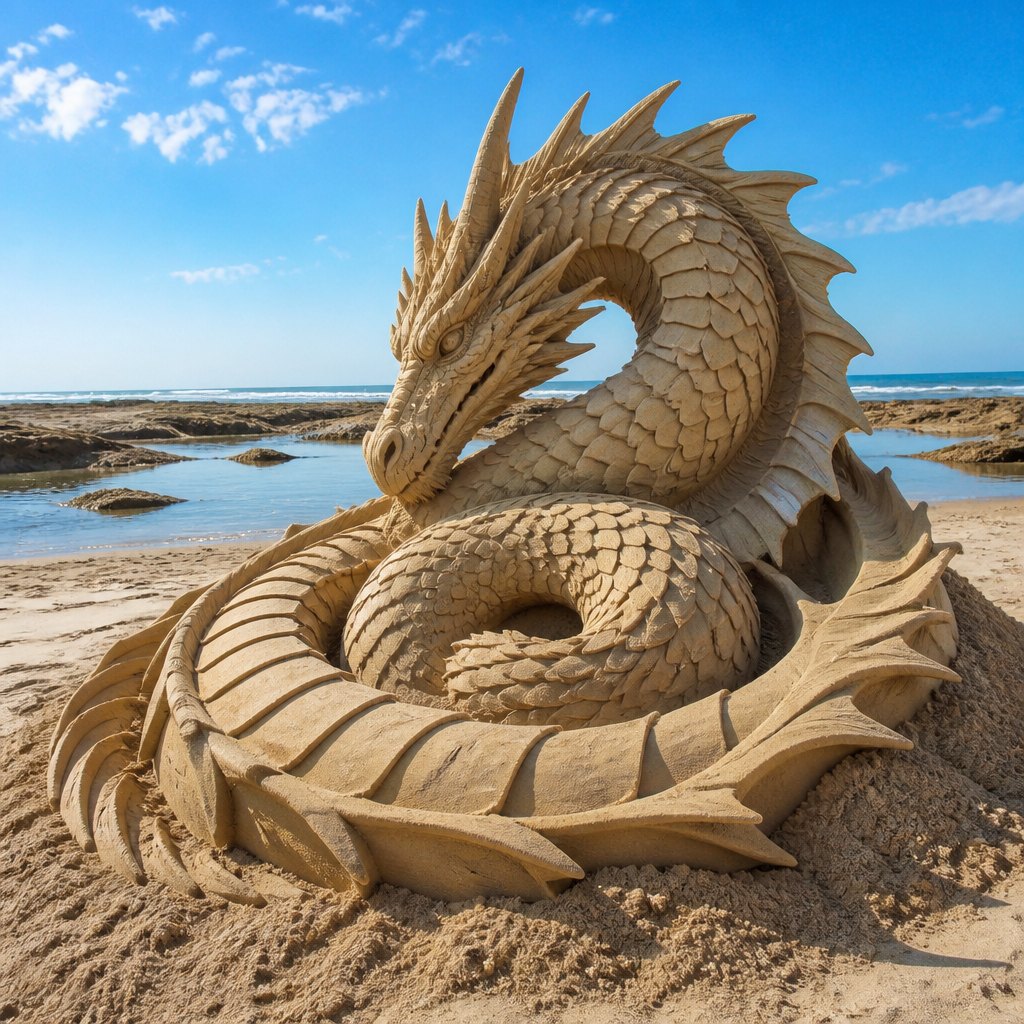
This example was generated from a prompt like: “A towering sand sculpture of a coiled sea dragon on a sunny beach, fine trowel-carved scales, straw-cleared recesses, wet compacted sand texture, tide pools reflecting blue sky in the background.”
Open the Sand Sculpture Style generator →The medium today
Sand sculpture today ranges from casual beach sandcastles to museum-scale exhibitions and international competitions judged on technical difficulty and design. Dedicated sand museums maintain large indoor and outdoor figurative works that are rebuilt on a new theme each season, while touring festivals bring professional carvers to beaches and public plazas worldwide. Some pieces receive a light sugar-water or biodegradable glue coating to slow weathering for the length of a display, though nearly all sand sculpture remains temporary, eventually leveled by rain, wind, or reclaimed by the tide.
Compose your own
Beginners can start with a bucket, a flat trowel or old kitchen spatula, and sand packed with just enough water to hold its shape when squeezed into a ball. Build in compacted layers rather than one loose pile, tamping each layer firmly with a flat board before adding the next, then carve from the top down once the mass is solid. Keep a spray bottle nearby to remoisten drying sand as you work, since dry sand crumbles under a blade. Start with simple geometric forms—cubes, cones, arches—before attempting figures, and use a straw to blow loose grains out of tight carved recesses. Work close to a water source and expect the piece to last only a day or two outdoors, so photograph it as soon as it's finished.
Frequently asked questions
Why don't sand sculptures collapse while being carved?
Because the sand is compacted tightly in layers before carving, removing air pockets and letting grains lock together through moisture and friction; a loosely piled sandcastle has none of that internal strength.
How long does a sand sculpture last?
Casual beach sculptures usually last only until the next tide or rain. Competition and museum pieces, sometimes coated with a thin sugar-water or glue spray, can hold detail for weeks if kept dry and undisturbed.
What's the ideal sand for sculpting?
Fine, angular-grained sand with little organic debris packs and holds detail best; very rounded or coarse beach sand tends to crumble more easily than the sand used at dedicated sculpture festivals and museums.
Do sand sculptors use molds?
Rarely for the final form—most sculpture is carved by hand from a compacted mass. Wooden forms are sometimes used only to compact the initial block before all carving is done by removing material with tools.