
Paper art is any work built primarily by folding, cutting, curling, layering, or molding paper rather than painting or drawing on it. Origami transforms a single uncut square through a sequence of folds alone; papercutting removes material with knife or scissors to leave a lace-like negative pattern; quilling coils narrow paper strips into tight spirals arranged like tiny mosaic tiles; paper sculpture builds three-dimensional form from cut, curved, and glued sheet, often layered to create depth and shadow. What makes paper distinctive as a medium is how visibly its physical limits shape the work: it creases permanently, tears along weak points, and holds a curve only until humidity changes it, so successful paper art works with those properties rather than against them. The medium spans folk tradition and fine art equally — Chinese and Mexican papercutting, Japanese origami, and Polish wycinanki all developed independently as functional and ceremonial crafts before being absorbed into gallery and commercial illustration practice.
What defines the medium
Origami
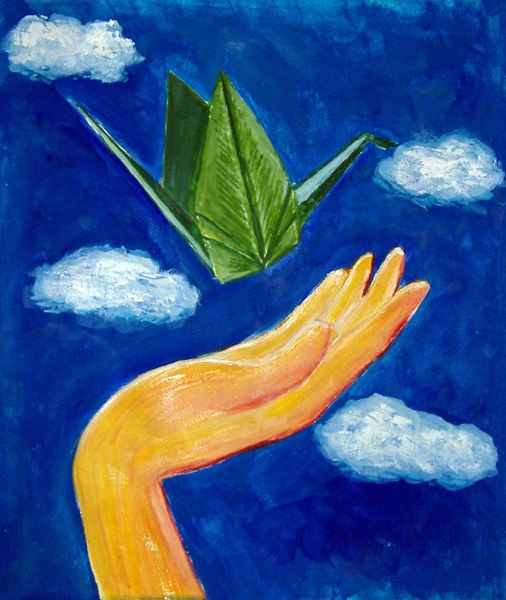
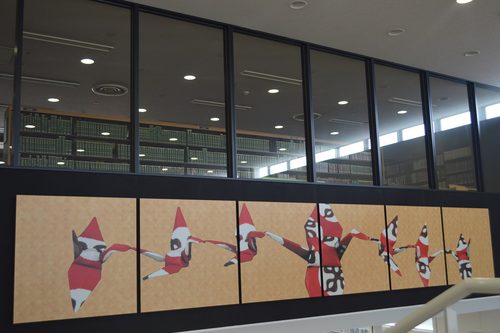
Folding a single sheet, traditionally without cutting or gluing, builds three-dimensional form purely through the geometry of creases — a discipline that has produced everything from simple cranes to mathematically complex tessellations and modular assemblies.
Papercutting
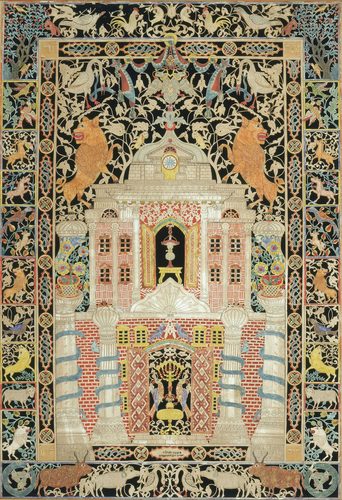
Removing material with a blade or scissors leaves a lace-like negative pattern, held together by the remaining connected paper — a technique found worldwide in traditions from Chinese jianzhi to Mexican papel picado and Polish wycinanki.
Quilling
Coiling and shaping narrow strips of paper into tight spirals, then arranging them edge-up like tiny mosaic tiles, builds flat or raised decorative patterns once common on furniture and now popular in illustration and cards.
Paper sculpture
Cutting, scoring, curling, and gluing sheet paper into three-dimensional form lets artists build everything from pop-up book mechanisms to freestanding figures, relying on curved and folded planes rather than solid mass for structure.
Layering and collage
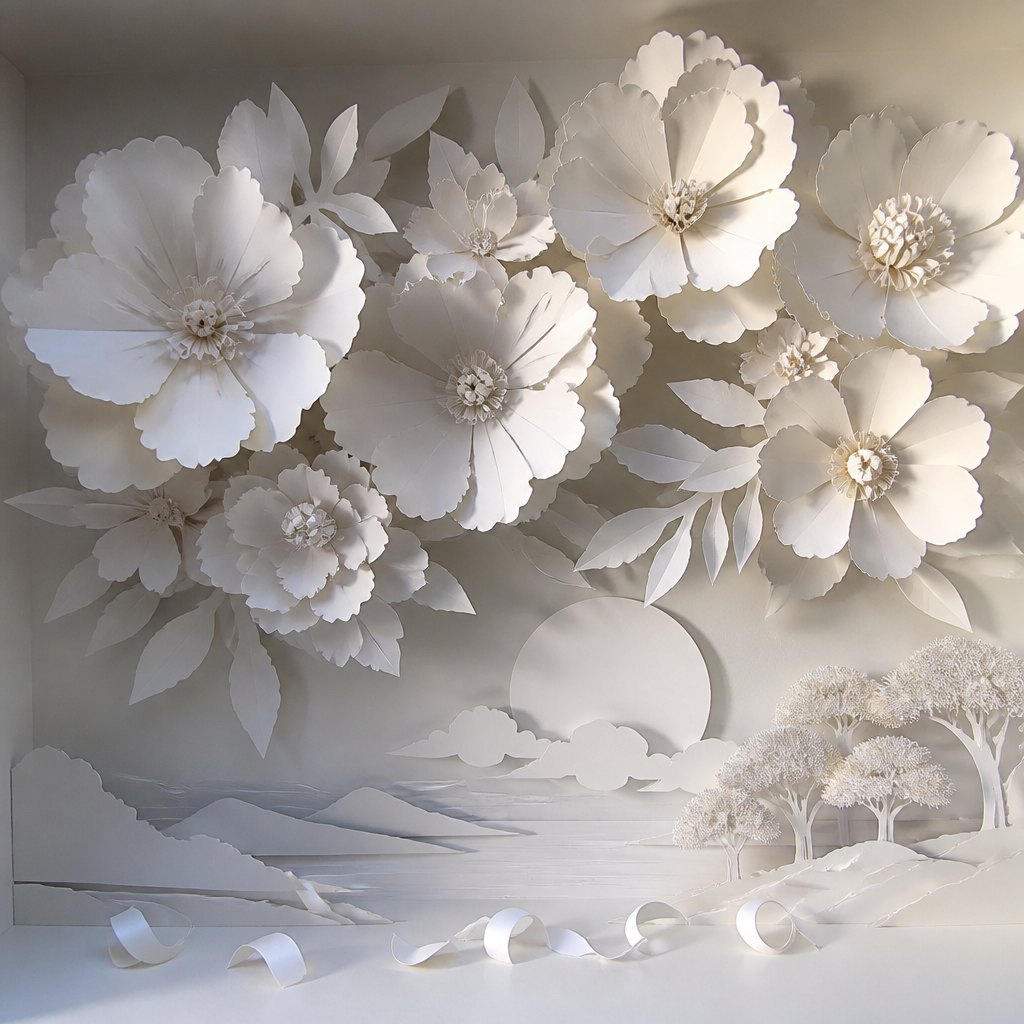
Stacking cut or torn paper shapes at different depths, often with shadow gaps between layers, builds an illusion of dimension and depth from a fundamentally flat material, a technique shared with paper-cut illustration and shadow-box art.
Paper pulp and casting
Reducing paper to wet pulp and pressing or molding it lets artists cast dimensional forms and textures the way clay or plaster would, blurring the line between paper craft and sculpture proper.
Materials decoder
The toolkit of paper art
- crease pattern
- → the map of fold lines, mountain and valley, that an origami piece collapses along to reach its final form
- craft knife and cutting mat
- → the precision tools that let papercutters remove fine, connected negative-space patterns without tearing the sheet
- quilling strips and slotted tool
- → narrow paper ribbons wound tightly around a slotted tool to form the coils that build quilled designs
- bone folder
- → a smooth-edged tool used to press creases sharp and flat without cutting or marking the paper
- pop-up mechanism
- → hidden folded hinges and V-folds engineered so a flat page springs into three-dimensional form when opened
- handmade paper pulp
- → cast or molded wet fiber that dries into dimensional, often deckle-edged forms distinct from cut sheet paper
The story
Paper itself originated in China around the 2nd century BCE, and decorative paper-cutting is documented there by the 6th century CE, used in festivals and religious offerings. The craft spread along trade routes into Japan, where it merged with local paper-folding customs to eventually become origami, and into the Islamic world and Europe, where silhouette-cutting became a popular parlor art by the 18th century. Mexican papel picado developed as a distinct tradition of perforated tissue banners for festivals and altars. Quilling emerged in Renaissance Europe, reportedly practiced by nuns and monks to imitate gilded metalwork on religious objects using rolled paper edged in gold leaf. Origami formalized into a structured art form in 20th-century Japan, and later gained a parallel mathematical tradition as folders and researchers discovered links between crease patterns and geometry. Paper sculpture and pop-up engineering grew alongside the printing and publishing industries, turning flat pages into mechanically animated three-dimensional scenes.
Masterpieces of the medium
| Work | Artist | Date | Why it matters |
|---|---|---|---|
| Papel Picado Banners | Unknown | traditional, still practiced | perforated tissue-paper banners cut in stacks and strung for Mexican festivals and Día de los Muertos altars |
| Traditional Crane (Orizuru) | Unknown | traditional Japanese form | a single uncut square folded into origami's most widely recognized figure |
| Scherenschnitte Silhouettes | Unknown | 18th-19th century | finely cut paper silhouette portraits and scenes popular across Europe and early America |
| Chinese Jianzhi Papercuts | Unknown | traditional, since c. 6th century CE | symmetrical cut-paper designs used for window decoration and festival ornament |
| Pop-Up Book Engineering | Unknown | 20th century onward | cut-and-fold paper mechanisms that animate flat pages into three-dimensional scenes |
 AI-generated
Try the medium
Try paper art with AI
This example was generated from a prompt like: “A cluster of hand-cut white paper flowers layered on a shadow-box background, delicate scalloped petal edges, visible fold creases catching soft directional light, faint drop shadows separating each paper layer, a few loose paper curls scattered below.”
Open the Architectural Origami Narrative generator →The medium today
Contemporary paper art spans gallery-scale installation, editorial illustration, greeting-card design, and competitive origami engineering pushing crease geometry toward mathematically complex insects and multi-part modular sculptures. Paper-cut light boxes, layered shadow-box scenes, and large freestanding paper sculpture have become popular for retail displays and photography backdrops. Digital laser and vinyl cutters now execute papercutting designs with a precision hand-cutting can't match, while computational origami software helps designers plan crease patterns for forms too complex to fold by trial and error.
Compose your own
To render paper art convincingly, keep every surface flat-planed between sharp creases rather than smoothly curved like fabric or clay — paper folds into facets, not gradients. Show crisp, slightly rounded fold lines catching a highlight, and let cut edges look clean and slightly fibrous rather than perfectly smooth. Layered paper pieces need visible drop shadows between stacked planes to sell the depth, with each layer casting a soft-edged shadow on the one behind it. Quilled coils should look springy and slightly uneven, not machine-perfect circles. Keep the color palette flat and matte, since most paper has little sheen, and let thin sheets show slight translucency when backlit.
Frequently asked questions
What's the difference between origami and papercutting?
Origami builds form purely through folding, traditionally from a single uncut square with no cutting or gluing. Papercutting removes material with a blade or scissors to create a pattern, and often stays flat rather than becoming three-dimensional.
Can origami use more than one sheet of paper?
Traditional origami uses one uncut square, but modular origami assembles many identical folded units, often without glue, into larger geometric forms like polyhedra. Both are considered origami, distinguished mainly by single-sheet versus multi-piece construction.
Why does paper hold a fold permanently?
Folding crushes and reorganizes the paper's cellulose fibers along the crease line, creating a physical weak point the fibers can't fully spring back from. That permanent deformation is what lets flat paper hold complex three-dimensional shapes.
Is quilling the same as papercutting?
No — quilling coils narrow paper strips into shapes rather than cutting a sheet. The two are often combined in the same piece, quilled elements added as raised, dimensional accents on top of a flat cut-paper design.