

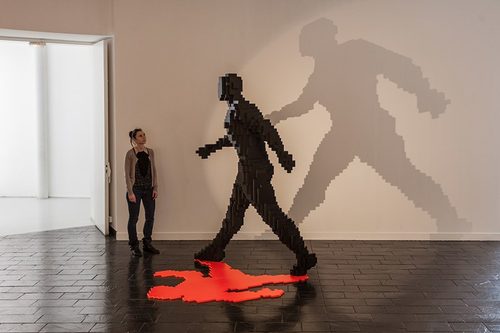
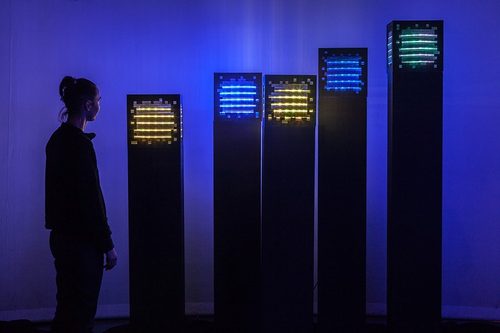
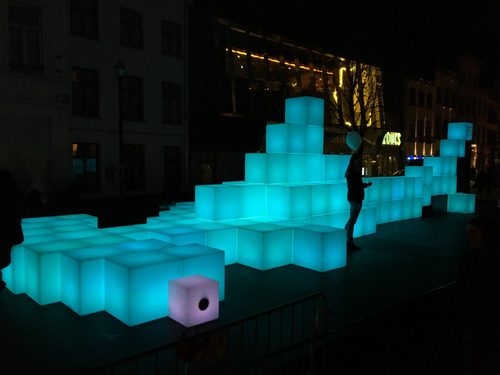
Voxel art builds three-dimensional objects and scenes out of voxels—the volumetric equivalent of a pixel, a small cube fixed to a position in a 3D grid. Instead of continuous curved surfaces, every form is assembled from stacked and packed cubes, giving voxel art its signature blocky, faceted silhouette. Artists work in dedicated tools such as MagicaVoxel, Qubicle, or in-game editors like Minecraft, placing one colored cube at a time or filling regions with a bucket tool much like pixel art in 2D. Color usually comes from a fixed, limited palette, reinforcing a retro, hand-placed look even in complex scenes. Lighting and shading are often kept simple—flat color per face or basic ambient occlusion—so the geometry itself, not surface texture, carries the visual interest. Finished voxel models can be rendered as still images from an isometric camera, animated, or exported as game assets or 3D-printed objects, sitting between pixel art's grid discipline and full 3D space.
What defines the medium
Working in a fixed grid
Every voxel occupies one exact cell in a three-dimensional grid, so there is no freehand curve or arbitrary angle. Shapes are built additively, one cube at a time, much like stacking physical building blocks.
Limited color palette
Voxel artists typically restrict themselves to a small, consistent palette of colors assigned per project, reinforcing the form's retro character and keeping large scenes visually coherent despite blocky geometry.
Isometric or fixed-angle framing
Many voxel scenes are composed and rendered from a locked isometric or three-quarter camera angle, a convention inherited from early strategy games, which reads the cubic geometry clearly without distortion.
Silhouette over detail
Because individual voxels are visible at typical resolutions, artists design recognizable forms through overall silhouette and proportion rather than fine surface detail, similar to how pixel art relies on limited pixels.
Additive and subtractive building
Models are shaped by adding cubes to build up form or carving cubes away to cut in windows, doors, or texture, a two-directional process similar to physical block construction or voxel-based sculpting.
Exporting for games and print
Finished voxel models commonly export to game engines as low-poly meshes or to 3D printers as physical objects, since the cubic grid translates cleanly into both real-time rendering and additive manufacturing.
Materials decoder
The toolkit of voxel art
- voxel cube
- → the basic unit of voxel art, a small cube fixed to one grid position, functioning as a 3D pixel
- isometric camera angle
- → a fixed, tilted viewpoint used to display voxel scenes without perspective distortion, common in strategy games
- flat-color palette
- → a small, saved set of colors assigned to a project, giving voxel scenes their consistent retro look
- MagicaVoxel grid
- → the software's editable 3D grid interface, where cubes are placed, painted, and erased one at a time
- blocky silhouette
- → the stepped, cube-edged outline that distinguishes voxel forms from smooth-shaded 3D models
- ambient occlusion shading
- → soft shadowing in crevices between cubes that adds depth without hiding the underlying grid structure
The story
The word voxel, a blend of volume and pixel, entered use in the 1970s within medical imaging and scientific visualization, describing a single unit of value on a regular 3D grid. Video games adopted cube-based visuals early, with 1982's Q*bert built from an isometric pyramid of cubes, and 1990s titles such as Comanche using true voxel rendering engines for terrain before polygonal graphics became standard. Voxel art as a distinct creative practice grew alongside sandbox-building games, most visibly Minecraft, released in 2011, which let millions of players construct worlds entirely from cubic blocks. The free tool MagicaVoxel, released in 2013, gave artists a dedicated editor for building and rendering detailed voxel models outside any game, spurring an online community of standalone voxel illustration and animation, and the style has since crossed into game assets and 3D printing.
Masterpieces of the medium
| Work | Artist | Date | Why it matters |
|---|---|---|---|
| Q*bert | Gottlieb | 1982 | arcade game built from an isometric stack of cubes, an early precursor to voxel-style visuals |
| Comanche: Maximum Overkill | NovaLogic | 1992 | one of the first commercial games to render terrain using a true voxel graphics engine |
| 3D Dot Game Heroes | Silicon Studio | 2009 | action-adventure game rendered entirely in visible cubic voxels as a tribute to 8-bit graphics |
| Minecraft | Mojang Studios | 2011 | sandbox building game that popularized voxel-based construction for a global audience |
| MagicaVoxel | Unknown | 2013 | free voxel editor release that established standalone voxel art as an online creative community |
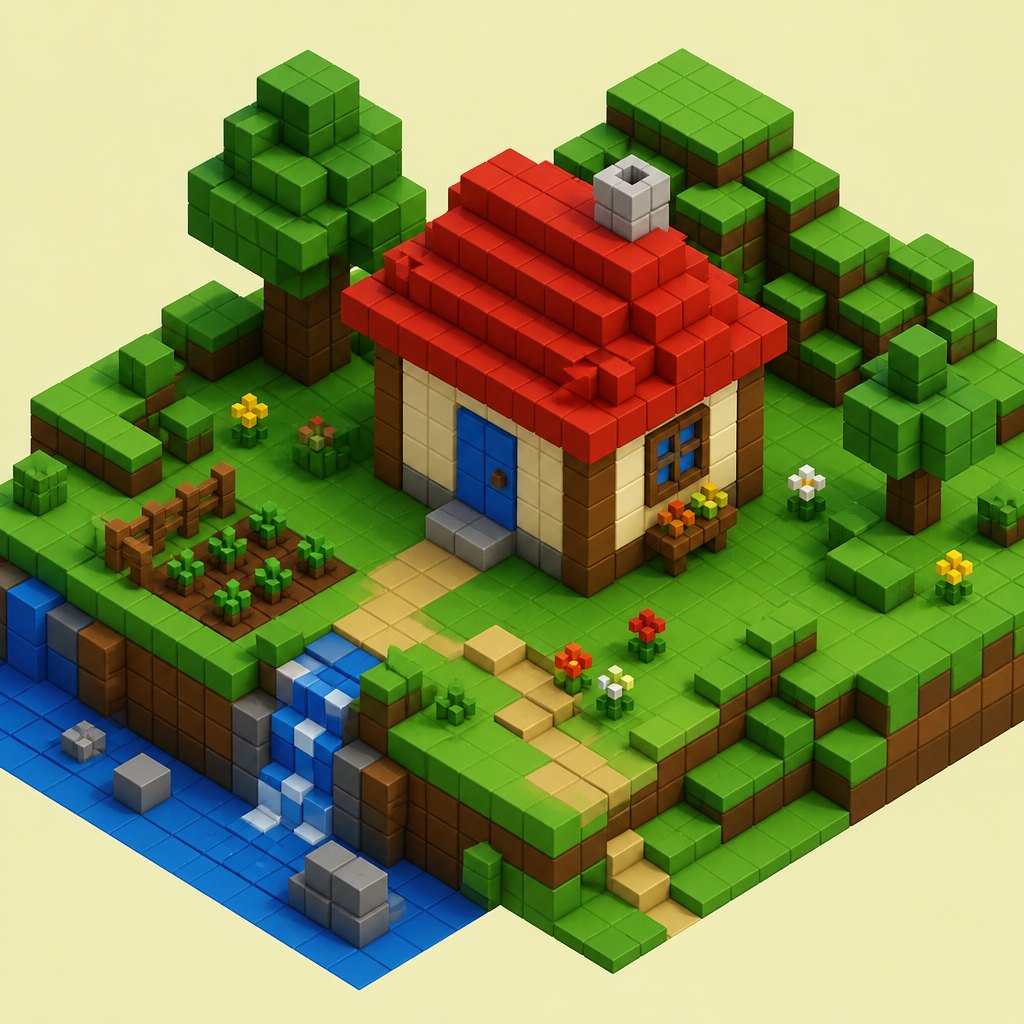 AI-generated
Try the medium
Try voxel art with AI
This example was generated from a prompt like: “A small voxel-style cottage with a red cube roof and blue cubic door, sitting on a green grid-block terrain, rendered in isometric view with flat colors and soft ambient occlusion shading in the crevices.”
Open the Voxel Art Style generator →The medium today
Voxel art today circulates as standalone digital illustration, game assets for indie titles, and physical objects produced through 3D printing. Online communities built around free tools continue to share models ranging from tiny icons to detailed dioramas and landscapes. The style is also used commercially for app icons, mascots, and collectible digital objects, valued for rendering quickly and reading clearly at small sizes. Some creators animate voxel scenes frame by frame or rig them for real-time interactive use in games.
Compose your own
Begin with a free dedicated editor such as MagicaVoxel, which handles building, coloring, and rendering in one interface. Start small—a single object like a chair, tree, or vehicle—rather than a full scene, to learn how the cube grid behaves in three dimensions. Build up silhouette first with large cube blocks, then add smaller cubes for detail once the overall shape reads clearly. Limit your color palette to a handful of hues from the start rather than adding colors freely. Study pixel art references for palette and silhouette discipline, since the same principles carry directly into voxel work, and render from a fixed isometric angle while learning.
Frequently asked questions
What's the difference between voxel art and regular 3D modeling?
Regular 3D models use smooth polygonal meshes that can curve freely, while voxel art is built from a fixed grid of cubes, giving it a blocky, stepped surface closer to 3D pixel art than to sculptural modeling.
What software is used to make voxel art?
MagicaVoxel is the most widely used free tool, alongside Qubicle and in-game editors such as Minecraft's building system. Some 3D programs also include voxel sculpting modes for blocking out forms.
Can voxel art be 3D printed?
Yes—voxel models translate directly into a grid of cubic units that many 3D printers and slicing programs can interpret, making voxel art one of the more print-friendly digital art forms available.
Why do voxel scenes usually use an isometric camera?
An isometric or fixed-angle view avoids the perspective distortion that can make cubic edges look uneven, presenting the blocky geometry cleanly, a convention inherited from early strategy and building games.