
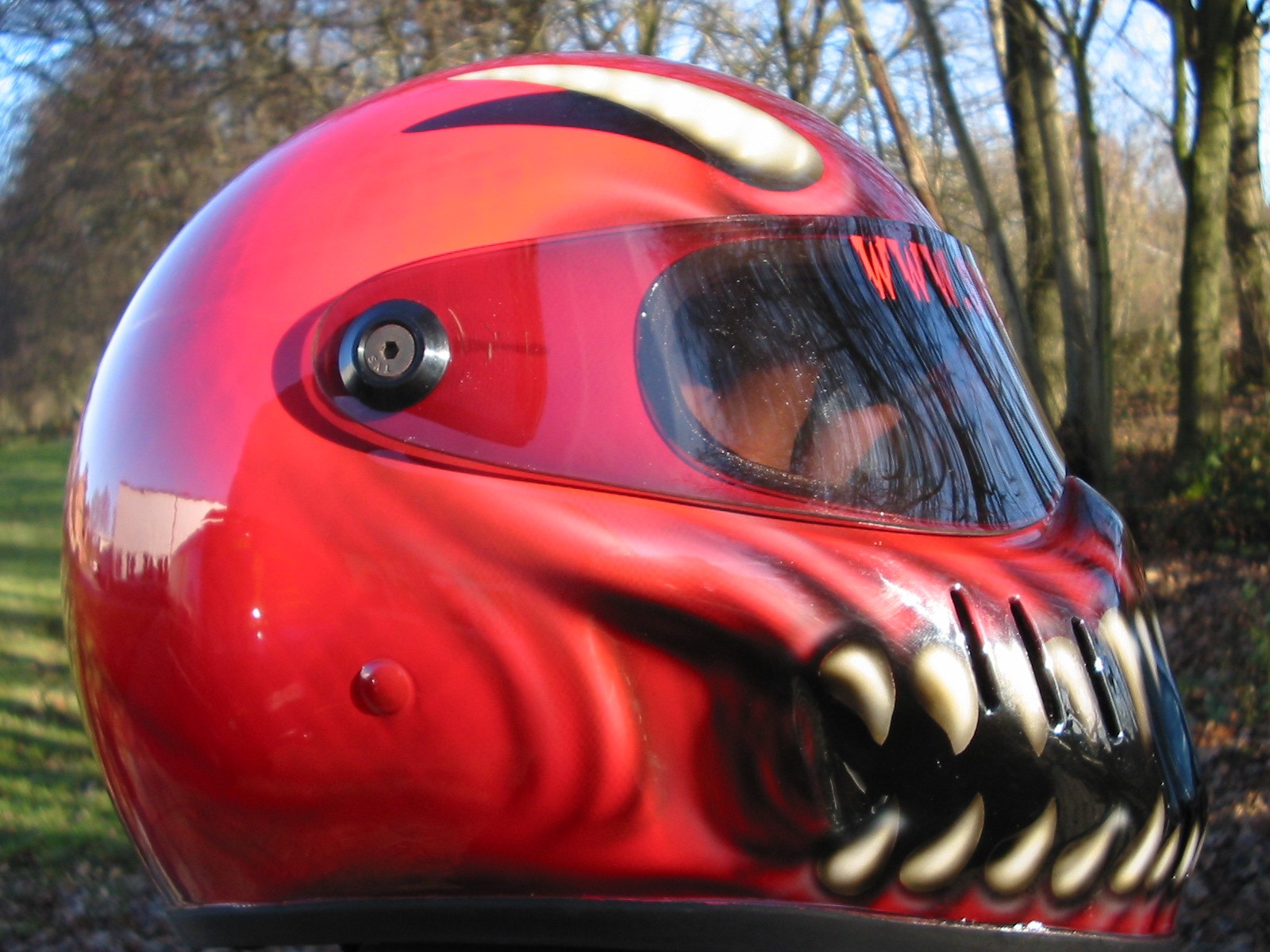
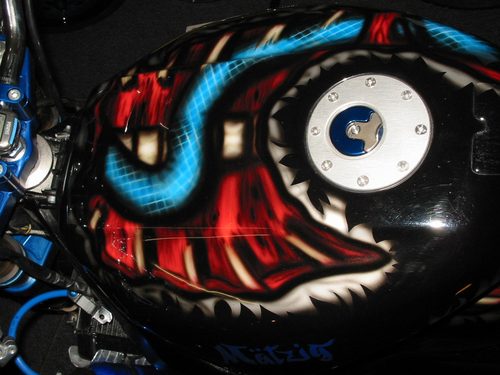
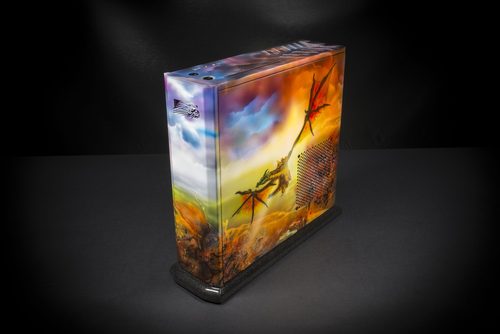
Airbrush art uses a small handheld tool that atomizes paint or ink into a fine mist using compressed air, then directs that spray onto a surface through a nozzle controlled by a trigger. A compressor supplies steady air pressure through a hose to the airbrush, while the artist controls how much paint enters the airstream, producing anything from a wide soft mist to a hairline-thin spray. The technique excels at smooth gradients and seamless blending with no visible brush marks, and it pairs naturally with masking: stencils, cut frisket film, or tape block areas to create crisp, hard edges within an otherwise soft, sprayed field. Paints range from thinned acrylics and enamels to specialized airbrush inks, all reduced to a consistency that will pass through the airbrush's small nozzle without clogging. Airbrush work appears across illustration, custom automotive and motorcycle paintwork, t-shirt and sign painting, nail art, cosmetics, model building, and special-effects makeup, recognizable by its soft-edged gradients, glossy finish, and absence of visible tool strokes.
What defines the medium
Compressor and air supply
An airbrush needs a steady compressed-air source, either a small compressor or a canned air supply, with a regulator to control pressure. Lower pressure gives finer, softer spray; higher pressure moves more paint faster for coverage.
Masking and stencils
Crisp edges within an airbrushed piece almost always come from masking rather than freehand control—cut frisket film, tape, or paper stencils block spray from reaching an area, leaving a hard line against the soft surrounding gradient.
Layered fine-mist buildup
Color and value build gradually through many thin passes rather than one heavy coat, letting the artist control opacity and blend gradients smoothly without pooling or dripping paint on the surface.
Double-action trigger control
Most professional airbrushes use a double-action trigger: pressing down releases air, pulling back releases paint, letting a single motion control spray width and paint volume simultaneously for fine control.
Surface preparation
Automotive and mural airbrush work requires primed, sealed surfaces so paint adheres evenly and survives outdoor exposure, while illustration work on paper or board needs a smooth, non-absorbent surface to keep spray edges crisp.
Paint viscosity
Paint must be thinned to a specific consistency, thin enough to pass through the airbrush's small nozzle without clogging but thick enough to hold color and coverage, a balance adjusted by trial with each new paint or ink.
Materials decoder
The toolkit of airbrush art
- double-action airbrush
- → the handheld spray tool with a trigger controlling both air and paint flow, the core instrument of the medium.
- compressor and hose
- → the compressed-air source feeding the airbrush at a controlled, steady pressure, essential for even spray.
- frisket/stencil film
- → thin adhesive film cut into shapes to mask areas from spray, producing crisp hard edges within a soft-sprayed field.
- soft gradient blend
- → the signature smooth, seamless color transition with no visible brush marks, achievable only through layered fine mist.
- chrome and flame effects
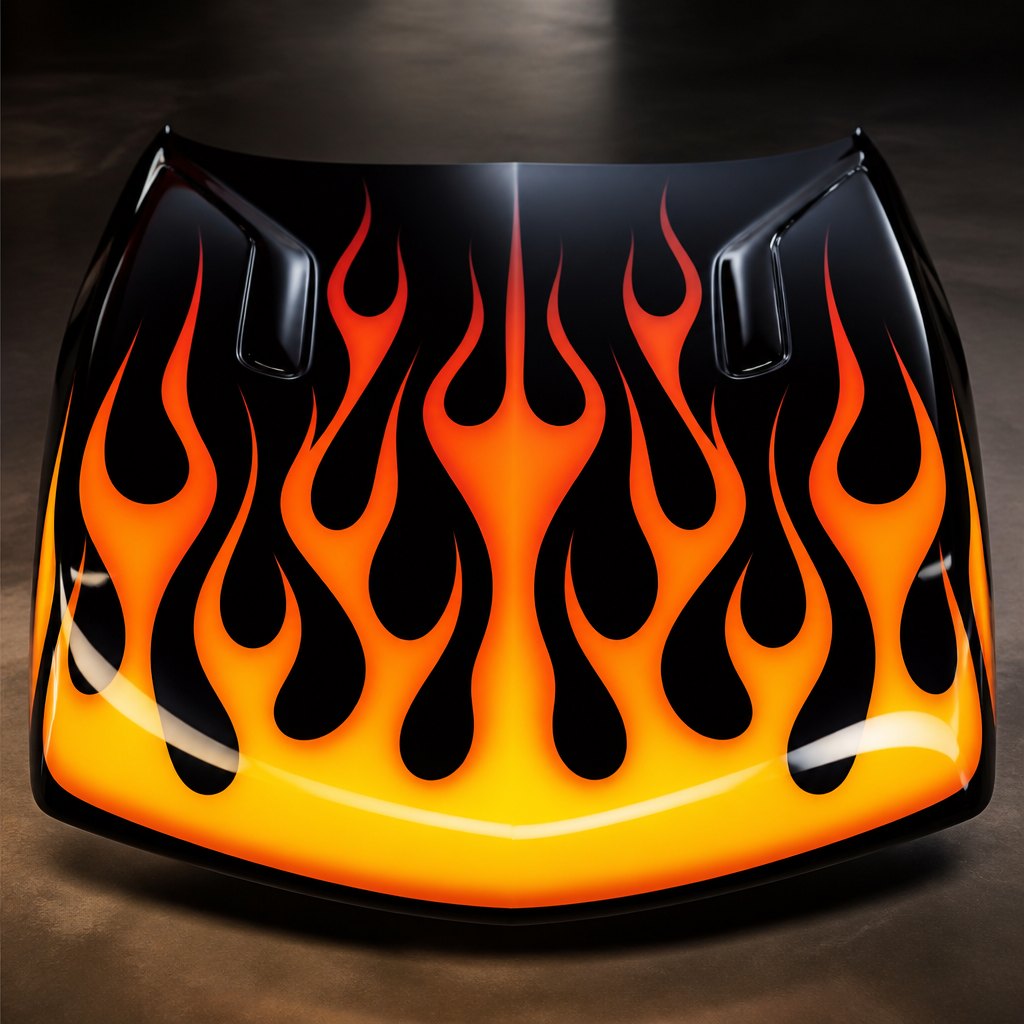
- → high-gloss metallic and fire-gradient effects common in custom automotive airbrush work, built from many thin sprayed layers.
- overspray halo
- → a faint soft edge of drifted paint outside a stencil's boundary, a telltale sign of hand-masked airbrush work.
The story
The airbrush traces to the late nineteenth century: American inventor Francis Edgar Stanley patented an early spray-paint device in 1876, and American painter Charles Burdick developed and patented a refined, practical airbrush in 1893, founding the Fountain Brush Company, later the Aerograph Company, in London to manufacture it. Early airbrushes found rapid use in photographic retouching, smoothing studio portrait negatives, and in commercial illustration through the early twentieth century. The tool became closely tied to mid-twentieth-century American commercial art, used for glossy pin-up illustration, movie posters, and advertising, and by the 1950s and 1960s it had spread into custom automotive and motorcycle paintwork, producing flames, metallic fades, and pinstriping on hot rods. Boardwalk and mall airbrush portrait and t-shirt stalls became a fixture of American popular culture from the 1970s through the 1990s. Digital airbrush tools in image-editing software now simulate the same soft-gradient effect without physical paint.
Masterpieces of the medium
| Work | Artist | Date | Why it matters |
|---|---|---|---|
| Aerograph airbrush design | Charles Burdick | 1893 | the first widely manufactured practical airbrush, patented and produced through Burdick's Aerograph Company |
| Airbrushed photographic retouching plates | Unknown | early 1900s | commercial photo studios used airbrush to smooth and correct portrait negatives before printing |
| Airbrushed Hollywood poster and lobby-card art | Unknown | 1930s-1940s | studio art departments used airbrush to give promotional art a glossy, photographic gradient finish |
| Pin-up calendar illustration | Unknown | 1940s | commercial pin-up art relied on airbrush for smooth skin tones and softly blended backgrounds |
| Custom hot-rod flame paint jobs | Unknown | 1950s | early car-customizing culture adopted airbrush for vivid flame and metallic-fade designs on vehicle bodies |
 AI-generated
Try the medium
Try airbrush art with AI
This example was generated from a prompt like: “A custom car hood freshly airbrushed with vivid orange-to-yellow flame gradients over glossy black paint, smooth seamless color blending, crisp stenciled flame edges, high-gloss clear-coat finish, studio lighting.”
Open the Airbrush Art Style generator →The medium today
Airbrush technique today spans custom car and motorcycle paintwork, t-shirt and boardwalk portrait stalls, nail art, temporary tattoos, cosplay and special-effects makeup, model-kit painting, and sneaker customization. Fine artists still use physical airbrush for smooth gradient illustration and murals, while photo-editing and digital-painting software include airbrush tool settings that simulate the same soft, layered spray effect without any physical paint or compressor. The technique remains valued anywhere a perfectly smooth gradient or crisp stenciled edge is needed.
Compose your own
Beginners typically start with an entry-level airbrush kit paired with a small compressor, since consistent air pressure matters more than a premium tool at first. Practice basic control exercises on scrap paper before tackling a real piece: dots, straight lines, dashes, and gradient fades from dark to light, all done at a consistent distance from the surface. Learning to thin paint to the right, milk-like consistency for the nozzle prevents clogging and spattering. Simple stencils cut from tape or stencil film are the easiest way to get clean edges early on, before attempting freehand control. Working in a ventilated space or with a mask is essential, since airbrushing produces fine airborne paint particles.
Frequently asked questions
What's the difference between an airbrush and a spray can?
An airbrush gives fine, adjustable control over spray width and paint flow through a trigger and separate air supply, allowing precise gradients and detail. A spray can releases paint at a fixed rate and pattern, better suited to broad, quick coverage.
Do I need a compressor to airbrush?
Yes, some steady air source is required—either a small electric compressor, a CO2 tank, or in rare cases canned propellant air, since the airbrush itself has no way to generate the pressurized air it needs to atomize paint.
What paint works in an airbrush?
Acrylics, enamels, and dedicated airbrush inks all work if thinned to the right consistency, roughly the thickness of milk, so they pass through the airbrush's small internal nozzle without clogging or spattering.
Can I get crisp edges with an airbrush, or is it only good for soft blends?
Both are possible: freehand spray naturally produces soft, diffused edges, but masking with tape, cut film, or stencils blocks the spray precisely, giving hard, clean edges wherever the mask meets the surface.