
Balloon art, or balloon twisting, uses long, thin latex balloons inflated with a hand or electric pump, then twisted, folded, and locked into segments to build recognizable shapes—dogs, swords, flowers—entirely from air-filled rubber. Standard twists include the basic twist, which pinches one segment; the lock twist, which secures two twisted bubbles so they hold; and the fold twist, used for symmetrical ears or petals. Beyond single figures, large-scale balloon art links hundreds or thousands of inflated balloons over a wire or foam armature to build arches, columns, and character sculptures for parades and events. Tools are minimal: a hand or electric pump, balloons in various shapes such as long '260' pencil balloons and round modeling balloons, and glue dots or fishing line for bigger installations. The look is defined by bright, glossy, uniformly colored rubber segments and visible twist points, and the whole form stays lightweight and temporary, typically deflating or bursting within days.
What defines the medium
Core twist vocabulary
The basic twist, lock twist, fold twist, and tulip twist form the foundation of nearly every shape; twisters combine these few moves in sequence to build complex figures.
Balloon selection by size and shape
Long '260' pencil balloons suit hand-twisted figures like animals and swords, round balloons add volume, and specialty shapes serve as petals, hearts, or hands.
Inflation control
Leaving an uninflated tail of a few inches at the balloon's end prevents bursting during twisting and gives room to tie off the finished shape securely.
Structural locking
Twisted segments must be locked in pairs against another segment or they unwind on their own; large installations also need internal wire or foam frames for support.
Color sequencing
Twisters often inflate several colors in a planned order before starting so a finished shape's color pattern, like a dog's spots, appears in the right place without stopping mid-build.
Scale progression
Simple single-balloon animals suit walk-around entertaining, while multi-balloon sculptures and armature-supported arches or columns are built for parades, storefronts, and event decor.
Materials decoder
The toolkit of balloon art
- 260 pencil balloon
- → a long, thin latex balloon that is the standard tool for hand-twisted animals, swords, and figures
- basic twist
- → a single pinch-and-rotate segment, the fundamental building block of every twisted balloon shape
- lock twist
- → two twisted bubbles rotated together so neither unwinds, used for ears, legs, and joints
- uninflated tail
- → a slack length of latex left untwisted at the balloon's end, giving room to tie off without popping
- balloon arch or column
- → rows of inflated balloons clustered densely over a frame to build large-scale event decor
- foil or mylar balloon
- → a metallic, non-latex balloon used for shapes, numbers, and letters rather than hand twisting
The story
Rubber balloons trace to 1824, when Michael Faraday used rubber to make gas-filled balloons for laboratory experiments. Modern latex balloon manufacturing followed in 1931 with a patented rubber balloon design that became the template for the toy and party balloon industry. Balloon animals grew out of circus and clown entertainment in the early to mid twentieth century, and by the 1960s and 1970s balloon twisting had spread into birthday party and event entertainment. Macy's Thanksgiving Day Parade introduced giant inflated character balloons for its New York procession starting in 1927, establishing an outdoor tradition of large-scale balloon sculpture still running each year. Guinness World Records has since tracked recurring attempts at the largest balloon sculpture and longest balloon chain, and professional balloon artists now train through dedicated conventions and certification programs held internationally.
Masterpieces of the medium
| Work | Artist | Date | Why it matters |
|---|---|---|---|
| Macy's Thanksgiving Day Parade balloon floats | Unknown | 1927-present | giant inflated character balloons introduced for an annual New York parade |
| Twisted balloon dog | Unknown | Early 20th century | a simple animal shape twisted from a single balloon, a foundational form in balloon twisting |
| First patented modern latex balloon | Unknown | 1931 | the rubber balloon design that became the standard material for later balloon art |
| Guinness World Record largest balloon sculpture | Unknown | Ongoing record category | large-scale public balloon sculptures built for recurring record attempts and events |
| New Year balloon drop | Unknown | 20th century tradition | thousands of balloons released from a suspended net as a celebration installation |
 AI-generated
Try the medium
Try balloon art with AI
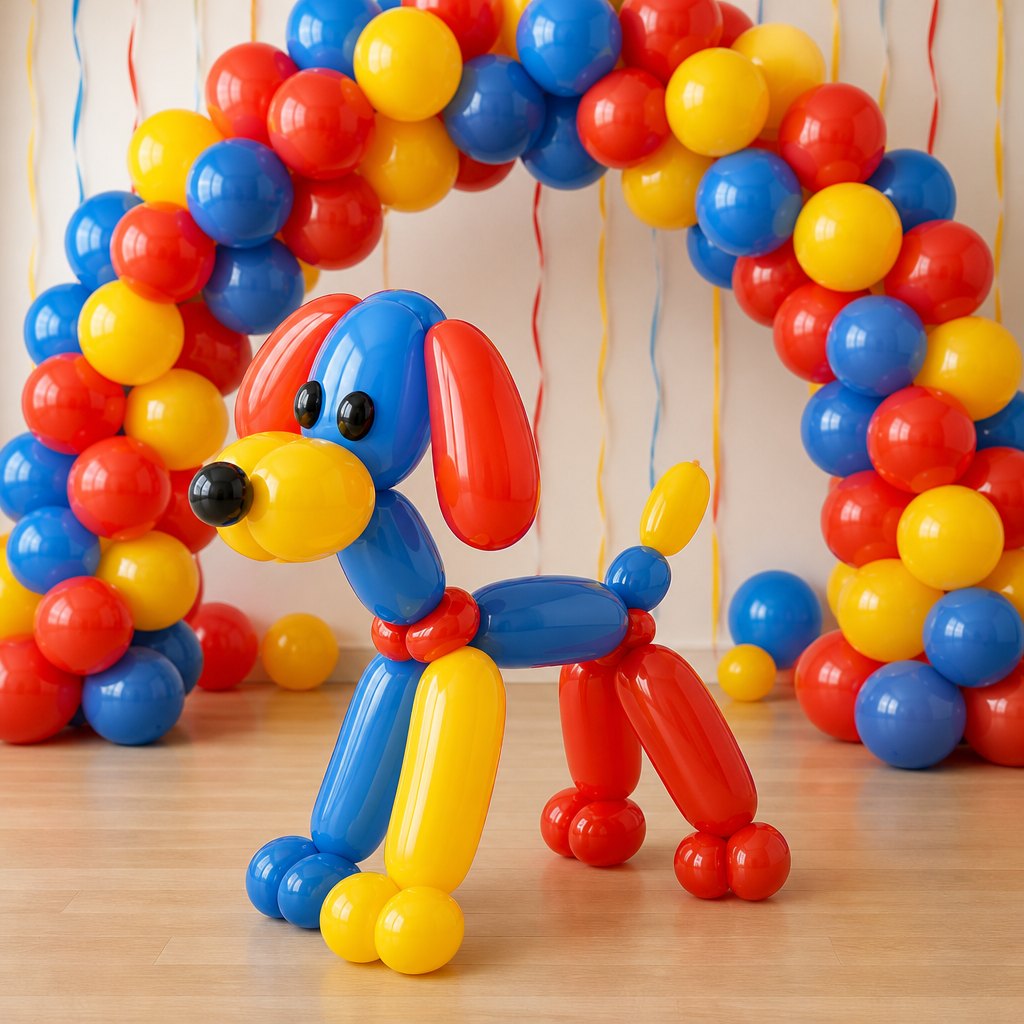
This example was generated from a prompt like: “A colorful twisted balloon dog and a large balloon arch made of clustered round balloons in red, yellow, and blue, glossy latex surfaces, festive party setting, bright even lighting, visible twist points on the figure.”
Open the Balloon Art Style generator →The medium today
Balloon art today ranges from quick walk-around entertaining at parties to elaborate wedding, corporate, and store-opening installations built with hundreds of balloons over armatures. Professional decorators use specialized pumps, foil balloons, and frame supports to make large displays last several days. Balloon drop ceilings, parade floats, and record-attempt sculptures continue the large-scale side of the form, while single-balloon animal twisting remains its most familiar, entry-level version.
Compose your own
Beginners start with a bag of 260 pencil balloons and a hand pump, learning to inflate a balloon while leaving an uninflated tail. Practice the basic twist and lock twist first, using them to make a simple dog or sword, since most tutorials break shapes into a short sequence of these two moves. Progress to combining balloon sizes and colors for more detailed figures, then try small freestanding sculptures before attempting larger arch or column displays that need a frame or hand-truck support.
Frequently asked questions
What kind of balloon is used for twisting figures?
Long, narrow latex balloons commonly called '260' pencil balloons are the standard for hand-twisted animals and figures, chosen for their length and stretch tolerance during twisting.
Why do balloon animals sometimes pop while being made?
Popping usually happens from over-inflating, leaving no uninflated tail, or twisting too tightly near the knot. Leaving slack and inflating slightly under full capacity reduces the chance of bursting.
How long do balloon sculptures last?
Standard latex balloons typically last a few days before deflating, shorter in direct sunlight or heat. Foil balloons and helium-treated latex with a special coating can last noticeably longer.
Do large balloon displays need a frame?
Yes—arches, columns, and character sculptures usually rely on a wire, PVC, or foam armature to hold their shape, with individual balloons clustered onto it rather than freestanding on their own.