
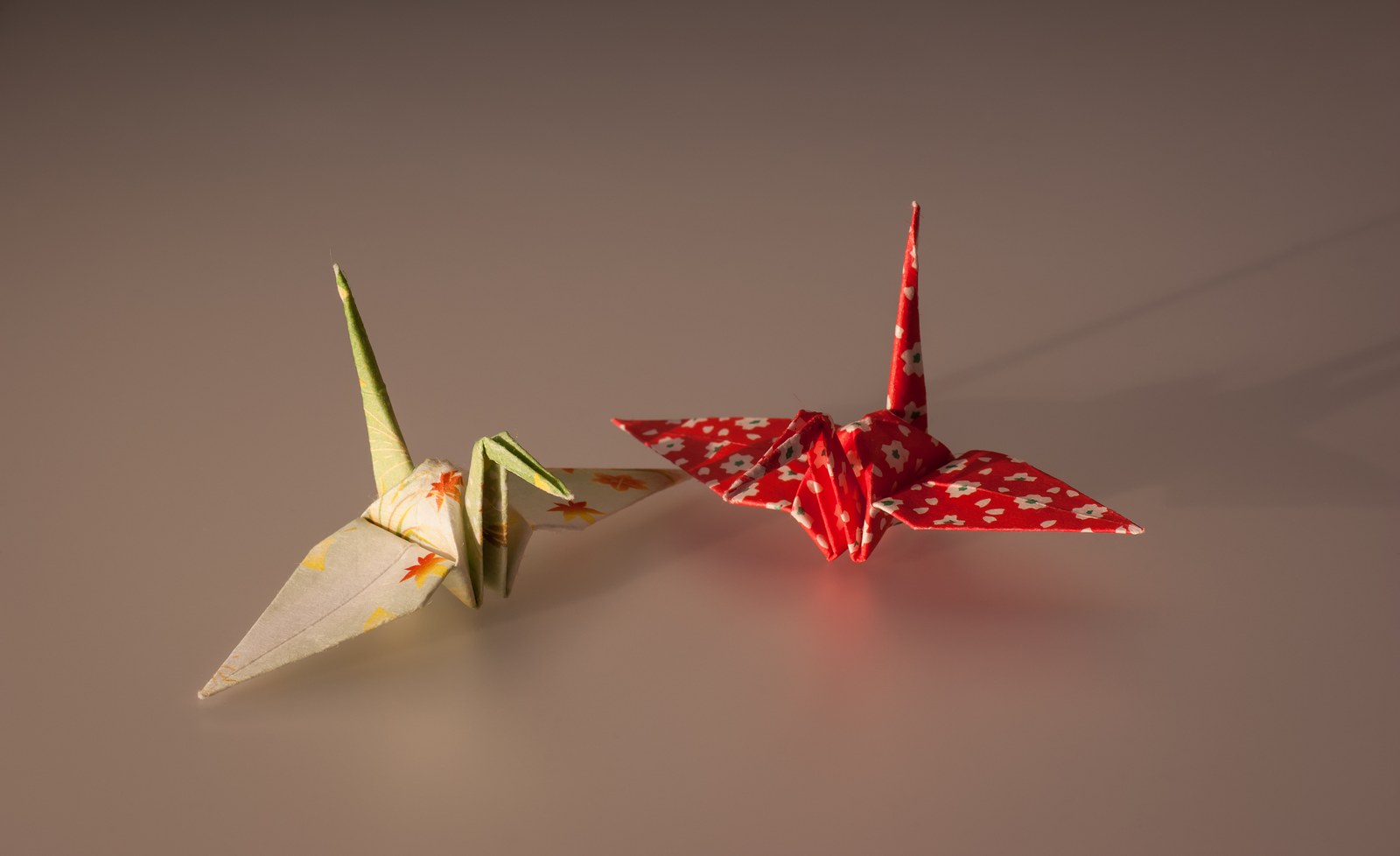
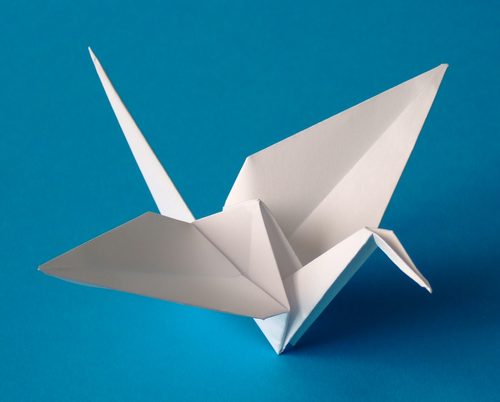
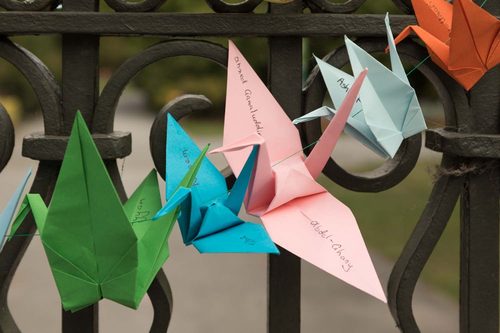
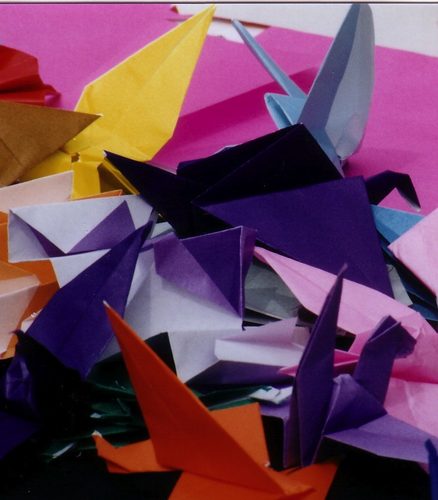
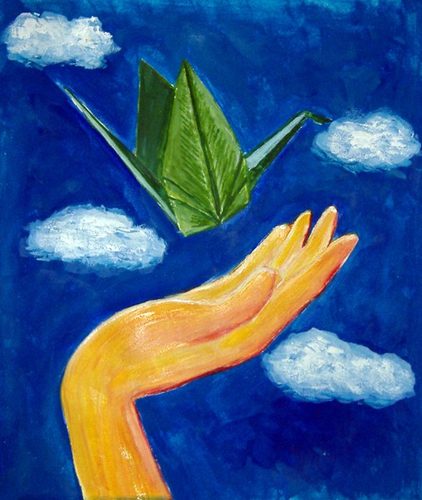
Origami is the art of folding paper into representational or abstract forms using only creases, without cutting, gluing, or adding material. A single square sheet—traditionally colored on one side, white on the other—is folded along a sequence of valley and mountain creases until flat geometry becomes a three-dimensional crane, box, flower, or animal. Paper choice matters: crisp kami paper holds sharp creases for simple models, while thicker foil-backed or wet-folded paper allows softer, sculptural curves for complex designs. Folders work from published diagrams using standardized arrows and symbols, or from crease patterns that map every fold needed to collapse a flat sheet into its final form. Modular origami builds larger sculptures from many identical folded units slotted together without adhesive. Beyond decorative models, origami folding principles inform engineering fields such as satellite solar panels and medical stents, where compact folded structures must expand into larger shapes.
What defines the medium
The single uncut square
Classic origami starts from one square sheet with no cuts and no glue, relying entirely on folds to build form. This constraint pushes folders toward inventive crease sequences rather than added material or trimming.
Reading diagrams and symbols
Folders follow standardized diagram symbols—dashed lines for valley folds, dash-dot lines for mountain folds, arrows for direction—developed to communicate sequences across languages. A published diagram guides each step from flat paper to finished model.
Bases before details
Most representational models begin from a recognized base—bird base, waterbomb base, frog base—that sets up symmetrical points before the folder shapes legs, wings, or petals from those points. Learning bases speeds up learning new models.
Wet-folding for curves
Wet-folding dampens heavier paper before folding, letting it hold soft curves and rounded forms instead of sharp creases. The technique suits animal and floral models where a lifelike silhouette matters more than geometric precision.
Modular assembly
Modular origami folds many identical or complementary units, then locks them together through tabs and pockets without glue, building complex polyhedra, balls, or stars from repetition rather than a single elaborate fold sequence.
Paper choice and grain
Thin, crisp kami paper suits simple geometric models, while foil-backed or tissue-foil paper holds fine detail for complex insects and figures. Paper weight, size, and grain direction all affect how cleanly a crease holds.
Materials decoder
The toolkit of origami
- valley fold line
- → a dashed line in origami diagrams marking a fold where the paper creases toward the folder, the most basic fold in any sequence
- mountain fold line
- → a dash-dot line marking a fold away from the folder, used alongside valley folds to build three-dimensional structure
- kami paper
- → thin, crisp, colored-on-one-side paper cut to a perfect square, the standard material for beginner and diagrammed models
- crease pattern
- → a map of every fold line needed to collapse a flat sheet into its final form, used by advanced folders instead of step diagrams
- bird base
- → a foundational fold with four symmetrical points, the starting shape behind the classic crane and many bird and insect models
- wet-folded curve
- → a rounded, sculptural surface produced by dampening paper before folding, identifying advanced representational animal models
The story
Paper folding developed in Japan alongside the spread of papermaking from China, with the earliest surviving instructions appearing in the 1797 book Hiden Senbazuru Orikata, which documented connected multi-crane folds. Ceremonial folded paper, called noshi, accompanied gifts in Japanese court culture for centuries before recreational folding spread more widely. In nineteenth-century Germany, educator Friedrich Froebel incorporated paper folding into kindergarten curricula, spreading basic folding technique through European schools. Japan and parts of Europe developed folding traditions largely independently before shared diagram systems in the twentieth century let folders worldwide read the same instructions. The paper crane became an internationally recognized symbol of peace after a 1955 story of a thousand cranes folded in Hiroshima. Mathematicians later formalized origami's geometry, and folded structures now inform engineering designs from collapsible solar panels to medical stents that expand once inside the body.
Masterpieces of the medium
| Work | Artist | Date | Why it matters |
|---|---|---|---|
| Orizuru (Paper Crane) | Unknown | traditional, Japan | the single most recognized origami model, folded from one uncut square and central to the senbazuru custom |
| Hiden Senbazuru Orikata | Unknown | 1797 | earliest known printed origami instruction book, documenting connected multi-crane folding patterns |
| Froebel's Kindergarten Folding Exercises | Friedrich Froebel | 1830s-1840s | introduced paper folding as an educational method in early childhood curricula across Europe |
| Kusudama | Unknown | traditional, Japan | modular ball of folded paper units, used decoratively and historically in seasonal customs |
| Sadako's Thousand Cranes | Unknown | 1955 | senbazuru project later associated with Hiroshima peace memorials, popularizing crane folding worldwide |
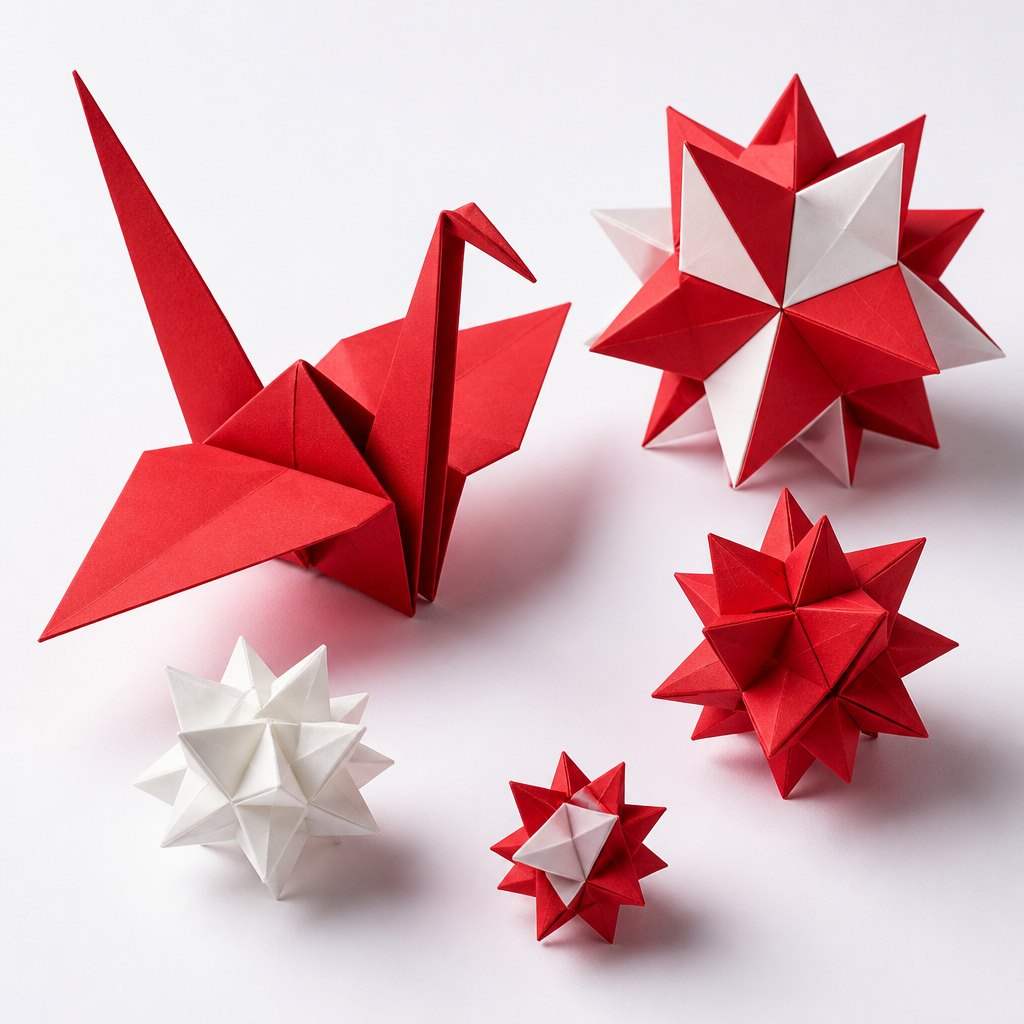 AI-generated
Try the medium
Try origami with AI
This example was generated from a prompt like: “A folded paper crane and modular geometric paper stars arranged on a plain white table, crisp sharp creases catching soft studio light, traditional origami paper in red and white, clean minimalist composition, high detail on fold lines.”
Open the Origami Art Style generator →The medium today
Origami today spans traditional single-model folding, competitive complexity folding of insects and dragons with dozens of legs, and origami-inspired engineering used in aerospace and medical design. Paper folding is taught in classrooms for geometry and fine motor skills, and origami societies worldwide publish diagrams and host conventions. Digital tools now generate crease patterns for extremely complex models before any paper is touched. Public sculpture installations and museum exhibitions regularly feature large-scale folded paper works, and origami remains a popular subject for tutorial videos demonstrating step-by-step folding sequences.
Compose your own
Start with a perfect square of thin paper and a single simple model, like the traditional crane or a waterbomb base, following a printed or video diagram step by step rather than skipping ahead. Crease each fold firmly with a fingernail or bone folder so it holds cleanly, and complete each step fully before moving to the next—origami sequences build on earlier folds. Practice the handful of foundational bases, since most models grow from them. Once comfortable, move to wet-folding for softer curves or try modular origami, which only requires folding one simple unit correctly and repeating it many times. Patience with precise, flat creases matters more than fast folding.
Frequently asked questions
What paper works best for origami?
Thin, crisp paper that holds a sharp crease works best for most models—standard kami paper for practice, and thicker foil-backed paper for complex designs with many layers, since it resists tearing under repeated folding.
Is origami only about paper cranes?
The crane is the most recognized model, but origami includes thousands of designs—animals, flowers, geometric polyhedra, boxes, and modular sculptures built from many folded units, ranging from a few folds to hundreds of steps.
What's the difference between origami and kirigami?
Origami uses only folds on a single uncut sheet, while kirigami allows cutting and sometimes gluing paper. Kirigami can achieve shapes folding alone cannot, but it departs from origami's traditional no-cut, no-glue restriction.
Do I need special tools for origami?
No—origami traditionally needs only paper and hands, though a bone folder helps create crisp creases and tweezers assist with tiny folds on complex models. Precision and patience matter more than any specialized equipment.