
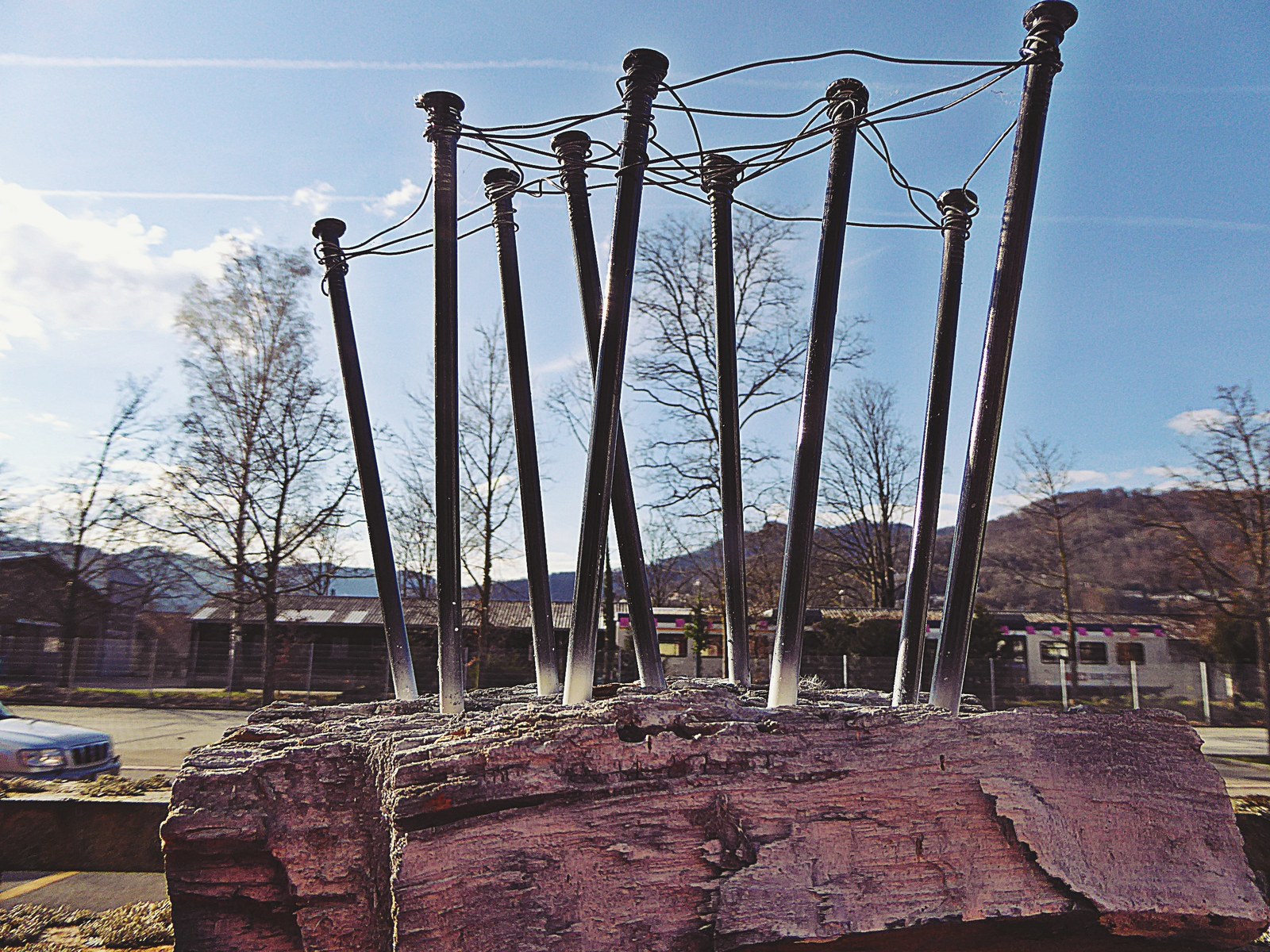
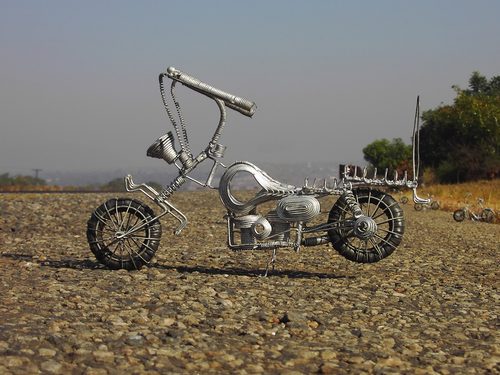
Wire art builds sculptural form by bending, twisting, coiling, and joining metal wire—copper, aluminum, steel, or galvanized wire—into figures, armatures, or freestanding three-dimensional line drawings. Tools are simple: pliers, wire cutters, a mandrel for coiling, and solder or a soldering iron for permanent joints, with welding used on heavier gauges. Because wire is thin, the form favors open, linear silhouettes over filled mass—figures read as continuous outlines or woven mesh rather than solid shapes. A piece can be one continuous strand bent freehand, or several strands twisted and wrapped together for thicker sections and textured surfaces. Finish ranges from bright bare metal to oxidized patina, paint, or wrapped thread and beads. The defining look is exposed structure: every twist, kink, and joint stays visible, doubling as both construction method and decoration, with negative space between the wires reading as part of the composition.
What defines the medium
Gauge selection
Wire thickness determines flexibility and rigidity. Fine gauges bend easily for detail and jewelry, while thicker gauges hold their shape and support larger, freestanding sculptural forms.
Continuous line versus armature
Some pieces use one uninterrupted strand bent into a contour drawing in space; others build a rigid frame first, then wrap or mesh finer wire over it for surface and volume.
Joining methods
Wire ends are twisted together, soldered, wrapped, or welded, chosen by metal type and gauge. Soldered joints hold permanently; twisted joints stay adjustable but can loosen over time.
Open silhouette and negative space
Wire sculpture reads largely through the gaps between strands rather than filled mass, so the empty space inside and around a figure is as compositionally important as the metal itself.
Base and stability
Freestanding wire figures need a weighted base, splayed feet, or an embedded support, since thin wire alone often cannot hold a standing pose without help.
Surface treatment
Finishes include bare polished metal, chemically induced patina, paint, or wrapped thread and beads, each changing whether the piece reads as industrial, decorative, or sculptural.
Materials decoder
The toolkit of wire art
- twisted double strand
- → two wires twisted together for a reinforced joint or a thicker visual line within a figure
- soldered joint
- → a small metal blob where two wire ends were fused with heat, marking a permanent connection
- open mesh or woven wire
- → interlocking loops built into a net-like surface, common in larger wire sculptures and busts
- continuous contour line
- → a single unbroken wire bent to trace a figure's outline without cutting, a hallmark of gestural wire portraiture
- coiled or springform wire
- → tight spirals wound around a mandrel, used for texture, hair, or flexible joints in a figure
- patina or oxidized finish
- → a darkened or colored surface from chemical treatment or natural weathering of bare metal
The story
Wire has ancient decorative use in gold and silver filigree jewelry across Egypt, the Mediterranean, and later Islamic and European craft traditions. Wire sculpture entered fine art in the early twentieth century through direct-metal construction: Spanish sculptor Julio González, who died in 1942, pioneered welded iron and wire figures after working alongside Picasso. In Paris during the 1920s, wire portraits and a miniature wire-and-found-object circus were made and performed for small audiences, part of a broader turn toward line-based, open-form sculpture. Across Southern and West Africa through the twentieth century, artisans developed a parallel tradition of wire toy-making, twisting recycled telephone and fencing wire into detailed toy cars, bicycles, and animals, a craft still practiced and sold today. Wire sculpture and wire jewelry now sit alongside these traditions as both fine art and popular craft worldwide.
Masterpieces of the medium
| Work | Artist | Date | Why it matters |
|---|---|---|---|
| Woman Combing Her Hair | Julio González | 1936 | welded iron and wire figure by a pioneer of direct-metal sculpture |
| Guitar (maquette) | Unknown | 1912 | an early cardboard-and-wire construction sculpture, now held in a major museum collection |
| Cirque Calder | Unknown | 1926-1931 | a miniature wire-and-found-object circus of figures performed in Paris studio gatherings |
| Tuareg filigree wire jewelry | Unknown | Traditional, ongoing | handworked silver and wire jewelry from Saharan artisan communities |
| African wire toy vehicles | Unknown | 20th century-present | recycled wire toy cars and animals made and sold across Southern and West Africa |
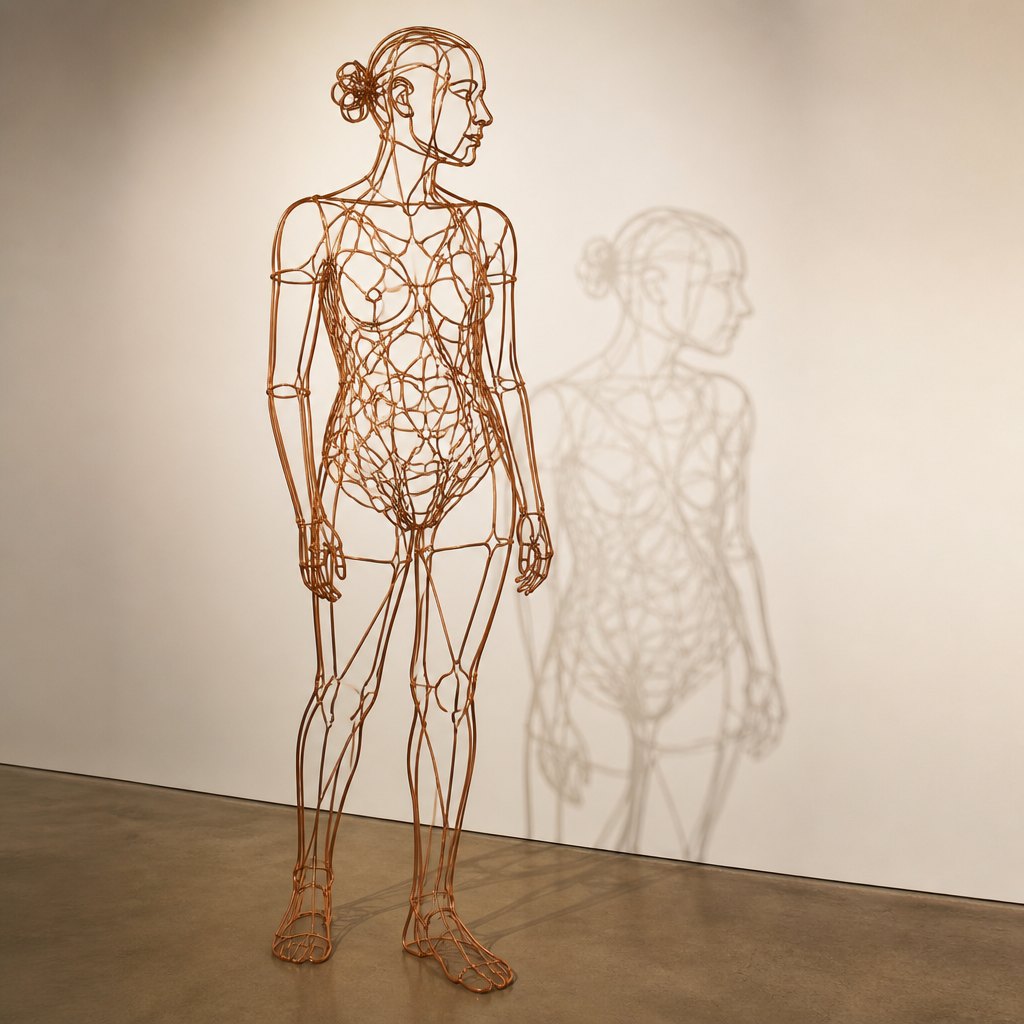 AI-generated
Try the medium
Try wire art with AI
This example was generated from a prompt like: “A life-sized standing figure sculpted entirely from bent copper wire, continuous unbroken contour lines forming the body, open mesh texture in the torso, warm gallery lighting casting linear shadows on a white wall.”
Open the Wire Art Style generator →The medium today
Wire art today spans gallery sculpture, street portrait busking where an artist twists a likeness in minutes, craft-fair jewelry, and large public wire installations. Craft workshops teach wire figure-making as an accessible entry point into three-dimensional art. Recycled and upcycled wire toy-making remains an active folk craft tradition, and wire mesh is also used in larger contemporary installation and public sculpture work.
Compose your own
Beginners start with soft aluminum or copper wire around 18 to 20 gauge, plus basic pliers and cutters. Practice bending simple shapes and a continuous-line contour figure before attempting anything freestanding. A mandrel or dowel helps make consistent coils for hair or texture. Add a weighted base, bent feet, or a wood block to keep a figure standing. Once comfortable with basic bends, progress to soldering or wrapping joints for pieces meant to last.
Frequently asked questions
What gauge of wire should a beginner use?
Around 18 to 20 gauge aluminum or copper wire is a good starting point—thin enough to bend by hand, thick enough to hold a shape without collapsing, and inexpensive to practice with.
Do wire sculptures need to be soldered?
Not always. Small decorative pieces can rely on tight twisted joints, but larger or freestanding sculptures usually need soldered, welded, or wrapped joints to stay stable over time.
Can wire art stand without a base?
Thin wire alone often cannot support a standing pose reliably. Most freestanding figures use splayed feet, a weighted base, or an embedded rod for stability.
Is wire sculpture the same as wire jewelry?
They share techniques like twisting, coiling, and wrapping, but wire sculpture builds larger freestanding or wall forms, while wire jewelry works at a small, wearable scale, often with precious metals.