
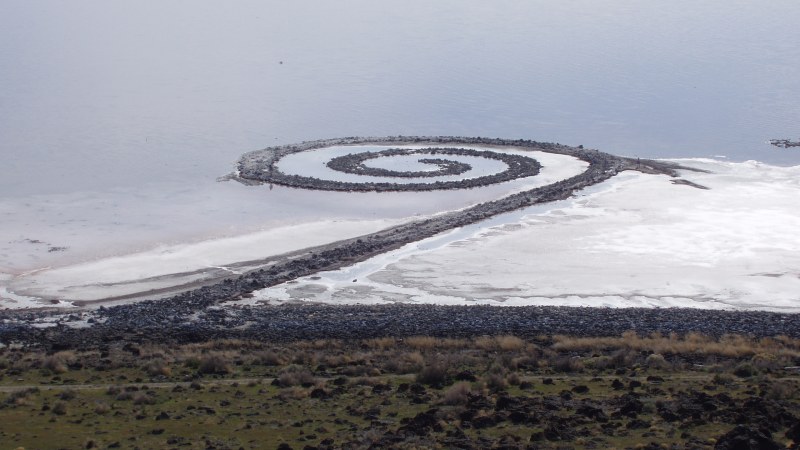
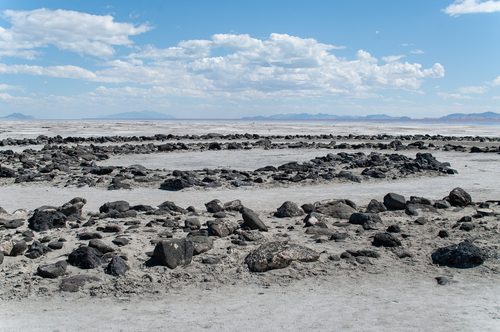
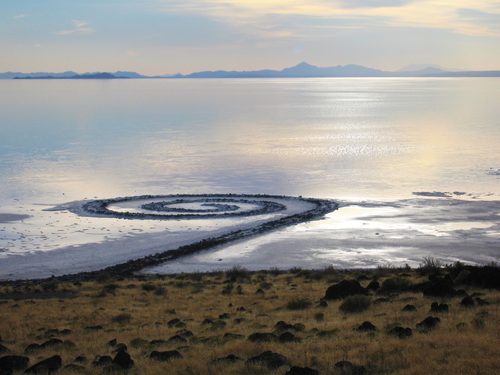
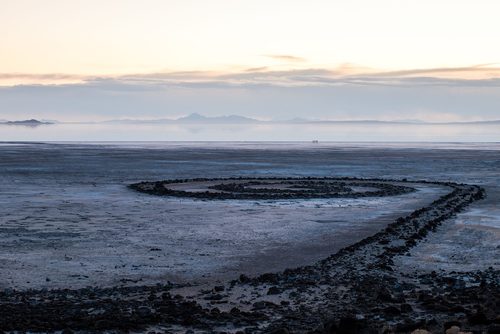
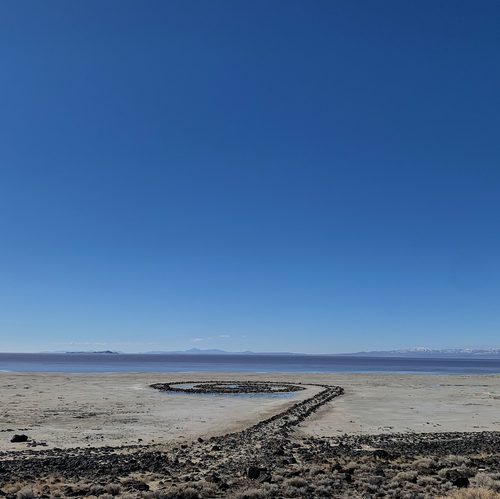
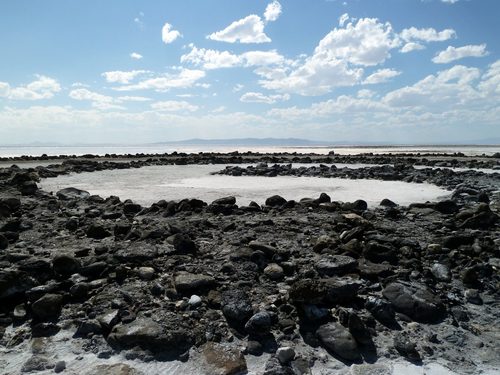
Environmental art, also known as land art or earthworks, uses the raw materials of a landscape—soil, rock, sand, water, ice, or living plants—to build large-scale works directly into a site rather than placing an object within it. Artists move earth with heavy machinery, arrange stones or salt crystals by hand, or redirect water and light to shape a place over time. Many works are sited in remote deserts, lakebeds, or mesas chosen for their scale, geology, or isolation from urban development. Because the material is the land itself, environmental art is often temporary or slowly changing: tides submerge and re-expose a spiral of rock, wind reshapes a line of stones, or a structure is left to erode, decay, or be reclaimed by vegetation. Documentation—photography, film, and maps—frequently outlives the physical work and becomes the primary way audiences encounter it. Some pieces double as functional structures, such as a chamber aligned to solstice light, blurring the line between sculpture, architecture, and astronomical instrument.
What defines the medium
Site selection and scale
Land artists choose remote sites—deserts, mesas, lakebeds—valued for geology, isolation, or specific light and horizon conditions. Works are built at a scale meant to be experienced by walking or driving through them, not viewed from one spot.
Using the land as material
Rather than importing sculpture into a landscape, environmental artists move, cut, or rearrange the earth's own material—soil, rock, salt—often with bulldozers or heavy equipment borrowed from mining and construction.
Impermanence and change
Many works are designed to weather, erode, submerge, or be reclaimed by plant growth over years or decades. This built-in impermanence is treated as part of the work's meaning rather than a flaw to be prevented.
Documentation as primary record
Because sites are remote and works change or vanish, photography, film, and maps made at the time of construction often become the main way the piece is studied and exhibited, sometimes outliving the physical earthwork itself.
Astronomical and site alignment
Several major works align with solstice or equinox light, echoing ancient monuments like Stonehenge. Precise surveying and orientation are treated as integral design decisions, not incidental details.
Minimal intervention versus large-scale earthmoving
Approaches range from a few placed stones or a line walked repeatedly into grass to earthworks displacing hundreds of thousands of tons of rock, spanning very different scales of physical labor and machinery.
Materials decoder
The toolkit of environmental art
- displaced earth and rock
- → raw excavated soil and stone left exposed as the work's surface, showing visible machine-cut edges and layered geology
- spiral or geometric earthwork form
- → a coiled or straight-line arrangement of rock and soil built directly into terrain, best seen from above or a great distance
- aligned aperture or chamber
- → an opening or tunnel positioned to frame the sun or stars on a specific date, linking the work to astronomical cycles
- salt crystal crust
- → a white mineral coating that forms on rock and soil submerged in saline lakes, changing a work's color and texture over time
- walked or worn path
- → a line or shape pressed into grass or earth through repeated footsteps rather than added material, fading without maintenance
- aerial photography documentation
- → overhead photographs taken at the time of construction, often the only way to see a work's full geometric form
The story
Environmental art emerged in the late 1960s in the United States as a small group of artists moved beyond the gallery to build directly into deserts and lakebeds, rejecting the commercial art object in favor of remote, often unsellable sites. Nevada's Double Negative, a pair of massive cuts into a mesa, and Utah's Spiral Jetty, a coil of basalt rock built into the Great Salt Lake, became the movement's defining works of 1969 and 1970. Around the same period, artists in Britain and continental Europe developed a related but gentler practice of walking and rearranging natural materials found on site, publishing photographs rather than altering the land permanently. Ancient precedents include ceremonial mounds, geoglyphs such as Peru's Nazca Lines, and astronomically aligned megaliths like Stonehenge, which land artists frequently cited as reference points. By the 1970s and 1980s, environmental art expanded to include ecological restoration projects, and it continues today through site-specific installations exhibited via photography and film.
Masterpieces of the medium
| Work | Artist | Date | Why it matters |
|---|---|---|---|
| Spiral Jetty | Unknown | 1970 | a 1,500-foot coil of black basalt rock and earth built into Utah's Great Salt Lake, periodically submerged by shifting water levels |
| Double Negative | Unknown | 1969-1970 | two enormous trenches cut into a Nevada mesa, displacing roughly 240,000 tons of rock and rhyolite |
| Sun Tunnels | Unknown | 1973-1976 | four large concrete cylinders arranged in the Utah desert and aligned to frame the solstice sunrise and sunset |
| Nazca Lines | Unknown | c. 500 BCE-500 CE | enormous geoglyphs scraped into the Peruvian desert floor, visible in full only from the air |
| Stonehenge | Unknown | c. 2500 BCE | a megalithic stone circle in England aligned to solstice sunrise, a frequent reference point for land art |
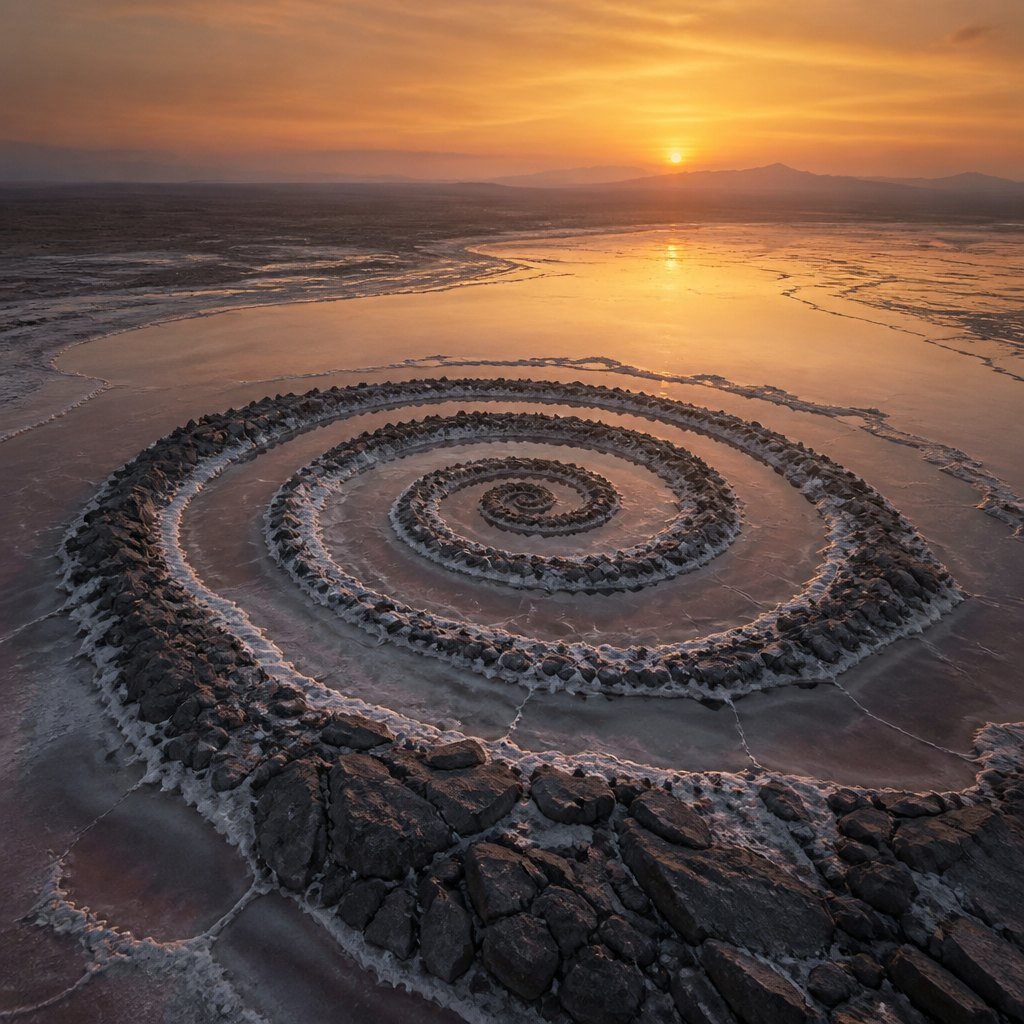 AI-generated
Try the medium
Try environmental art with AI
This example was generated from a prompt like: “An enormous spiral of dark basalt rock coiling into a shallow salt lake at sunset, salt crust crystallizing on the stones, vast empty desert horizon beyond, aerial perspective, muted earth-toned palette.”
Open the Environmental Art Style generator →The medium today
Environmental art today spans restored wetlands, reforestation projects framed as artworks, and new earthworks built with attention to ecological impact rather than pure spectacle. Some artists collaborate with scientists to track erosion, water levels, or plant regrowth as part of a work's ongoing life. Remote desert works from the 1970s remain pilgrimage sites, visited in person or experienced through archival photography and satellite imagery. Museums increasingly exhibit environmental art through film, maps, and preserved materials rather than the physical earthwork, since most major pieces cannot be moved or lent.
Compose your own
A beginner can start at a small, personal scale: rearranging stones, leaves, or sand on a walk and photographing the result before nature erases it, which mirrors the documentation habits of the movement's earliest artists. Working with locally found natural materials—rather than importing anything—keeps a first project true to the form's core idea. Studying a site's geology, light, and seasonal change before intervening helps a work respond to its specific place rather than looking arbitrary. Because land art depends on scale and remoteness, photographing from multiple distances, including aerial or drone shots if possible, is essential for sharing work most viewers will only ever see in images.
Frequently asked questions
What's the difference between environmental art and land art?
The terms are largely interchangeable; land art usually refers specifically to large earthworks built by moving soil and rock, while environmental art can also include ecological, restorative, or temporary natural-material works.
Can I visit famous land art works in person?
Some, like Spiral Jetty, are on public land and accessible by a drive plus a walk, though visibility depends on water levels and weather. Others are on private land with limited or seasonal public access.
Why do land artists use such remote sites?
Remote deserts, mesas, and lakebeds offer scale, geological interest, and freedom from zoning or ownership restrictions that would prevent moving large amounts of earth, along with dramatic natural light and isolation.
Is environmental art permanent?
Rarely by design—tides, erosion, and plant growth continually reshape most works, and many artists treat that ongoing change as part of the piece rather than something to prevent.