
Light art treats illumination itself as the primary material rather than a way of showing off a solid object. Artists bend glass neon tubing filled with noble gases, arrange commercial fluorescent or incandescent fixtures, program LED arrays, or project moving images and lasers onto walls, buildings, and open air. Because the work is made of light, it depends entirely on darkness or dim surroundings to be legible, and it often changes appearance completely between day and night. Neon requires a glassblower to heat and shape tubing by hand, then fill it with gas and wire it to a transformer; LED and projection work relies on programmed sequences, sensors, and software rather than a fixed physical form. Many pieces are architectural in scale, wrapping a building facade or filling an entire gallery room with color, while others are small tabletop or wall-mounted fixtures. Because the medium is inseparable from electricity, light art is also uniquely dependent on power supply, wiring, and, for outdoor works, weatherproofing of components not originally designed to face rain or heat.
What defines the medium
Darkness as a working condition
Light art is designed to be seen in low ambient light, since brightness or color contrast disappears in daylight. Galleries and outdoor sites are chosen or modified specifically to control surrounding light levels.
Neon fabrication process
Neon works begin with a glass tube heated and bent by hand into letters or shapes, then filled with neon or argon gas and fitted with electrodes wired to a transformer. Each bend is made individually, so no two tubes are perfectly identical.
Programmed sequence and control
LED and projection-based works rely on programmed timing, color sequences, or sensor-triggered responses rather than a fixed static image, giving the artist control over how the piece changes across minutes or hours.
Architectural and site integration
Large-scale light art is frequently designed to wrap a building facade, bridge, or public plaza, working with the structure's existing geometry rather than standing as a freestanding object separate from it.
Color from gas or diode, not pigment
Color in neon comes from the specific gas used and the tinted glass tubing, not applied pigment; LED color comes from mixing red, green, and blue diodes electronically, giving both media a saturation pigment cannot match.
Dependence on power and maintenance
Because the work is electrical, it requires a continuous power source, periodic bulb or transformer replacement, and, for outdoor pieces, weatherproof housing, making ongoing maintenance part of long-term ownership.
Materials decoder
The toolkit of light art
- hand-bent neon tubing
- → glass tubing heated and curved by hand into letters or shapes, glowing in a signature saturated color from its internal gas
- fluorescent tube fixture
- → a standard commercial light tube used unaltered as sculptural material, arranged in grids or angled compositions
- LED array
- → a grid of small diode lights individually addressable in color and timing, producing programmed patterns or moving images
- architectural projection
- → moving or still imagery projected onto a building facade at large scale, visible only after dark
- laser beam
- → a tightly focused, single-color beam of light, often used to draw sharp lines or patterns through fog or haze
- transformer and wiring housing
- → the exposed or hidden electrical components that power a light work, occasionally left visible as part of its industrial look
The story
Light as an artistic material followed closely behind its industrial invention. Neon tube lighting, developed in France and first shown publicly in Paris in 1910, was adapted almost immediately for advertising signage, and by the 1920s and 1930s illuminated signs had transformed commercial strips in cities including Paris, London, and Las Vegas into early examples of large-scale public light display. Artists began treating light as a fine-art medium rather than commercial signage in the 1960s, arranging commercial fluorescent tubes and neon into gallery sculpture and using early strobe and projection technology in installation work. Kinetic and op art movements of the same decade explored light, motion, and perception together. Laser technology, developed in 1960, entered art and public spectacle by the 1970s. Major international exhibitions began featuring large-scale light installations by the late 1970s, and LED technology's falling cost and programmability from the 2000s onward made responsive, color-shifting light art far more accessible to artists and public commissions alike.
Masterpieces of the medium
| Work | Artist | Date | Why it matters |
|---|---|---|---|
| First public neon signage | Unknown | 1912 | one of the earliest commercial neon tube signs illuminated a Paris boulevard, launching neon as a mass visual medium |
| Times Square electric signage | Unknown | 1920s-1930s | large illuminated advertising displays turned a New York intersection into an early landmark of public light spectacle |
| Las Vegas Strip neon corridor | Unknown | 1940s-1960s | dense concentrations of large-scale neon signage made an entire street into an internationally recognized illuminated landscape |
| Fluorescent tube sculpture exhibitions | Unknown | 1960s | unaltered commercial fluorescent fixtures were first exhibited as minimalist sculpture, establishing industrial lighting as a fine-art material |
| Large-scale light installations at international exhibitions | Unknown | 1970s | major recurring art exhibitions began regularly featuring room-scale and building-scale light works, cementing the medium's institutional standing |
 AI-generated
Try the medium
Try light art with AI
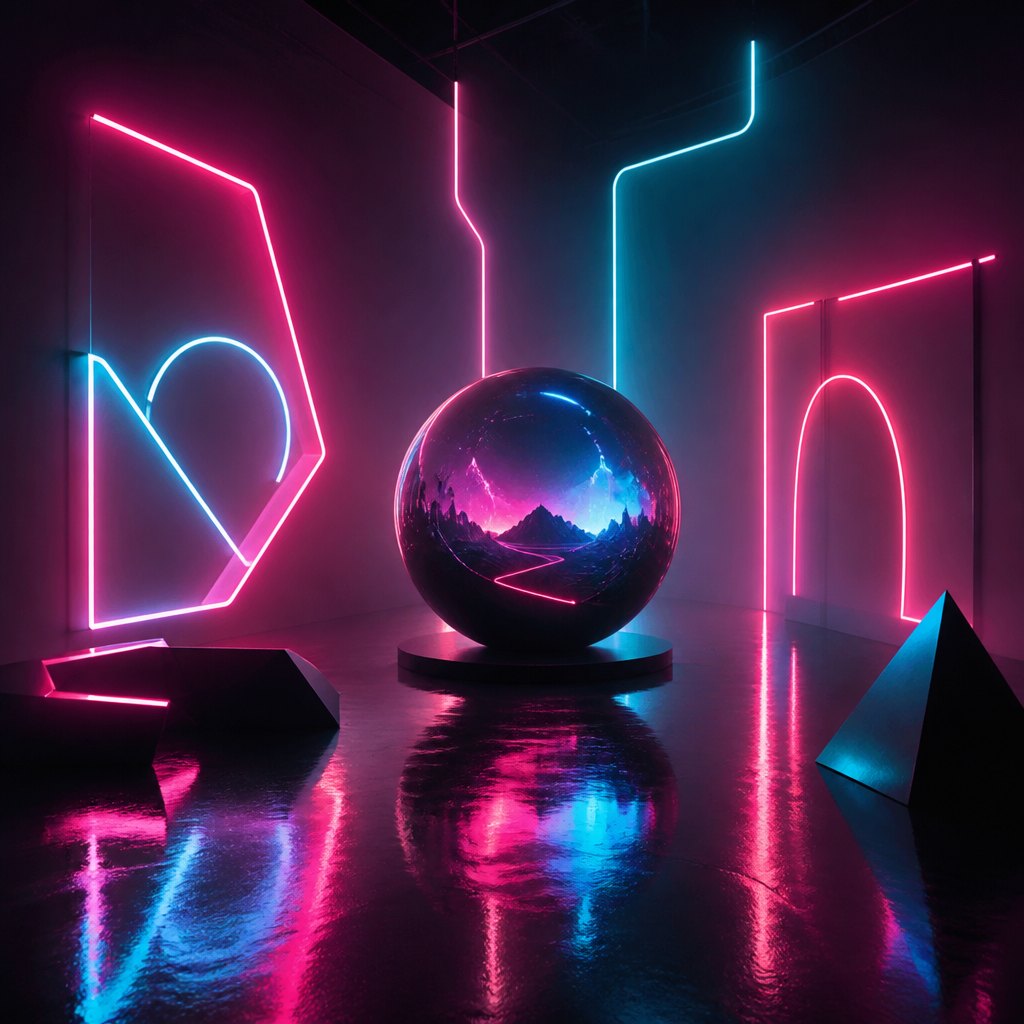
This example was generated from a prompt like: “A dark gallery room glowing with hand-bent neon tubing in electric pink and cyan, geometric shapes reflecting on a polished black floor, soft haze in the air catching the colored light.”
Open the Light Art Style generator →The medium today
Contemporary light art ranges from intimate neon signage in galleries and homes to building-scale LED facades and laser displays at festivals and public events. Falling LED costs and programmable color control have made responsive, sensor-triggered installations common in museums and public plazas alike. Cities increasingly commission illuminated public art for winter festivals and nighttime tourism, while smaller neon studios continue hand-bending tubing for both art and custom signage. Projection mapping now lets artists transform entire building facades temporarily without any permanent alteration to the structure.
Compose your own
A beginner typically starts with accessible tools rather than hand-bent neon, which requires specialized glassblowing training: LED strip lighting, small programmable microcontrollers, or simply photographing existing light sources like signage and streetlights to study how color and glow behave in darkness. Learning basic electrical safety and how transformers or drivers regulate voltage is essential before building anything permanent. Testing compositions in a fully darkened room reveals how a piece will actually read, since daylight photographs of light art are misleading. Renting time with a local neon shop or glass studio is the standard route into hand-bent tube work once basic electrical and design skills are in place.
Frequently asked questions
How does neon actually produce color?
Glass tubing is filled with a noble gas—neon for red-orange, argon with mercury for blue—and an electric current excites the gas atoms, causing them to glow; tinted glass further shifts the final color.
What's the difference between neon and LED light art?
Neon uses hand-bent glass tubing filled with gas and glows continuously in one fixed color per tube. LED uses solid-state diodes that can be individually programmed for color, brightness, and motion far more flexibly.
Why is light art usually shown in the dark?
Ambient daylight washes out the contrast and saturation that make illuminated color legible, so galleries dim rooms or works are sited outdoors at night to preserve the intended visual effect.
Is light art fragile or hard to maintain?
Yes, more than most sculpture—neon tubes can crack, transformers fail, and LEDs degrade over years of use, so owners typically budget for periodic bulb, tube, or driver replacement as part of upkeep.