
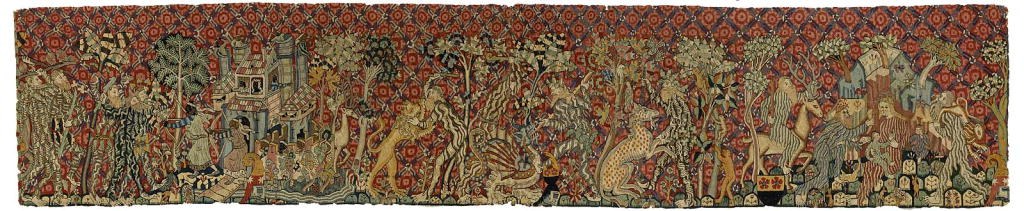
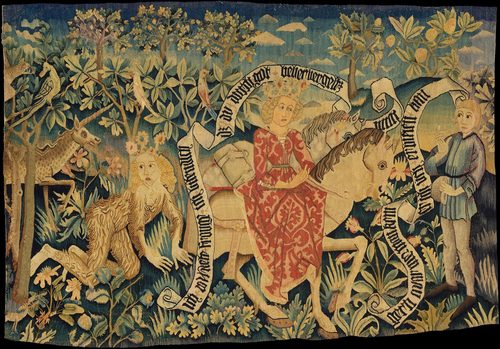
Fiber art covers work made primarily from fiber—wool, cotton, linen, silk, jute, or synthetic yarn—manipulated by weaving, knotting, coiling, felting, wrapping, or stitching rather than painted or carved. Tapestry weaving, the oldest branch, interlaces weft threads of different colors across a fixed warp on a loom to build an image or pattern, producing a ribbed, textured surface distinct from printed cloth. Basketry and coiling build structure by wrapping or stitching fiber bundles into spiraling forms. Felting compresses loose wool fibers with moisture, heat, and agitation into a solid, matted fabric without weaving at all. Since the mid-20th century, fiber art has also grown into three-dimensional and sculptural territory, with fiber built into freestanding or hanging forms that leave the wall and behave like sculpture. Natural dyes and hand-spun yarn remain common alongside commercial fibers. The medium is recognized by its handmade irregularity, visible structure of interlaced or knotted threads, and the tactile, often large-scale physical presence fiber gives a piece that flat media cannot.
What defines the medium
Warp and weft
Woven fiber art depends on a fixed set of vertical warp threads held taut on a loom, through which horizontal weft threads pass over and under to build the fabric or image, row by row.
Fiber selection
Wool, cotton, silk, jute, and synthetic yarns each behave differently—wool felts and dyes richly, silk gives sheen, jute adds coarse texture—so choice of fiber shapes both look and structural strength.
Structural technique defines surface
Weaving, knotting, felting, and coiling each produce a distinct surface: ribbed weave, raised knots, matted felt, or spiraling coiled rope. The technique chosen is as defining as the imagery itself.
Scale and installation
Fiber work ranges from small hand-sized samplers to room-filling sculptural installations of knotted rope or woven panels, with scale often central to the work's physical, immersive presence.
Color through dye and thread
Color comes from dyed or naturally colored fiber worked directly into the structure, whether hand-dyed yarn, plant-dyed wool, or commercial thread, rather than pigment applied after the fact.
Surface texture and relief
Looped, knotted, or piled techniques build raised, three-dimensional texture across the surface, giving fiber work a tactile relief that changes appearance with light and viewing angle.
Materials decoder
The toolkit of fiber art
- loom warp threads
- → taut vertical threads that form the fixed structure weft is woven through
- weft-faced tapestry weave
- → ribbed horizontal bands of color built row by row, hiding the warp beneath dense weft
- hand-spun yarn
- → irregular thickness and twist that signals fiber spun by hand rather than machine
- felted wool surface
- → dense, matted texture with no visible weave, formed by compressing loose wool fibers
- natural dye color
- → plant- or mineral-dyed fiber producing softer, less uniform hues than synthetic dye
- knotted fringe
- → loose fiber ends left hanging at an edge as a decorative, textural finish
The story
Fiber has been woven into cloth for millennia, with the earliest surviving fragments found in Egyptian and Andean burial sites. Tapestry weaving reached a peak in medieval and Renaissance Europe, producing narrative hangings like the Bayeux Tapestry, embroidered around the 1070s, and the Franco-Flemish Unicorn tapestries of the late 15th century, woven for royal and noble households. Coptic Egypt and Andean cultures such as the Paracas produced intricately patterned woven textiles centuries earlier. Indigenous weaving traditions, including Navajo blanket weaving in the American Southwest, developed distinct regional patterns using naturally dyed wool. In the early to mid-20th century, weavers associated with the Bauhaus workshop pushed fiber toward abstraction and modern design. From the 1960s onward, fiber artists moved textile technique off the loom entirely into freestanding sculptural and installation form, a shift now recognized as a founding moment of contemporary fiber art.
Masterpieces of the medium
| Work | Artist | Date | Why it matters |
|---|---|---|---|
| Bayeux Tapestry | Unknown | c. 1070s | embroidered narrative frieze depicting the Norman conquest of England |
| The Lady and the Unicorn tapestry series | Unknown | c. 1500 | Franco-Flemish millefleur tapestries woven in wool and silk |
| The Hunt of the Unicorn tapestries | Unknown | c. 1495-1505 | seven-panel woven tapestry series in wool, silk, and metallic thread |
| Coptic textile fragments | Unknown | 4th-7th century | densely patterned woven wool and linen fragments from Egypt |
| Navajo blanket weaving | Unknown | 19th century | hand-spun wool weaving with distinct regional geometric patterning |
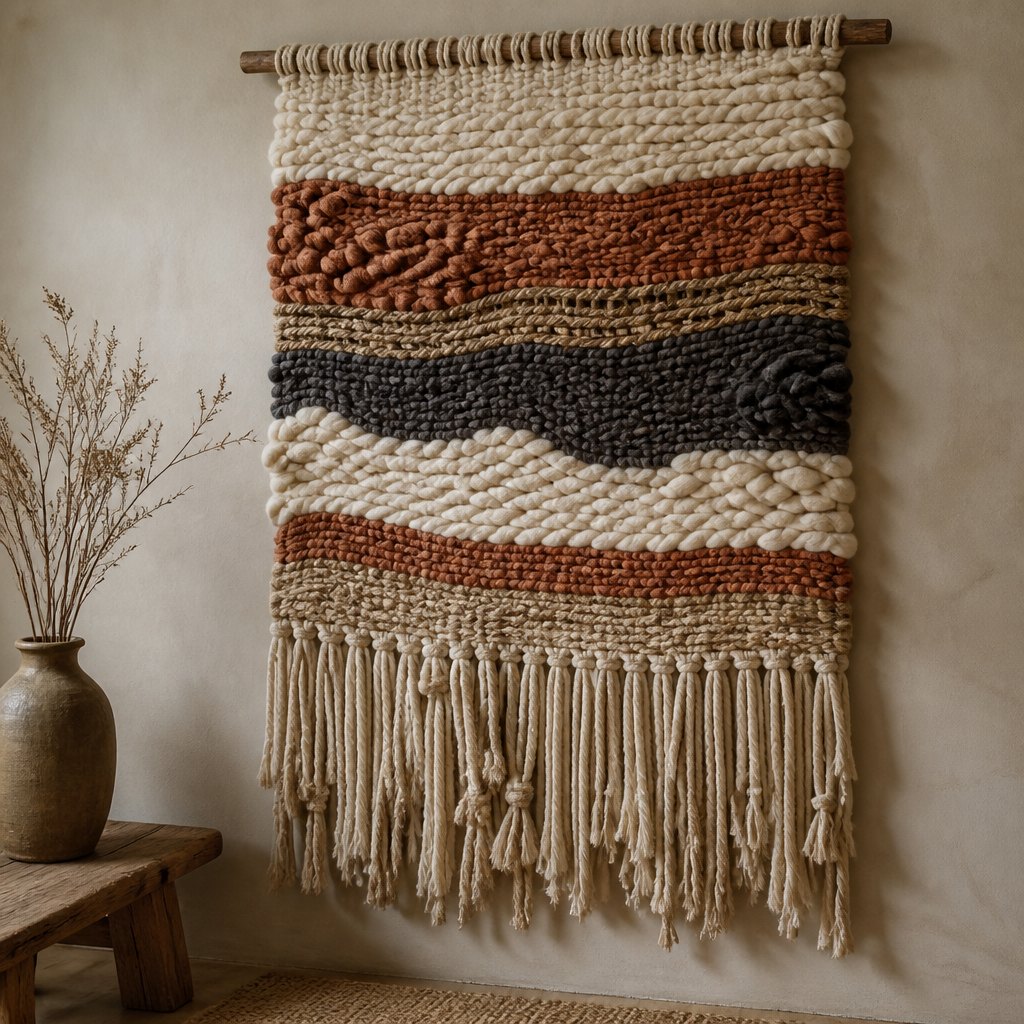 AI-generated
Try the medium
Try fiber art with AI
This example was generated from a prompt like: “A large woven wall hanging made of thick undyed wool and jute, textured horizontal bands in cream, rust, and charcoal, hand-knotted fringe hanging at the bottom, soft studio light.”
Open the Fiber Art Style generator →The medium today
Contemporary fiber art ranges from traditional tapestry weaving to large-scale sculptural installations that fill entire gallery rooms with knotted rope, dyed yarn, or woven panels. Natural fiber and sustainable dye practices have drawn renewed interest, alongside experimentation with unconventional materials like wire, plastic, or recycled textile waste. Fiber art now regularly appears in major contemporary art museums and biennials, treated as sculpture rather than craft. Community and social themes, including labor, identity, and domestic history, are common subjects explored through fiber's tactile, handmade qualities.
Compose your own
A beginner can start with simple frame-loom weaving, stretching warp threads across a wooden frame and weaving weft yarn over and under with fingers or a shuttle, building a small tapestry sampler to learn tension and beating the weft down evenly. Basic techniques to practice include soumak wrapping, rya knots for texture, and simple color blocking. From there, learners can try needle felting, stabbing loose wool with a barbed needle to compress it onto a surface, or wet felting, agitating wool with soap and water into solid fabric. Choosing a consistent fiber weight and a limited color palette keeps early pieces cohesive while technique develops.
Frequently asked questions
What is the difference between weaving and knotting?
Weaving interlaces threads over and under a fixed warp on a loom to build fabric row by row, while knotting joins cords directly to each other using knots like the square knot, with no loom involved.
What fibers are commonly used in fiber art?
Wool, cotton, linen, silk, and jute are the most common natural fibers, each chosen for texture, dye affinity, and strength, alongside synthetic yarns used for color range and durability.
Is felting the same as weaving?
No. Felting compresses loose wool fibers with moisture, heat, and agitation into a solid matted fabric with no woven structure, while weaving interlaces separate warp and weft threads on a loom.
Can fiber art be freestanding sculpture?
Yes—since the 1960s, fiber artists have built off-loom, three-dimensional and hanging sculptural forms from knotted rope, wrapped fiber, and woven panels that stand independent of a wall or frame.