
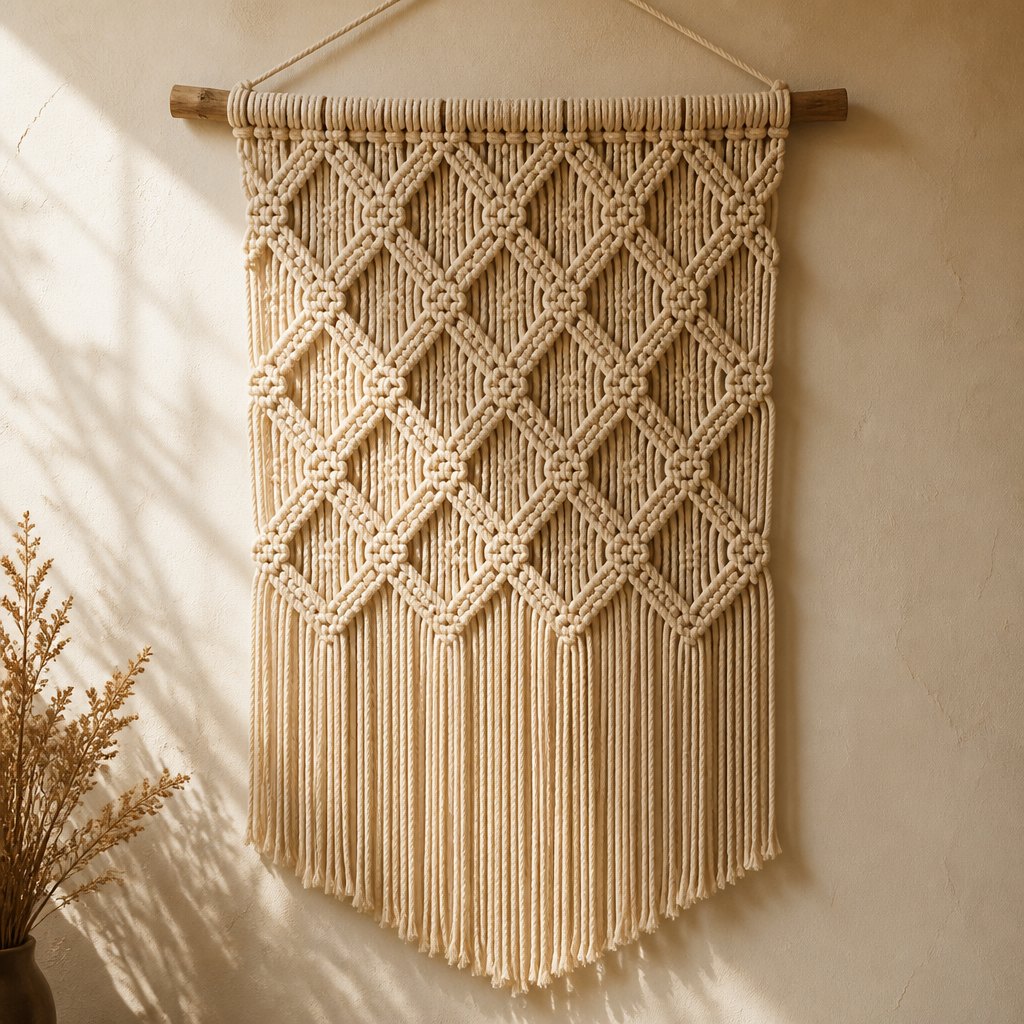
Macramé is textile work made entirely through knotting rather than weaving or stitching. Lengths of cord—cotton, jute, hemp, or waxed linen—are anchored to a fixed bar or ring with a larks head knot, then worked in vertical rows using a small set of repeating knots: the square knot, worked in groups to create flat, textured bands, and the half hitch, worked in diagonal or spiraling rows to build slanted patterns and lace-like open lattices. Because there is no loom or needle, the entire structure is held together by friction and knot tension alone, giving finished pieces a raised, sculptural texture distinct from flat woven cloth. Cord thickness and fiber choice shape the finished look: thin cotton cord produces delicate lace suitable for trim or jewelry, while thick natural rope produces bold, heavy wall hangings and plant hangers. Fringe left unknotted at the ends is a signature finishing touch. Macramé is recognized by its raised knotted texture, open diamond or lattice patterns, and hanging fringe.
What defines the medium
Core knots
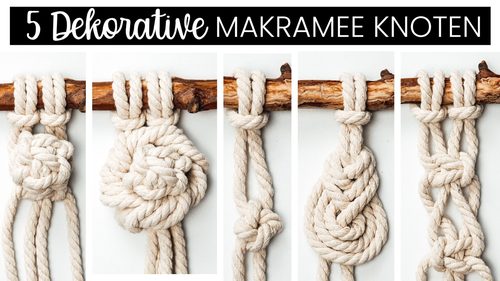
Nearly all macramé is built from two knots: the square knot, worked flat in repeating groups, and the half hitch, worked in diagonal rows. Complex-looking patterns are almost always these two knots combined.
Cord anchoring
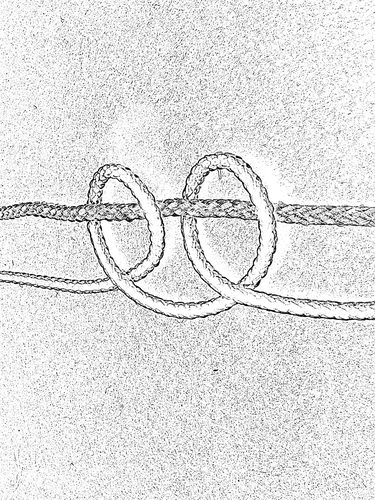
Work begins by mounting cords to a fixed bar, ring, or dowel using a larks head knot, which folds the cord in half and loops it around the anchor to create the starting row of working cords.
Working cords versus filler cords
In many patterns, some cords act as filler that stays straight while working cords knot around them, a distinction that shapes diagonal and spiral effects across the piece.
Pattern building through repetition
Diamond lattices, chevrons, and spirals all emerge from repeating a knot sequence across rows with a slight positional shift, rather than from unique knots for each visual effect.
Tension and knot consistency
Even tension across every knot is essential; loose or tight knots scattered through a piece disrupt the pattern and weaken the structure, since macramé relies on friction alone to hold its shape.
Fringe finishing
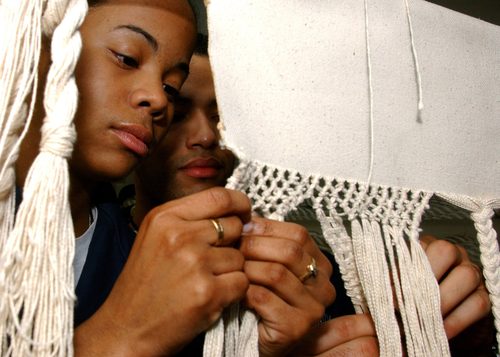
Cord ends left unknotted below the last row of pattern form the fringe, often trimmed level or combed out, and serve as the piece's signature finishing detail.
Materials decoder
The toolkit of macramé
- square knot
- → a flat, symmetrical knot worked in repeating pairs, the basic building block of macramé
- half hitch spiral
- → a diagonal knot repeated down one cord, creating twisting or slanted rows of texture
- larks head knot
- → the mounting knot that anchors a folded cord onto a bar, ring, or dowel to begin work
- natural cotton cord
- → soft, matte fiber that is the standard material for fine, even macramé knotting
- jute or hemp rope
- → coarse, heavy natural fiber used for bold plant hangers and large wall hangings
- unknotted fringe
- → loose cord ends left hanging below the pattern as a decorative, textural finish
The story
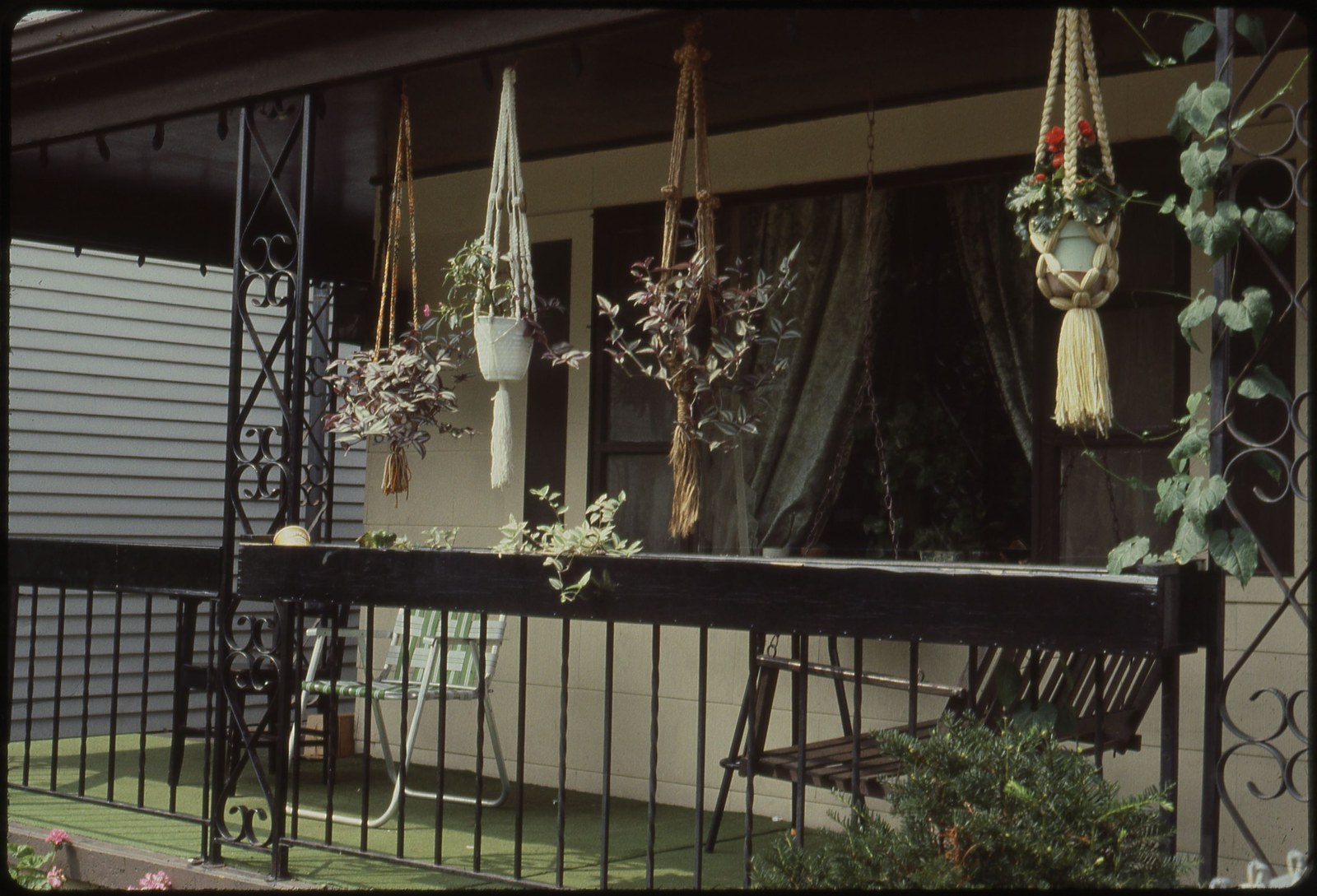
Decorative knotting has roots in Arabic weaving traditions, where fringe was knotted to finish the loose ends of woven cloth, a technique called migramah that spread into Mediterranean Europe with Moorish influence around the 13th century. Sailors carried knotting skills to sea, practicing elaborate knotted work on bell fringes, hammocks, and belts during long voyages, spreading the craft to port cities worldwide. Victorian households adopted macramé as parlor needlework in the 19th century, producing lace trims, doilies, and fringed textiles from published knotting pattern books. The craft faded through the early 20th century before returning dramatically in the 1970s, when macramé plant hangers, wall hangings, and owl motifs became fixtures of the era's decorative style. Interest declined again by the 1980s but has returned since the 2010s as a popular craft and home-décor revival, aided by online tutorials and renewed interest in handmade natural-fiber decor.
Masterpieces of the medium
| Work | Artist | Date | Why it matters |
|---|---|---|---|
| Macramé lace collar | Unknown | 19th century | fine knotted cotton lace made using Victorian parlor knotting technique |
| Sailor's macramé sea chest trim | Unknown | 19th century | nautical knotted rope work made aboard sailing ships during long voyages |
| Moorish fringe knotting | Unknown | 13th century | early European knotted-fringe technique tracing to Arabic textile finishing |
| Macramé wall hanging acquisition | Unknown | 1970s | period example marking macramé's recognition in decorative arts collections |
| Macramé plant hanger | Unknown | 1970s | knotted jute hanging planter, an icon of the era's decorative style |
 AI-generated
Try the medium
Try macramé with AI
This example was generated from a prompt like: “A macramé wall hanging in natural cotton cord, diamond lattice pattern of square knots and half hitches, long unknotted fringe at the bottom, hanging against a plain plaster wall in warm light.”
Open the Macrame Art Style generator →The medium today
Macramé today is a popular home craft and décor trend, seen in plant hangers, wall hangings, curtains, and jewelry made from cotton or jute cord. Online tutorials have driven a strong revival since the 2010s, with makers reviving 1970s patterns alongside new minimalist, monochrome designs. Craft fairs, online marketplaces, and social media have made macramé a common small-business craft. Design collections increasingly acknowledge macramé's decorative-arts history, holding examples from its Victorian lace era and its 1970s peak.
Compose your own
A beginner starts by mounting several lengths of cord onto a dowel or ring with larks head knots, then practicing the square knot in small groups to learn even tension. From there, half hitches introduce diagonal and spiral rows, which combine with square knots to build simple diamond or chevron patterns. A macramé board with pins, or simply taping cords to a table, keeps work steady while learning. Starting with a small project like a plant hanger or keychain builds knot memory before attempting a large wall hanging with multiple pattern rows. Cotton cord is easiest to learn on since it holds knots well and is simple to untie when correcting mistakes.
Frequently asked questions
What is the most basic macramé knot?
The square knot is the foundation of most macramé, worked in repeating pairs to build flat, textured bands. Nearly every pattern combines the square knot with the diagonal half hitch.
What cord works best for macramé?
Soft cotton cord is easiest for beginners since it holds knots well and unties easily. Jute and hemp add coarse texture for plant hangers, while waxed linen suits fine, lace-like work.
Is macramé the same as knitting or crochet?
No. Knitting and crochet use needles or hooks to loop a single continuous yarn, while macramé uses no tools at all, relying entirely on knotting multiple separate cord lengths by hand.
Do I need special tools for macramé?
Very few—cord, scissors, and a dowel or ring to mount cords to are enough to start. A pinned board helps hold tension for more complex patterns but is not required for simple projects.