
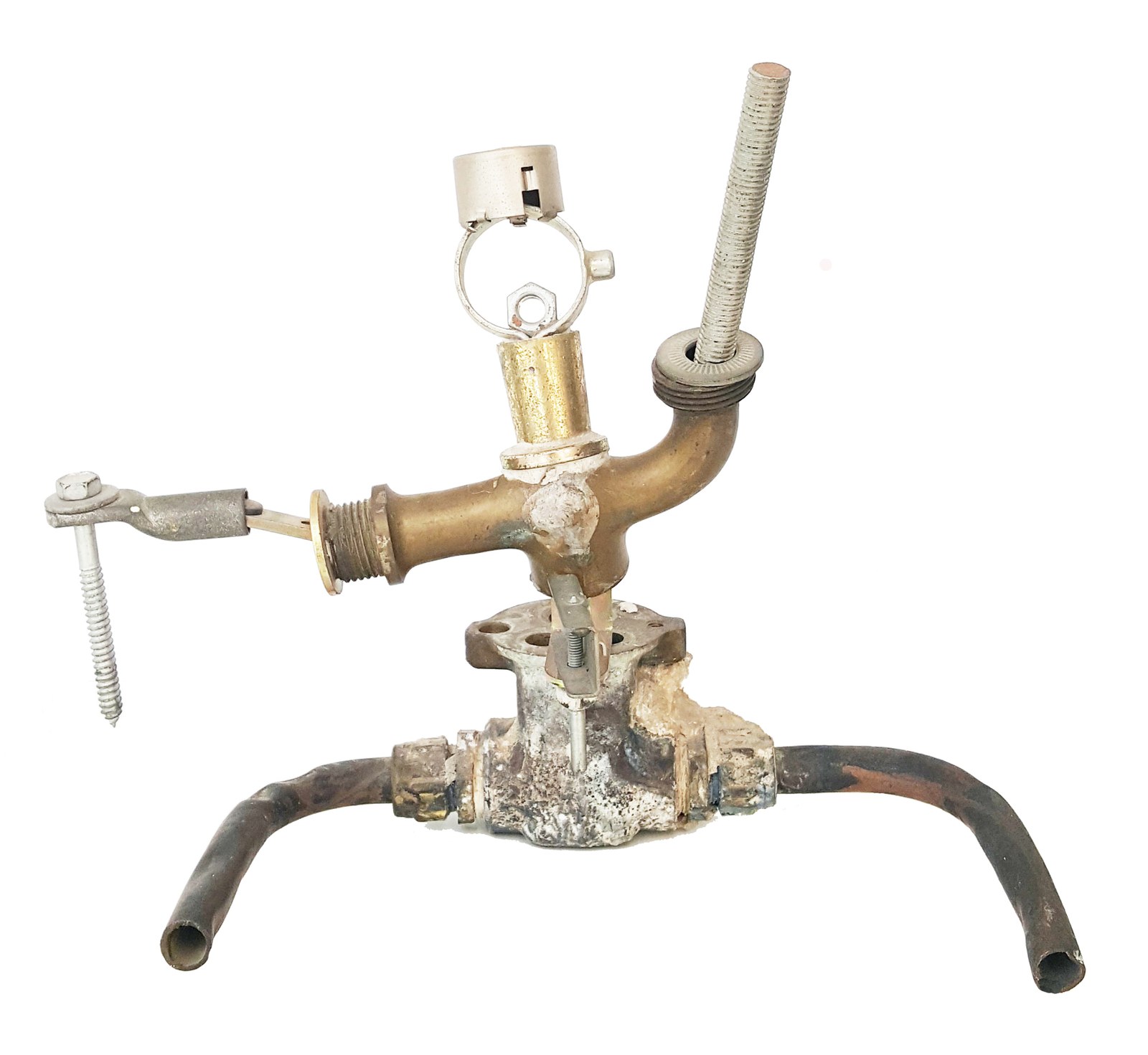
Found object art, also called assemblage or objet trouvé, builds artworks from existing objects rather than material shaped from scratch. An artist selects items—tools, toys, bones, packaging, hardware—for their form, texture, history, or symbolism, then joins them by gluing, wiring, nailing, soldering, or simple juxtaposition inside a box, frame, or freestanding armature. The readymade, a single unaltered object presented as art, sits at one extreme of the form; dense multi-object assemblage sits at the other. Materials carry visible signs of former use—rust, peeling paint, worn labels, scuffed edges—and these traces are usually preserved rather than sanded away. Tools are whatever joining method the material demands: epoxy, solder, screws, twine, a welding torch. There is rarely a hidden armature; the objects stay legible, their original identity remaining part of the meaning. The form rewards recognition and recontextualization over fabrication skill, asking viewers to see familiar things differently once pulled from ordinary use and placed in an art context.
What defines the medium
Selection over fabrication
The core act is choosing existing objects for their shape, wear, or associations rather than carving or modeling new material. A found-object artist's skill lies in seeing potential in an object others discard.
Readymade versus assemblage
A readymade presents a single unaltered object as art; assemblage combines multiple found objects into one composite piece. Many works sit between the two, lightly altering one or two components.
Visible joining methods
Glue, wire, nails, solder, or welds hold components together, and these joins are usually left exposed rather than hidden, since the construction method is part of the work's visible logic.
Preserved patina and wear
Rust, chipped paint, faded labels, and scratches are typically kept intact because they carry the object's history; over-cleaning a found piece can strip away the meaning it was chosen for.
Display context reframes the object
A pedestal, vitrine, wall mount, or gallery wall lifts an ordinary object out of its practical role and signals it should be read as art, doing much of the conceptual work.
Titling and juxtaposition
Because the materials are recognizable, the title and the specific pairing of objects usually carry the piece's meaning, often through unlikely combinations or puns on the objects' original functions.
Materials decoder
The toolkit of found object art
- rusted or weathered surface
- → signals an object sourced from junkyards, streets, or nature, its patina left intact as part of the work
- visible manufacturer's label or stamp
- → unaltered branding or text confirming the object's found, unmodified origin rather than fabrication
- exposed glue, wire, or weld joins
- → shows physically how separate found objects were locked together into one piece
- shadow box or vitrine
- → a framed glass-fronted case that presents small found objects with gallery-style formality
- repurposed machine parts
- → gears, springs, or tools reused for form or texture, giving the work an industrial, mechanical character
- driftwood, bone, or shell
- → natural found materials that give assemblage a weathered, organic rather than industrial character
The story
Found objects entered fine art through Cubist collage around 1912, when Picasso and Braque glued newspaper and packaging onto canvas. Marcel Duchamp's 1913 mounted bicycle wheel and 1917 signed urinal, titled Fountain, established the readymade—an unaltered object presented as art. Kurt Schwitters built his ongoing Merz assemblages from 1919 onward, gluing tram tickets, scrap wood, and debris into collages and eventually entire rooms. Surrealists in the 1930s used the term objet trouvé for chance-discovered objects charged with unconscious meaning. Mid-century American artists Joseph Cornell and, later, Robert Rauschenberg and Jasper Johns extended assemblage into shadow boxes and full-scale combine paintings. In France, Nouveau Réalisme artists of the 1960s built accumulations from mass-produced junk. The Museum of Modern Art's 1961 exhibition The Art of Assemblage surveyed the form internationally, cementing it as a recognized sculptural practice still active today.
Masterpieces of the medium
| Work | Artist | Date | Why it matters |
|---|---|---|---|
| Merzbau | Kurt Schwitters | 1923-1937 | an entire room built from accumulated found materials, plaster, and debris, expanded over years |
| Bicycle Wheel | Unknown | 1913 | a bicycle wheel mounted on a stool, widely cited as the first readymade sculpture |
| Fountain | Unknown | 1917 | a porcelain urinal signed 'R. Mutt,' a landmark readymade rejected from a New York exhibition |
| Bull's Head | Unknown | 1942 | a bicycle seat and handlebars combined to read as an animal head |
| The Art of Assemblage | Unknown | 1961 | a landmark museum exhibition in New York surveying found-object and collage art internationally |
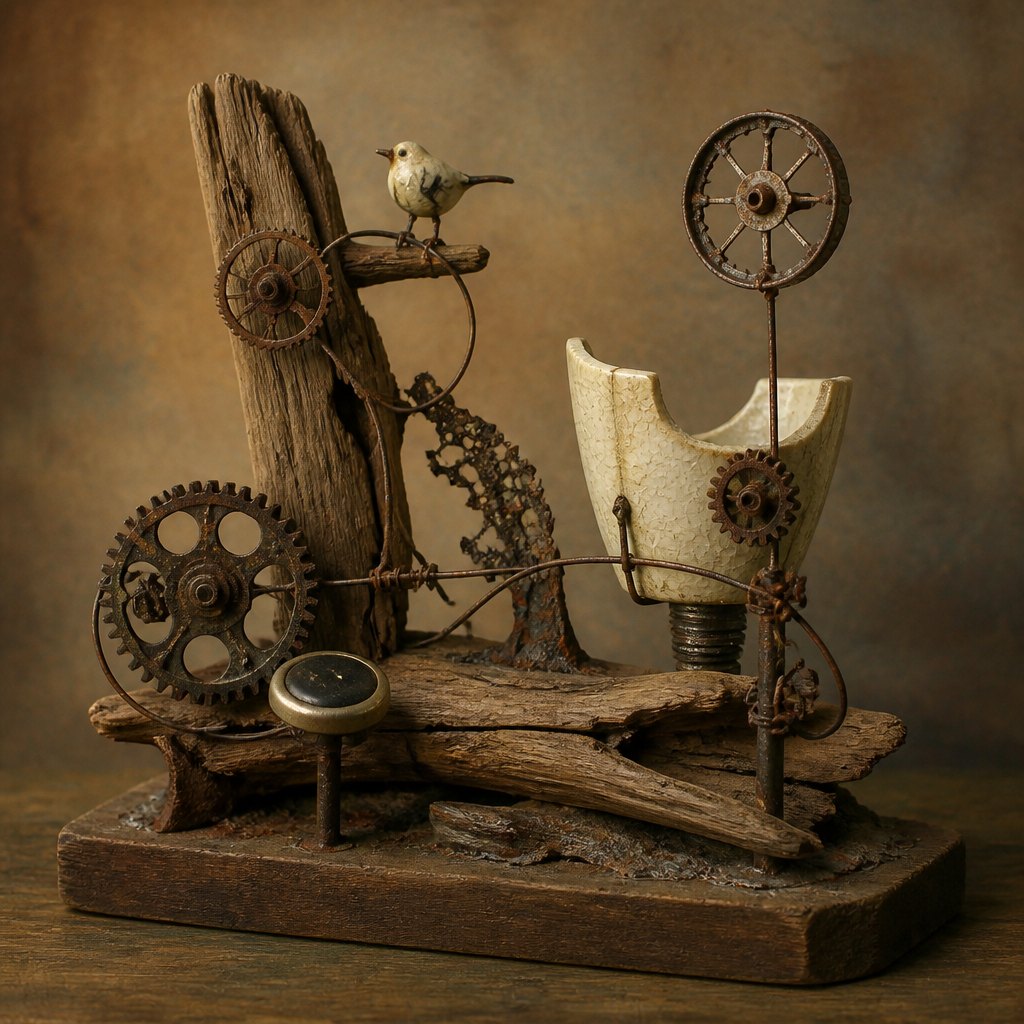 AI-generated
Try the medium
Try found object art with AI
This example was generated from a prompt like: “A tabletop assemblage sculpture built from rusted gears, an old typewriter key, driftwood, and a cracked porcelain cup, wired and glued together on a wooden base, warm studio lighting, weathered textures visible.”
Open the Found Object Art Style generator →The medium today
Found object art continues in environmental sculpture, upcycled art from ocean plastic and e-waste, street assemblage, and museum installations built from salvaged industrial and domestic material. It remains popular for community and educational projects because it requires no specialized fabrication skill, only sourcing, selection, and joining. Contemporary practice often foregrounds sustainability, turning discarded material into a stated part of the work's meaning.
Compose your own
Start by collecting objects with interesting form, texture, or personal history—hardware, packaging, broken toys, natural debris—and keep them sorted where you can see them together. Experiment with low-stakes joining methods first: hot glue, wire, or tape, before committing to epoxy, solder, or screws. Work on composition and negative space the way a sculptor would, and consider how a title or unlikely pairing changes the meaning of the combined objects. A single well-chosen object, presented deliberately, can be as strong as a dense assemblage.
Frequently asked questions
What's the difference between a readymade and assemblage?
A readymade is a single unaltered object presented as art, like Duchamp's mounted bicycle wheel. Assemblage combines multiple found objects into one composite sculpture, joined by glue, wire, or welds.
Do found objects need to be altered to count as art?
No. Many found-object works present objects entirely unchanged; the artistic act is the selection and the new context, such as a pedestal or gallery wall, rather than any physical alteration.
What materials work best for assemblage?
Almost anything durable enough to join: metal, wood, plastic, bone, glass, and packaging are common. Lightweight objects are easier to combine with glue or wire; heavier metal parts often need welding or bolts.
Is found object art the same as recycled art?
They overlap but aren't identical. Found object art values the object's original identity and history for its meaning, while recycled art can prioritize sustainability and material transformation over recognizability.