
Video art treats video technology—cameras, monitors, tape decks, projectors—as an artistic medium in its own right rather than a tool for broadcast television or narrative cinema. Works range from a single monitor playing a short looped tape to sprawling multi-channel installations built from dozens of screens stacked into a wall. Closed-circuit setups feed a live camera image directly to a nearby monitor, letting visitors see themselves delayed or altered in real time. Early practitioners exploited the raw texture of analog video—scan lines, static, feedback, and color distortion—as visual material distinct from film's photographic grain. Editing often relies on abrupt cuts, repetition, and appropriated broadcast footage rather than continuous narrative. Installation matters as much as content: monitor placement, cable visibility, projection scale, and room darkness are all treated as part of the finished work, not just presentation logistics.
What defines the medium
Single-channel versus installation
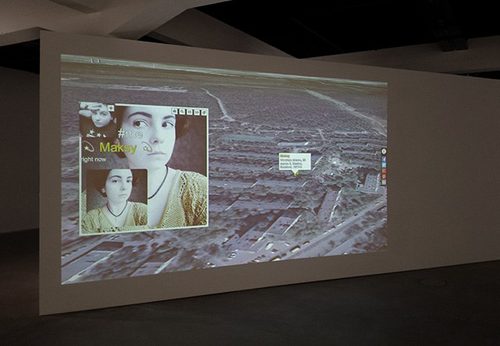
A single-channel work plays on one screen much like a short film, while an installation spreads footage across multiple monitors or projections arranged in space, requiring visitors to move around and choose viewing order.
Closed-circuit feedback
A live camera feeds directly into a nearby monitor with no recording in between, so visitors see themselves reflected, delayed, or distorted in real time, turning the viewer into part of the artwork's content.
Monitor and screen as sculpture
Older works often use the physical CRT monitor itself—its boxy shape, cables, and glow—as a sculptural object stacked or arranged deliberately, not hidden behind a wall or flush projection screen.
Appropriated broadcast footage
Many pieces edit together clips lifted from commercial television, advertising, and news broadcasts, recontextualizing familiar images through rapid cutting, repetition, or slowed playback.
Looping and installed duration
Because gallery visitors arrive at any point, most video art loops continuously on a set cycle rather than following a single fixed screening time, similar to sound installation practice.
Analog texture and glitch
Early video art embraced scan lines, static, tape degradation, and color bleed as expressive visual qualities, treating the technical imperfections of the format as part of its distinct look.
Materials decoder
The toolkit of video art
- CRT monitor
- → a boxy cathode-ray tube screen used both to display footage and as a physical sculptural object stacked in installations
- portable video camera
- → an early handheld recorder that let artists shoot and edit footage outside a broadcast studio for the first time
- video synthesizer
- → electronic hardware that generates or distorts video signal directly, producing abstract color patterns without a camera
- wall projection
- → video enlarged and thrown onto a gallery wall or screen, common in larger-scale contemporary installation work
- scan lines and static
- → the visible horizontal texture and signal noise of analog video, often kept deliberately visible as part of the aesthetic
- closed-circuit camera
- → a live camera wired directly to a nearby monitor, showing visitors a real-time or slightly delayed image of themselves
The story
Video art began with the 1965 release of the Sony Portapak, the first portable video camera and recorder, which let artists work outside broadcast television studios for the first time. In 1969, the exhibition "TV as a Creative Medium" at New York's Howard Wise Gallery became the first US gallery show dedicated entirely to video art, featuring closed-circuit installations that mixed live and delayed camera feeds. Artists through the 1970s built broadcast-style collage works from rapid-cut found and original footage. By 1977, documenta 6 in Kassel included a dedicated video art section, signaling institutional acceptance. The 1980s and 1990s brought larger multi-monitor and projection installations, and the shift from analog tape to digital formats from the 1990s onward reshaped editing, storage, and preservation practices across the field.
Masterpieces of the medium
| Work | Artist | Date | Why it matters |
|---|---|---|---|
| Sony Portapak | Unknown | 1965 | first affordable portable video camera and recorder, enabling independent video art practice |
| TV as a Creative Medium exhibition | Unknown | 1969 | first US gallery exhibition dedicated entirely to video art, held in New York |
| Wipe Cycle | Unknown | 1969 | closed-circuit installation combining live and delayed camera feeds shown at that exhibition |
| Global Groove | Unknown | 1973 | early broadcast-style video collage assembled from rapid-cut found and original footage |
| documenta 6 | Unknown | 1977 | first documenta exhibition to dedicate a section specifically to video art |
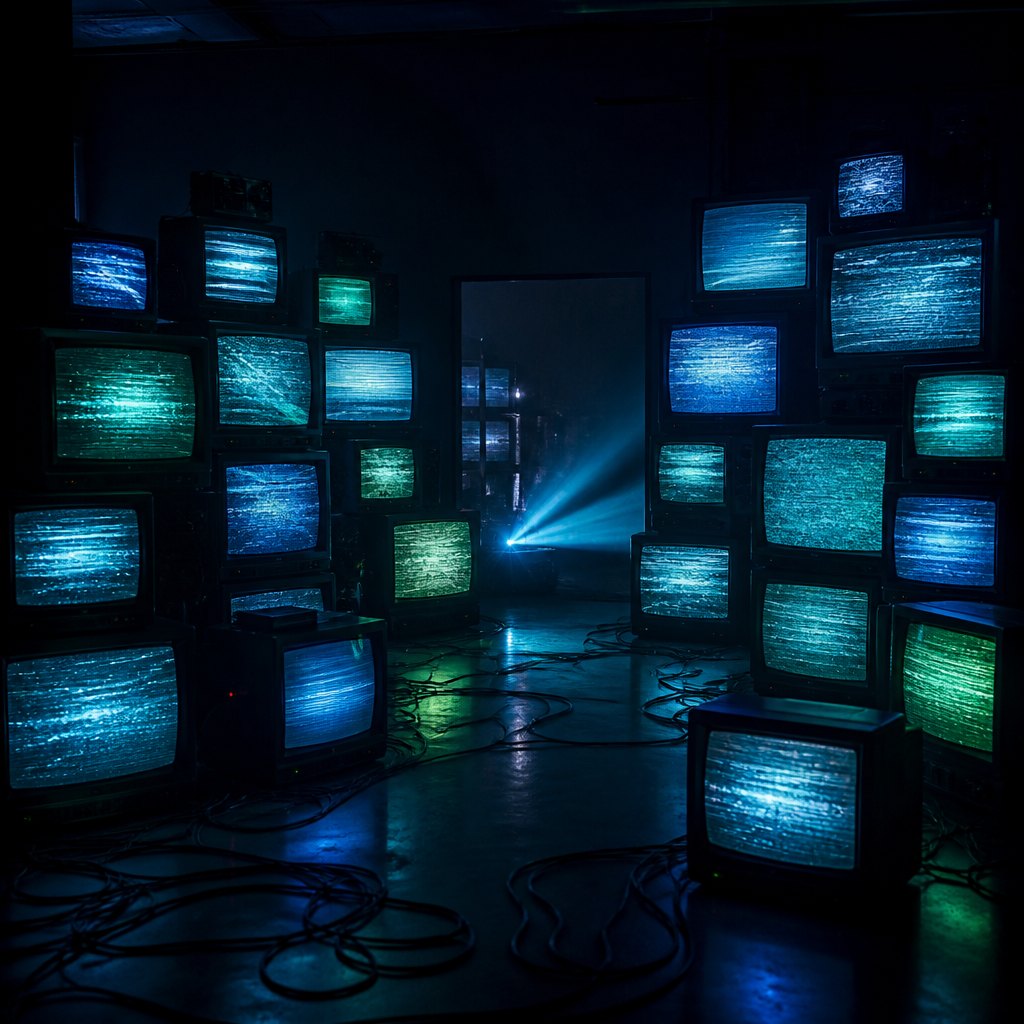 AI-generated
Try the medium
Try video art with AI
This example was generated from a prompt like: “A dark gallery room lined with stacked vintage CRT monitors glowing blue and green, tangled cables visible on the floor, faint static and scan-line texture on each screen, moody projection light, no visible faces.”
Open the Video Art Style generator →The medium today
Video art today spans single-channel works shown on gallery monitors, large-scale projection mapping across building facades, and multi-channel installations with synchronized audio. Museums actively restore and preserve early analog tapes as original playback equipment becomes scarce. Digital cameras and editing software have replaced most analog production, while online platforms let time-based work reach audiences well beyond a gallery's physical walls.
Compose your own
Start with any digital camera or smartphone and basic free editing software to build a short looped sequence rather than a conventional narrative. Study early single-channel works to see how repetition, appropriated footage, and abrupt cuts function differently than in film. Experiment with how a piece is shown—on a single monitor, projected large on a wall, or across several screens—since installation context changes a video's meaning. Consider looping length carefully, since gallery viewers may only watch a fragment at any given moment.
Frequently asked questions
How is video art different from film?
Film is typically made for continuous theatrical or broadcast viewing with a fixed running time. Video art is usually installed in a gallery, often loops indefinitely, and treats the screen or monitor itself as part of a physical, spatial artwork.
What is the difference between single-channel and installation video work?
Single-channel work plays on one screen much like a short film, while installation work spreads footage across multiple monitors or projections, requiring visitors to move through a space to see the whole piece.
Why is older video art hard to preserve?
Analog tape degrades over time and original playback hardware like specific CRT monitors and tape decks becomes scarce, so museums must transfer footage to new formats and sometimes fabricate replacement display equipment.
Do I need expensive equipment to start?
No—a smartphone camera and free editing software cover most beginner projects; the defining qualities of video art come from concept, looping, and installation choices rather than expensive production gear.