
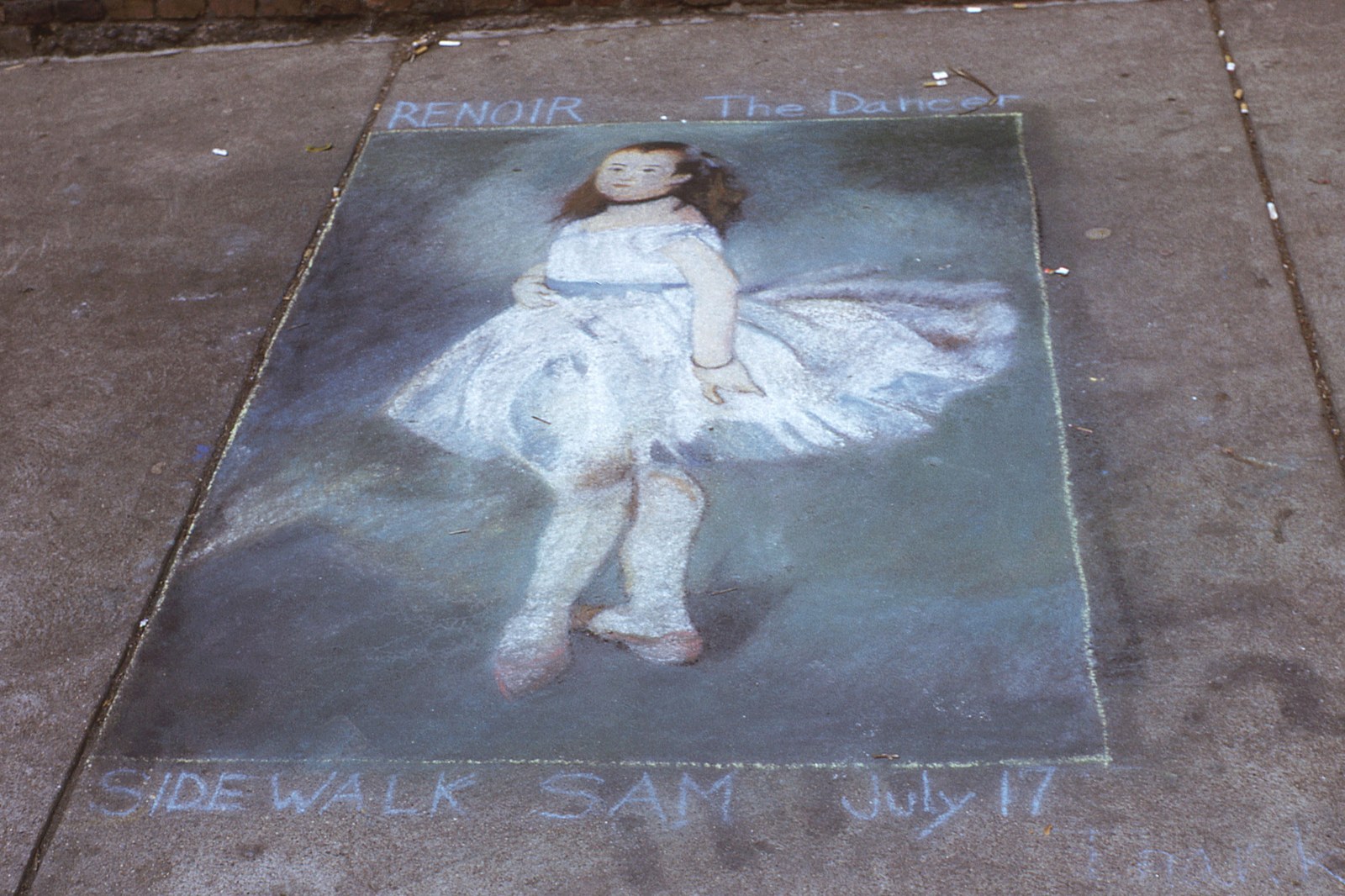
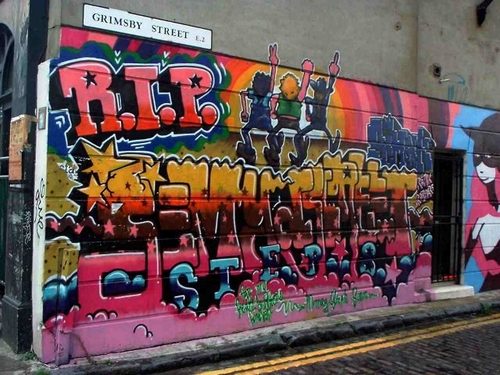
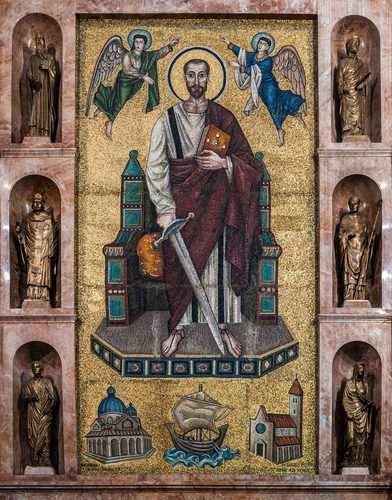
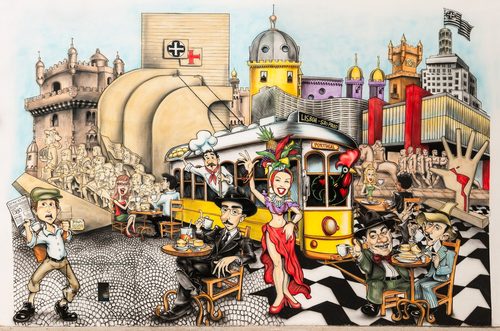
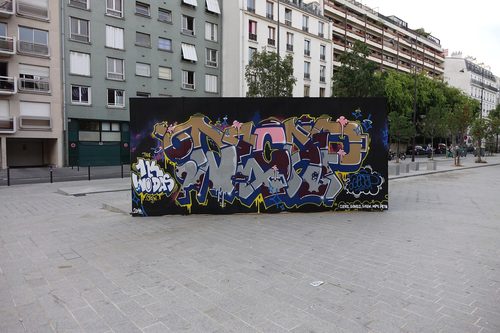
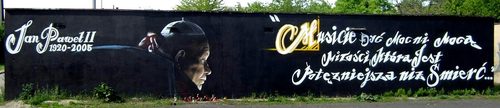
Graffiti art is lettering-based work made with aerosol spray paint or markers on trains, walls, and other public surfaces, produced within a distinct subculture of writers who developed their own vocabulary and visual rules. A tag is the simplest form, a stylized signature applied quickly with a marker or thin spray line. A throw-up is a fast, bubble-lettered outline filled with one or two colors. A piece, short for masterpiece, is the most developed form: large, multicolor lettering built from a pencil sketch or paper blackbook drawing, then scaled up with wide-cap spray cans, outlined, filled, and finished with highlights, drop shadows, and background effects. Wildstyle takes lettering further into interlocking, arrow-heavy forms that are difficult to read by design. Graffiti writers developed alongside train and subway systems, since a painted train car carries a name across a city. The visual signature of graffiti is bold outlined letterforms, dimensional shading, and dense compositions built for maximum visibility from a distance or a moving vehicle.
What defines the medium
Tags, throw-ups, and pieces
Graffiti has a recognized hierarchy of forms: a tag is a quick signature, a throw-up is a fast bubble-lettered fill, and a piece is a large, fully rendered multicolor work built from a planned sketch, each requiring different time and skill.
The blackbook sketch
Writers plan pieces in advance in a blackbook, a sketchbook used to draft letterforms, color combinations, and character designs before ever touching a wall or train, refining a personal style over many pages.
Can control and cap selection
Spray cans are fitted with interchangeable nozzle caps that control line width, from thin caps for outlines and detail to wide fat caps for filling large areas quickly with even coverage.
Outline, fill, and highlight structure
A typical piece is built in stages: a pencil or spray outline defines the letterforms, then flat color fills the interior, followed by highlights, shadows, and background effects like clouds or stars for depth.
Wildstyle lettering
Wildstyle interlocks letters with arrows, spikes, and overlapping forms until the name becomes difficult for outsiders to read, valued within writer culture as a marker of advanced skill.
Trains and walls as canvas
Graffiti developed alongside subway and freight train systems, since a painted car travels and displays a name across an entire city; legal walls and permission walls later gave writers a stable alternative surface.
Materials decoder
The toolkit of graffiti art
- bubble-letter throw-up
- → a fast, rounded lettering style filled with one or two flat colors, prioritizing speed over detail
- wildstyle interlocking letters
- → letters merged with arrows and spikes into a dense, hard-to-read form, a marker of advanced technical skill
- fat-cap fill
- → a wide spray pattern used to fill large lettering areas quickly with smooth, even color coverage
- thin-cap outline
- → a narrow, controlled spray line used for crisp letter outlines and fine detail work
- drop shadow and highlight
- → shaded edges and bright accents added to a piece's letters to give flat spray paint a three-dimensional look
- blackbook sketch
- → a hand-drawn draft of a piece's letterforms and colors, planned on paper before any spray touches a wall
The story
Graffiti writing began on New York City streets and subway cars in the late 1960s and spread rapidly through the 1970s, when writers competed to cover entire subway trains in elaborate, multicolor pieces. Wildstyle lettering developed during this period as writers pushed letterforms into increasingly complex, interlocking shapes. The 1983 documentary Style Wars captured this subway-era culture at its peak, recording writers, trains, and the rivalry between artists and transit authorities. New York's transit authority phased out heavily graffitied trains through aggressive cleaning programs by the late 1980s, pushing the culture onto walls and legal sites. The Bronx's Graffiti Hall of Fame, a schoolyard wall established in 1980, became one of the first sanctioned spaces for large-scale pieces. Berlin's western Wall segments carried extensive graffiti through the 1980s before the wall's fall in 1989. Graffiti writing has since spread globally, maintaining its own competitive, name-based culture wherever it appears.
Masterpieces of the medium
| Work | Artist | Date | Why it matters |
|---|---|---|---|
| New York City subway whole-car pieces | Unknown | 1970s-1980s | elaborate multicolor train paintings that defined graffiti's subway-era golden age |
| Style Wars documentary | Unknown | 1983 | a landmark film documenting New York subway graffiti writers and their culture |
| Graffiti Hall of Fame wall | Unknown | 1980-present | a sanctioned schoolyard wall in East Harlem that became an early legal graffiti site |
| Berlin Wall graffiti | Unknown | 1980s | extensive spray-painted imagery and text covering the wall's western side before 1989 |
| Wildstyle lettering development | Unknown | mid-1970s | interlocking, arrow-heavy letterforms that became graffiti's signature advanced style |
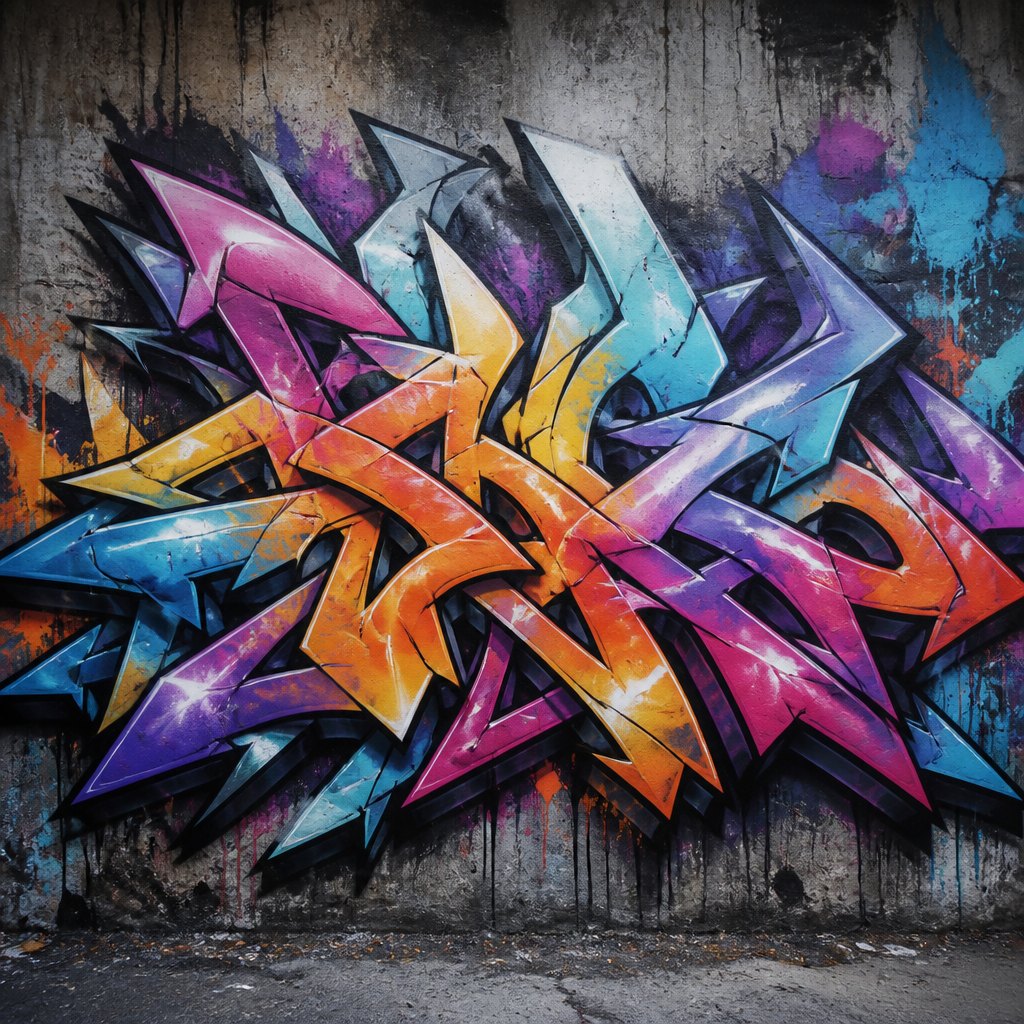 AI-generated
Try the medium
Try graffiti art with AI
This example was generated from a prompt like: “A subway-style graffiti piece in bold wildstyle lettering, interlocking arrows and spikes, multicolor spray-paint fill with drop shadows and highlights, painted across a concrete wall, gritty urban texture.”
Open the Graffiti Art Style generator →The medium today
Graffiti today spans illegal tagging, competitive piece-painting on legal walls, and commissioned murals that draw directly on graffiti's lettering style. Aerosol art festivals now bring writers together for sanctioned large-scale pieces, and graffiti-influenced lettering appears widely in commercial design, fashion, and branding. Photography and video remain central to graffiti culture, since much work is temporary and painted over, and archives of subway-era and wall pieces are preserved largely through documentary photographs rather than the physical works themselves.
Compose your own
Beginners usually start with a blackbook, sketching letterforms and color combinations on paper before ever using spray paint. Practicing on a legal wall or permission-based site avoids the legal risk of unauthorized painting. Basic tools are aerosol cans in a core color palette, with thin caps for outlines and wide fat caps for fills, plus a respirator mask for ventilation. Starting with simple bubble-letter throw-ups builds can control before attempting a full multicolor piece with outline, fill, highlight, and background stages. Studying existing letterforms and visiting legal graffiti walls in person helps beginners learn the style's conventions before developing an individual approach.
Frequently asked questions
What is the difference between a tag, a throw-up, and a piece?
A tag is a quick signature, usually done with a marker or thin spray line in seconds. A throw-up is a fast, bubble-lettered fill in one or two colors. A piece is a fully developed, multicolor work built from a planned sketch and can take hours.
What is wildstyle graffiti?
Wildstyle is an advanced lettering technique that interlocks letters with arrows, spikes, and overlapping shapes until the name is difficult for outsiders to read, developed in New York in the mid-1970s and prized within writer culture as a skill marker.
Is graffiti legal?
It depends on location and permission: painting on property without consent is generally illegal, while legal walls, permission-based sites, and commissioned murals give writers sanctioned spaces to work without legal risk.
Why do fat caps and thin caps matter?
Spray can nozzle caps control line width and paint flow. Thin caps give controlled, narrow lines for outlines and detail, while fat caps release a wider spray pattern that fills large lettering areas quickly and evenly.