
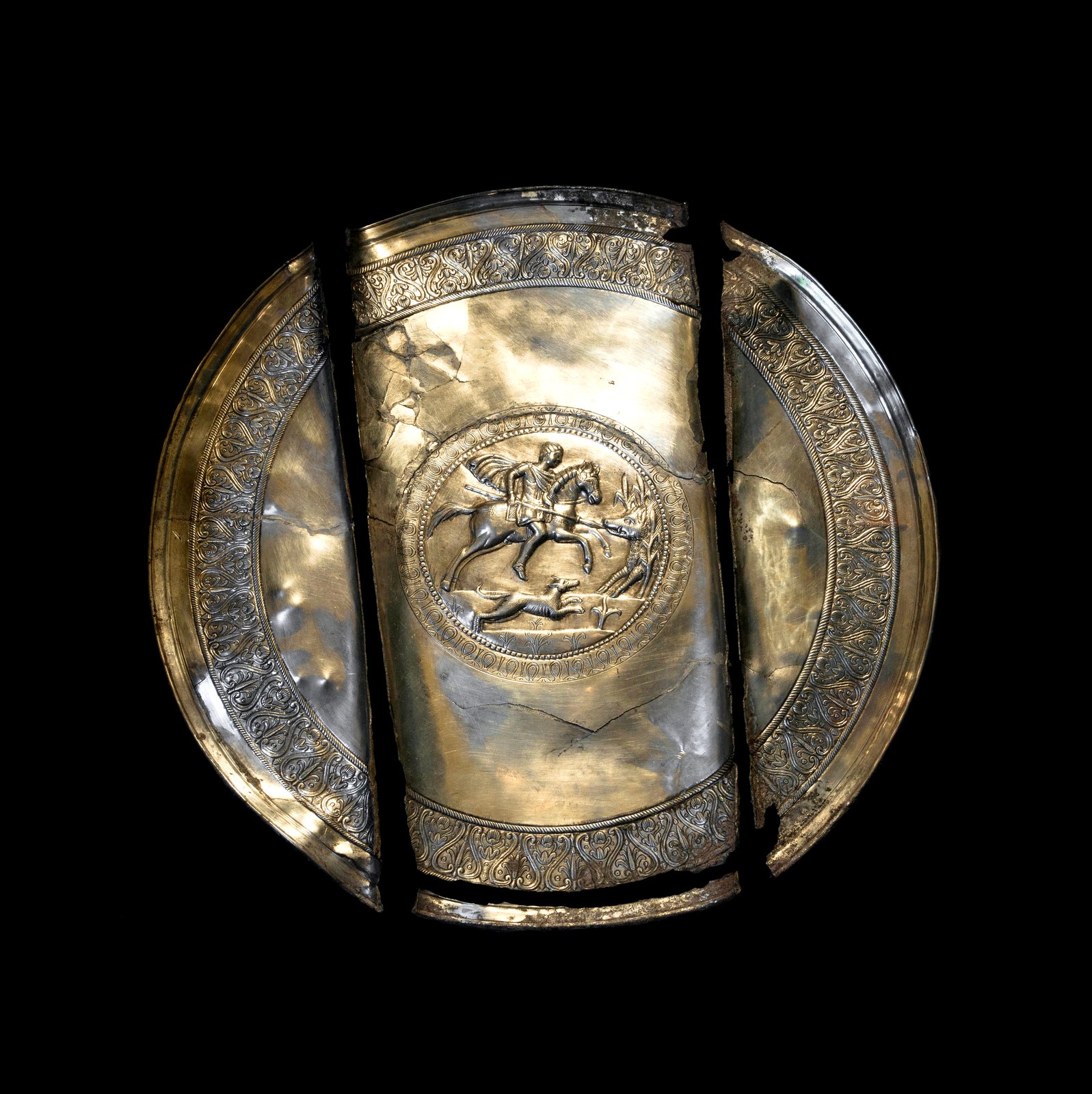
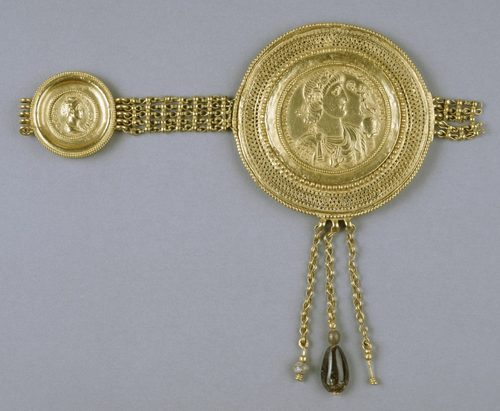
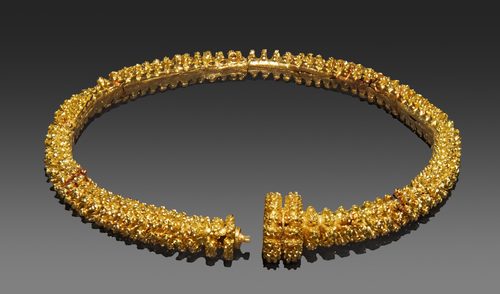
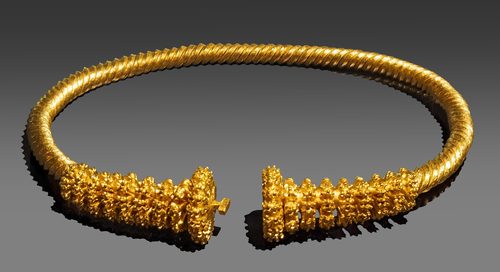
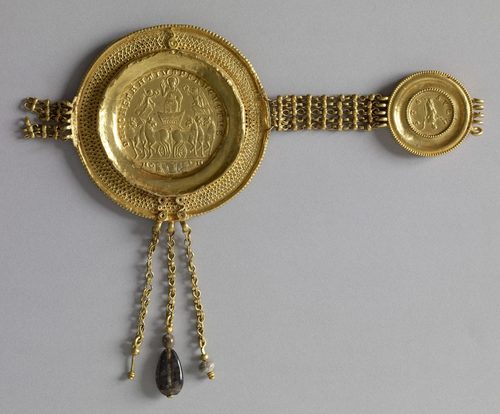
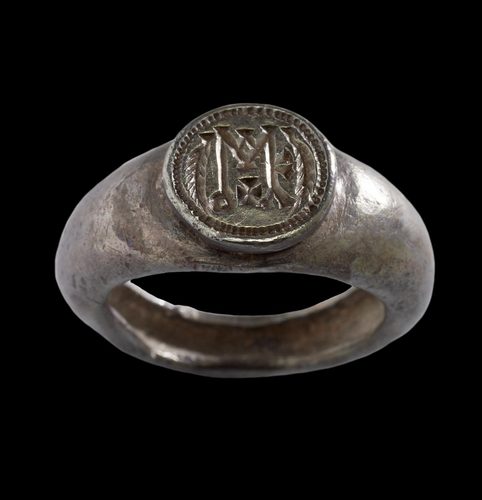
Jewelry art is the shaping of metal, gemstone, and other precious material into wearable ornament. Gold, silver, and platinum form the base, worked by casting molten metal in a mold, hand-fabricating from sheet and wire with a saw and torch, or a combination of both. Gemstones and pearls are held in place with settings—bezels that wrap a rim around the stone, prongs that grip it with metal claws, or pavé, where many small stones sit close together in a field of tiny beads. Enamel adds color by fusing powdered glass to metal in a kiln. Surface decoration includes engraving, filigree (fine soldered wirework), and repoussé, hammering a design up from the back of a sheet. Findings—clasps, hinges, and pin backs—are the functional hardware that make a piece wearable. The final look ranges from the fine, lace-like wire of filigree brooches to the bold, faceted stones and clean settings of modern rings.
What defines the medium
Metal purity and karat
Gold jewelry is marked by karat, indicating what fraction of the metal is pure gold versus alloy; 24 karat is pure, while 14 or 18 karat mixes in other metals for strength. Hallmark stamps certify this purity.
Stone-setting styles
Bezel settings wrap a metal rim fully around a stone for security, prong settings use claws to expose more of the stone to light, and pavé settings cover a surface with many small stones set close together.
Casting versus fabrication
Lost-wax casting pours molten metal into a mold made from a carved wax model, good for complex repeated shapes. Fabrication builds a piece by hand from sheet and wire, cutting, soldering, and shaping each part directly.
Enamel and surface color
Enamel work fuses powdered colored glass to metal in a kiln, producing durable, glossy color fields, either flooded into engraved compartments (cloisonné) or held by wire outlines soldered onto the surface.
Findings and hardware
Clasps, jump rings, pin backs, and earring posts are functional metal components soldered or attached last. They must be strong and comfortable, since they bear the physical stress of daily wear.
Designing for the body
Scale, weight, and edge finishing are worked out with wear in mind—rings must fit a finger comfortably, necklaces must drape correctly, and no sharp edge should catch on skin or fabric.
Materials decoder
The toolkit of jewelry-art
- gold
- → a soft, malleable precious metal marked by karat purity, the traditional base metal of fine jewelry
- filigree
- → fine wire twisted and soldered into lace-like openwork patterns, common in traditional gold jewelry
- bezel setting
- → a metal rim wrapped fully around a gemstone to hold it flush and protect its edges
- prong setting
- → slender metal claws gripping a stone at points, exposing more surface to light for brilliance
- enamel
- → powdered glass fused to metal in a kiln, producing smooth, glossy, permanent color
- hallmark stamp
- → a tiny stamped mark certifying metal purity, maker, or place of manufacture on finished jewelry
The story
Jewelry making dates to ancient Egypt, where goldsmiths worked gold with lapis lazuli and carnelian into collars and funerary ornaments by 2600 BCE. Mesopotamian and Etruscan goldsmiths refined granulation, fusing tiny gold beads into fine surface patterns, by the first millennium BCE. Medieval European jewelry centered on reliquaries and gem-set religious ornament, while Renaissance goldsmith guilds standardized apprenticeship and craft technique across Europe. In 1912, workers in London unearthed the Cheapside Hoard, a cache of Jacobean-era jewelry buried around 1600s, now held at the Museum of London. Peter Carl Fabergé's workshop produced jeweled Imperial Easter Eggs for the Russian court between 1885 and 1917. The early 20th century brought Art Nouveau's flowing enamel and gem work followed by Art Deco's geometric platinum and diamond designs, shaping much of jewelry's modern vocabulary.
Masterpieces of the medium
| Work | Artist | Date | Why it matters |
|---|---|---|---|
| Mask of Tutankhamun | Unknown | c. 1323 BCE | gold funerary mask inlaid with lapis lazuli, carnelian, and colored glass |
| Cheapside Hoard | Unknown | c. early 17th century | cache of Jacobean-era gem-set jewelry unearthed in London in 1912 |
| Imperial Easter Eggs | Peter Carl Fabergé | 1885-1917 | jeweled and enameled eggs made for the Russian imperial court |
| Imperial State Crown | Unknown | 1937 (current setting) | gold crown set with thousands of gemstones, part of the British Crown Jewels |
| Egyptian broad collar necklace | Unknown | c. 1981-1802 BCE | Middle Kingdom gold and faience collar found in royal burial contexts |
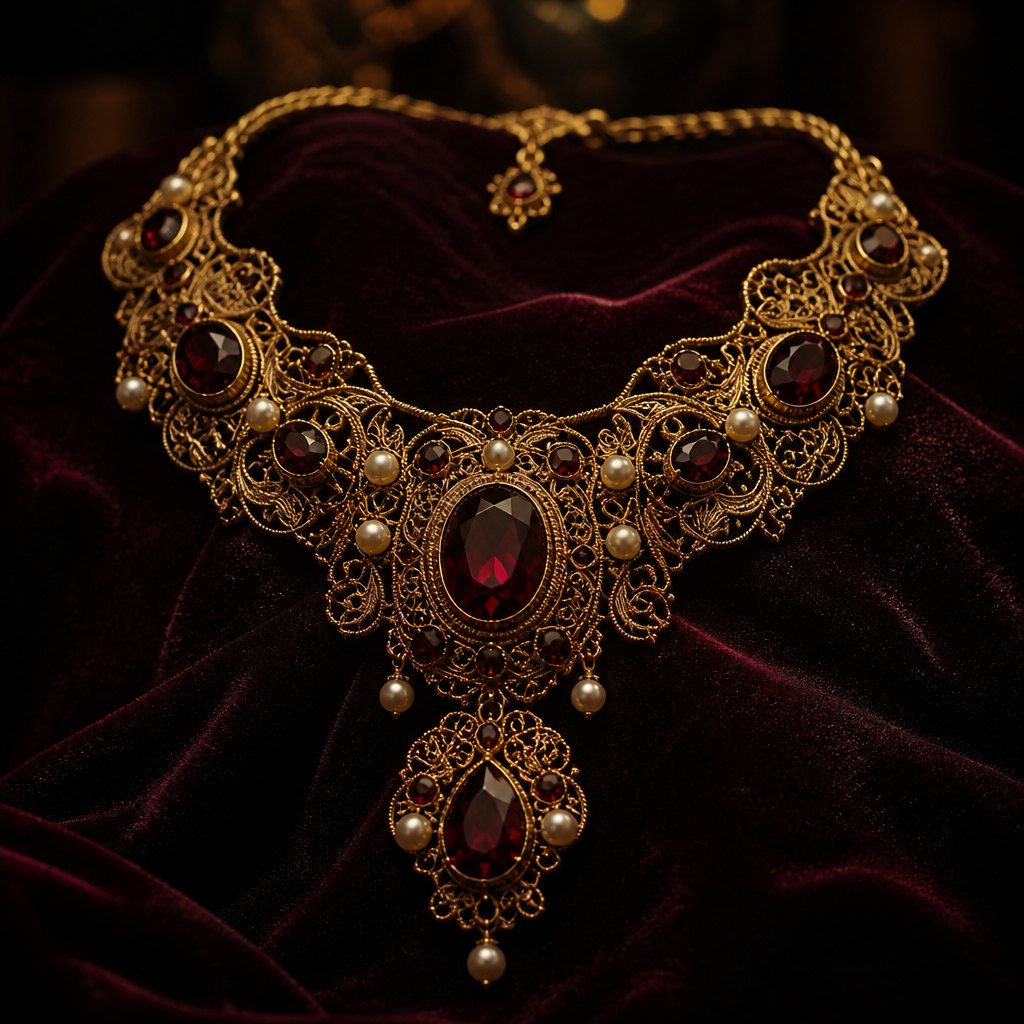 AI-generated
Try the medium
Try jewelry-art with AI
This example was generated from a prompt like: “An ornate antique gold necklace set with deep red garnets and small pearls, displayed on dark velvet under soft museum spotlighting, fine filigree wirework catching the light, richly detailed metal texture.”
Open the jewelry-art Art Style generator →The medium today
Contemporary jewelry making spans traditional hand-fabrication in gold and silver, mass production using CAD design and 3D-printed casting patterns, and growing use of lab-grown diamonds and recycled metal. Studio jewelers continue hand techniques like filigree and stone-setting, while larger workshops use computer-aided design for precise, repeatable pieces. Museums maintain active decorative-arts collections of historic jewelry, and mixed-material work combining metal with resin, textile, or found objects has expanded the field beyond precious-metal traditions alone.
Compose your own
A beginner starts with base metals like copper or silver-plated wire, learning to cut, bend, and wrap wire around beads or simple stones without soldering. Basic tools include flush cutters, round-nose pliers, and a jeweler's saw. The next step is simple bezel setting in sterling silver sheet, cut and shaped by hand, then soldered with a small torch. From there, casting, stone faceting knowledge, and enamel work build on the same core skills of cutting, joining, and finishing metal precisely.
Frequently asked questions
What does karat mean in gold jewelry?
Karat measures gold purity out of 24 parts; 24 karat is pure gold, while 18 or 14 karat mixes in other metals like copper or silver for added strength and altered color.
What is the difference between a bezel and a prong setting?
A bezel setting wraps a continuous metal rim around a stone for security and a smooth edge, while a prong setting uses separate metal claws that expose more of the stone's surface to light.
How is lost-wax casting used in jewelry?
A design is carved or 3D-printed in wax, then encased in plaster; the wax is melted out, leaving a cavity that molten metal fills, producing an exact metal copy of the original wax model.
What is filigree?
Filigree is fine metal wire twisted and soldered into intricate, lace-like patterns, historically used to create lightweight, decorative surfaces on rings, earrings, and brooches.