
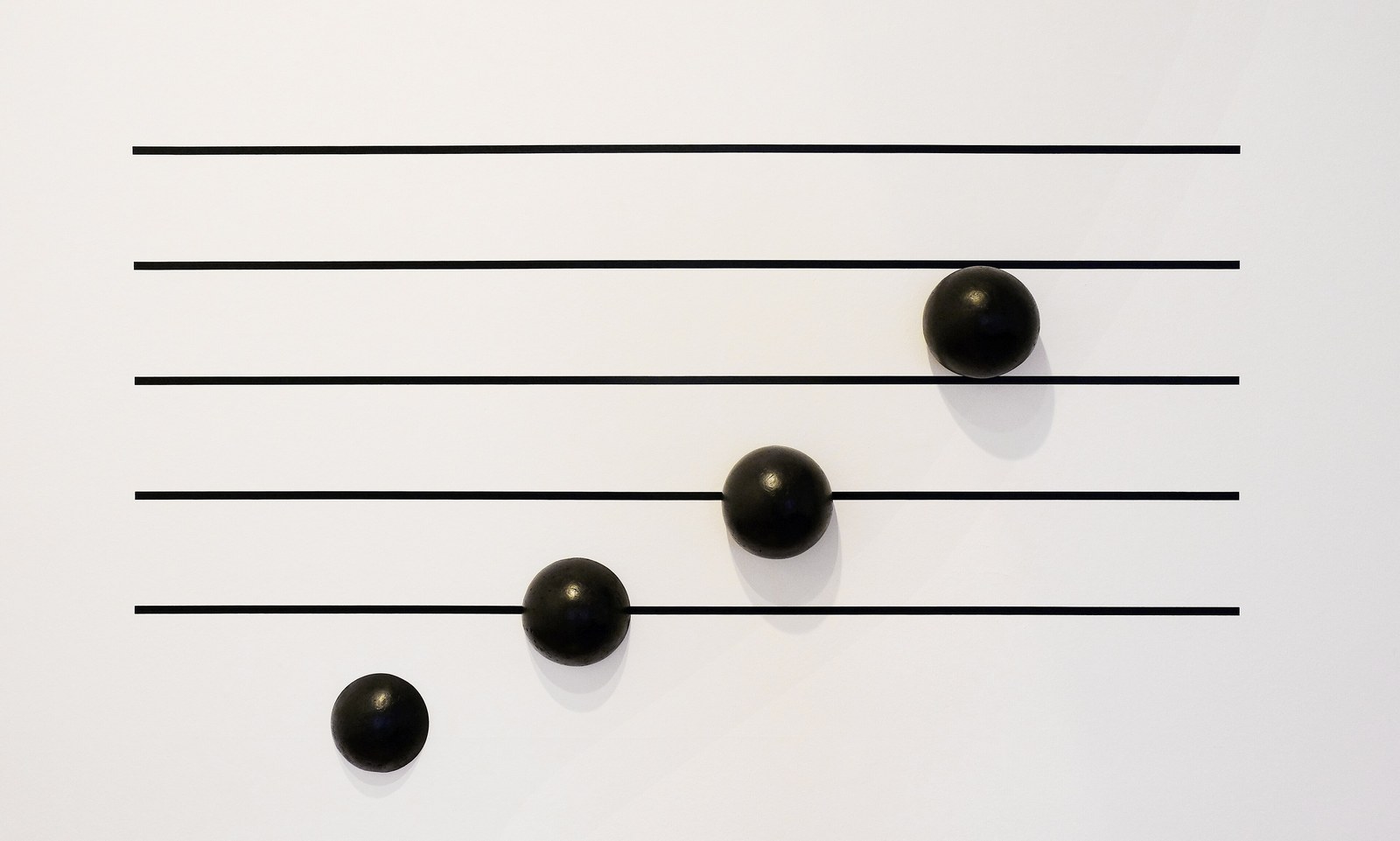
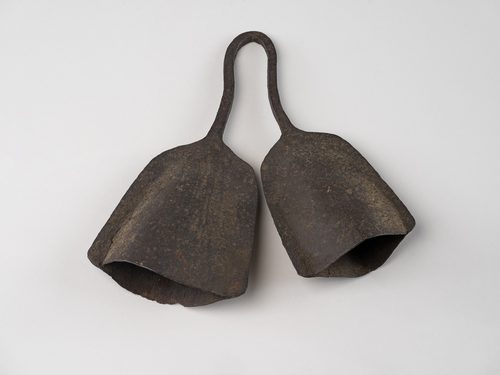
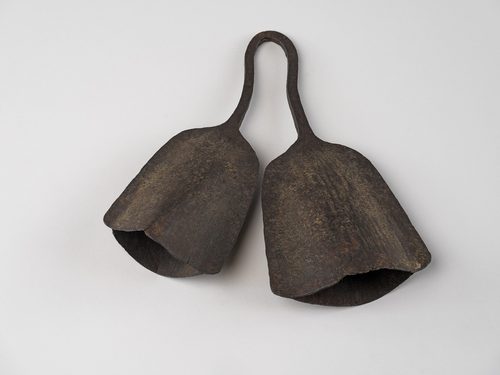
Sound art uses audible phenomena as its primary material rather than as accompaniment to an image or musical score. Practitioners shape field recordings, synthesized tones, feedback, amplified vibration, and found audio using microphones, contact mics, oscillators, tape loops, and multichannel speaker arrays. Unlike a concert, a sound art piece is usually installed in a specific space—a gallery room, a stairwell, a subway grate, a public plaza—so that architecture, echo, and visitor movement become part of the composition. Some works stay silent until touched or triggered; others loop continuously. Sound art overlaps with sculpture when speakers or resonating materials form a visible object, and with conceptual art when the piece is really an idea about listening. It abandons the concert hall's fixed seating and duration for open-ended, spatial listening that visitors enter and leave at will.
What defines the medium
Site-specific tuning
A sound piece is often composed for one particular room, using its echo, reverberation, and dimensions as instruments in their own right. Moving the same speakers to a different space can change the work entirely, so installation is rarely reproducible elsewhere unchanged.
Field recording as raw material
Many works begin outside the studio, capturing traffic, weather, machinery, or crowds on portable recorders. These recordings are edited, layered, or left largely untouched and presented as documents of a specific place and moment in time.
Multichannel speaker placement
Rather than a single stereo pair, installations often use many speakers positioned around a room so sound moves, overlaps, or surrounds listeners physically. Speaker placement is planned as carefully as pigment placement in a painting.
Looping and open duration
Because visitors arrive and leave at any moment, most sound art loops on a cycle or runs continuously rather than following a fixed start and end like a concert. There is no correct moment to begin listening.
Sound fused with object
Sound sculptures pair audible output with a visible resonating body—a vibrating sheet of metal, a stretched wire, a rotating disc—so the source of the sound is part of what is looked at, not hidden behind a stage curtain.
Documentation as record
Because installations are often temporary, photographs, stereo or multichannel recordings, and technical diagrams become the lasting record of a piece, similar to how documentation preserves performance art after an exhibition closes.
Materials decoder
The toolkit of sound art
- contact microphone
- → a small transducer clipped or taped directly to an object to pick up its internal vibrations rather than airborne sound
- multichannel speaker array
- → several speakers positioned around a room to move sound spatially instead of from one fixed point
- oscillator or tone generator
- → an electronic device producing pure, adjustable tones, common in works built from synthesized rather than recorded sound
- reel-to-reel tape loop
- → a physical loop of magnetic tape that repeats a fixed phrase, a staple of early experimental sound composition
- resonant metal or wire
- → a vibrating physical object—sheet metal, stretched string—used as both sound source and sculptural form
- acoustic foam panels
- → wedge-shaped foam lining a room to dampen echo, signaling a piece built for controlled, isolated listening
The story
Sound art's roots reach back to the Italian Futurists, whose Intonarumori noise machines, built by Luigi Russolo from 1913, generated industrial sounds for staged performances. Mid-century composers pushed the idea further: musique concrète, developed in Paris from 1948, composed music entirely from recorded and manipulated sounds rather than notated instruments, and the 1958 Brussels World's Fair featured a landmark multichannel speaker installation inside the Philips Pavilion. From the 1960s, artists began installing sound in galleries and public sites rather than concert halls, using tape, feedback, and site recordings. By the 1980s and 1990s, museums and biennials began treating sound installation as a distinct exhibition category alongside sculpture and video, a status it holds firmly today across major international shows.
Masterpieces of the medium
| Work | Artist | Date | Why it matters |
|---|---|---|---|
| Intonarumori (Noise Intoners) | Luigi Russolo | 1913 | wooden hand-cranked machines built to generate industrial and mechanical noise for staged performance |
| Poème électronique, Philips Pavilion | Unknown | 1958 | multichannel speaker installation composed for the Brussels World's Fair pavilion |
| I Am Sitting in a Room | Unknown | 1969 | tape composition built by re-recording spoken text in the same room until only resonance remains |
| Times Square | Unknown | 1977 | underground sound installation heard continuously through a New York subway grate |
| Sonic Boom exhibition, Hayward Gallery | Unknown | 2000 | first major United Kingdom survey exhibition dedicated entirely to sound art |
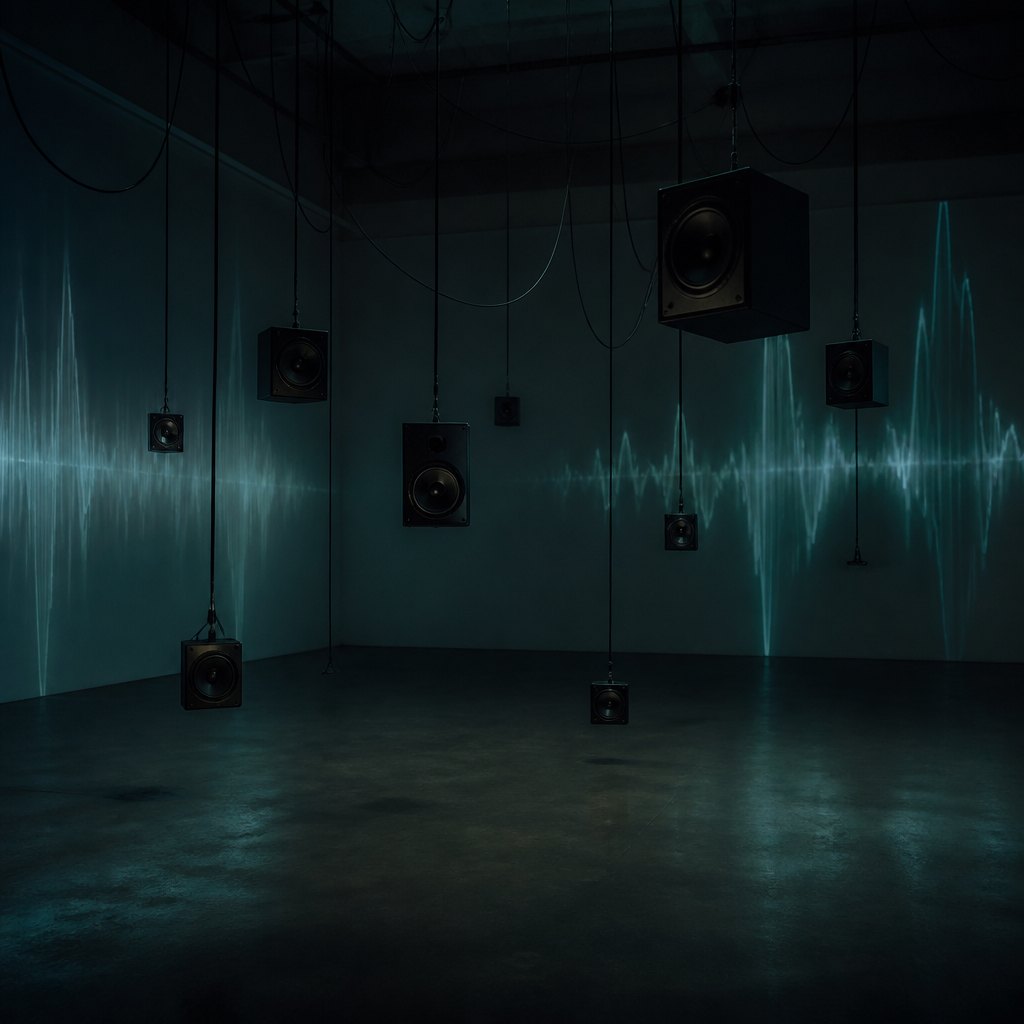 AI-generated
Try the medium
Try sound art with AI
This example was generated from a prompt like: “A dark gallery room with a scattered array of hanging speakers and thin cables, faint waveform patterns projected on the walls, dim blue-green ambient light, minimal empty floor space, quiet documentary photography style.”
Open the Sound Art Style generator →The medium today
Sound art today appears in museum galleries, public parks, and biennials, often built from field recordings, generative software, or environmental data translated into audible frequency. Headphone-guided sound walks let visitors carry an installation through a city street. Binaural and multichannel recording lets galleries reproduce three-dimensional listening at home. Archives now preserve early tape and speaker works alongside new pieces built from algorithmic and networked audio systems.
Compose your own
Start with a phone recorder or an inexpensive contact microphone and capture ordinary sounds—traffic, appliances, footsteps. Load recordings into free editing software and experiment with looping, layering, and slowing them down. Test playback through different spaces, since a hallway or stairwell changes a recording's character entirely. Rather than aiming for music, focus on how a listener moves through and experiences sound over time, and consider pairing speakers with a simple physical object so the sound source is visible.
Frequently asked questions
How is sound art different from music?
Music is typically composed for concert performance with a fixed start and end. Sound art is usually installed in a specific space, often loops indefinitely, and treats listening itself as a spatial, gallery-based experience rather than a scheduled event.
What equipment do I need to start?
A basic recorder or smartphone, a contact microphone for capturing vibration, and free audio editing software cover most beginner projects. Speakers and an amplifier become necessary once a piece moves from headphones to an installed room.
Can a sound art piece be silent for periods of time?
Yes—many works only produce sound when triggered by a visitor's movement or touch, or run on an irregular cycle with long silent gaps built deliberately into the composition.
How do museums collect and preserve sound installations?
Museums typically retain the recordings, speaker specifications, and installation instructions rather than a single fixed object, allowing a piece to be reinstalled accurately in a future exhibition space.