
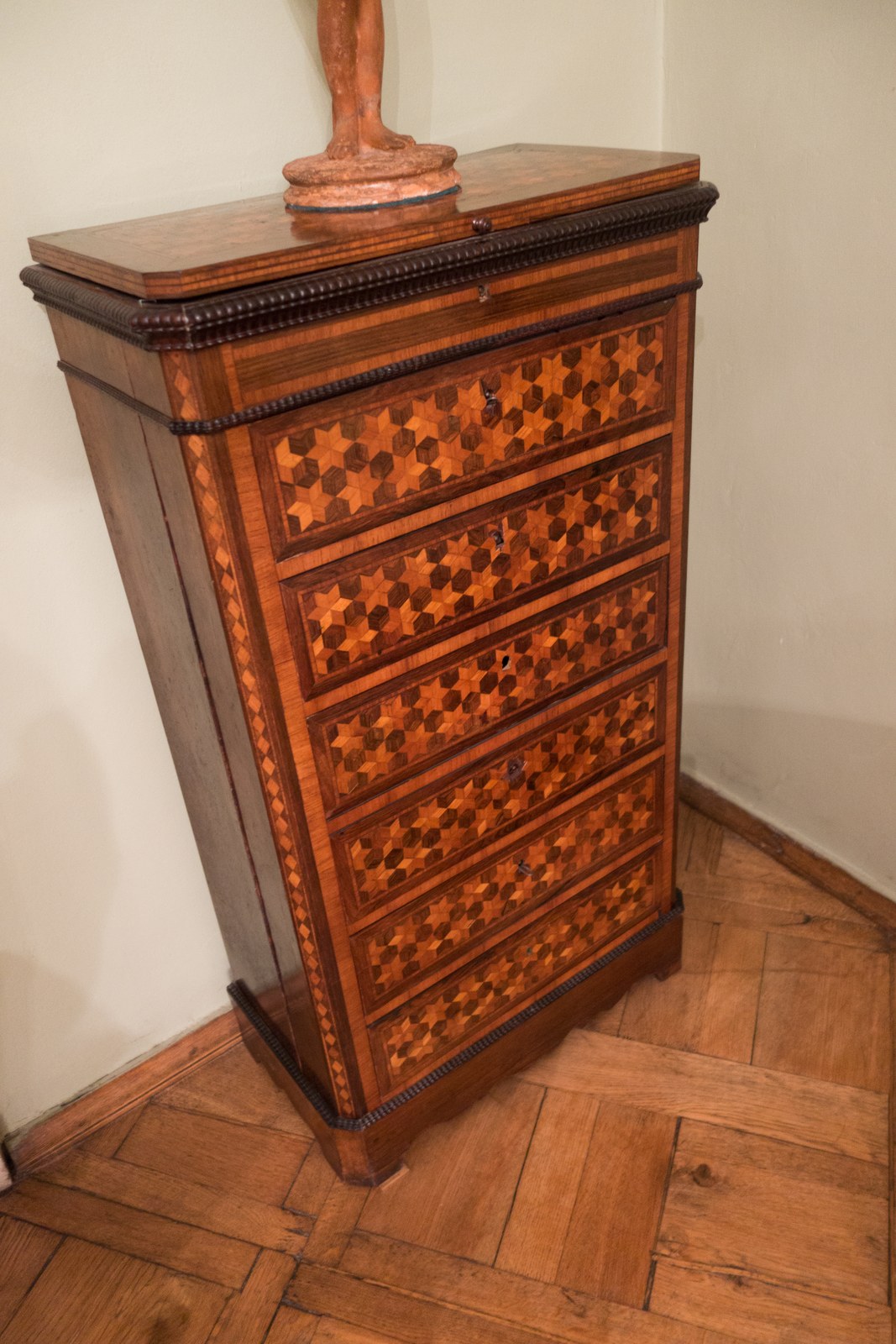
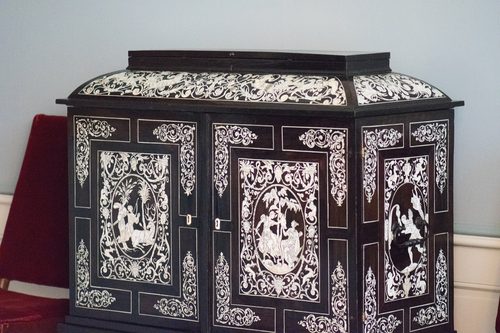
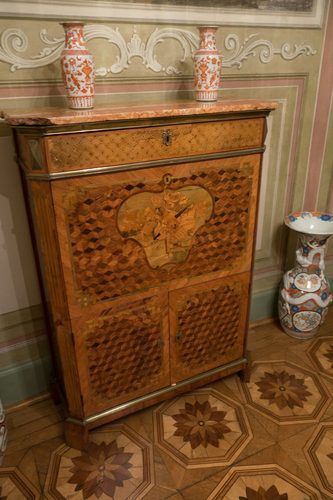
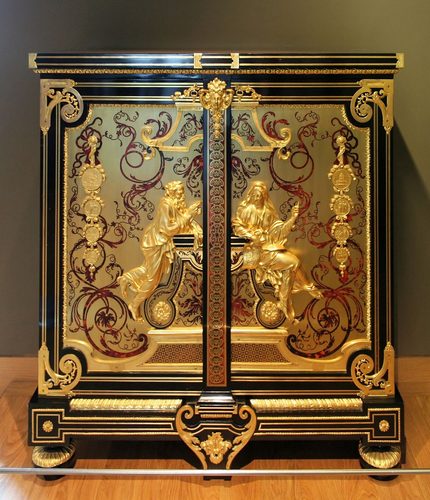
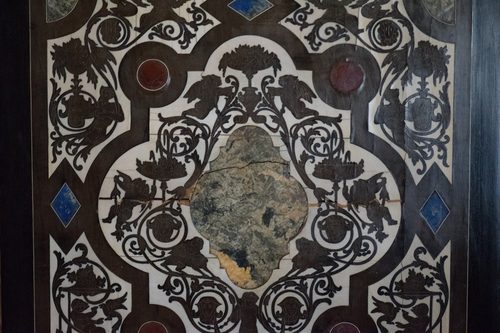
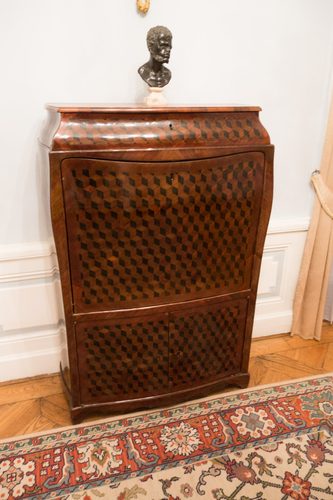
Marquetry is the craft of applying thin sheets of wood veneer, and sometimes shell, metal, or tortoiseshell, onto a solid structure to build decorative patterns or pictorial scenes. Unlike carving, which removes material, marquetry adds a mosaic of cut pieces edge to edge across a flat surface—tabletops, cabinet doors, chest fronts. Craftspeople stack several veneers together and cut through them at once with a fine-toothed fret saw or scroll saw, producing matching pieces that interlock like a jigsaw. Different wood species supply natural color and grain: pale sycamore, dark ebony, reddish kingwood, figured burls. Some marquetry, developed by André-Charles Boulle in seventeenth-century France, pairs brass and tortoiseshell rather than wood. Once cut, pieces are glued to a backing panel, leveled, scraped, and polished with shellac or wax so the inlay sits flush with the surrounding surface. The finished panel reads as flat, seamless color and pattern rather than raised relief.
What defines the medium
The double-cutting method
Two contrasting veneers are taped together and sawn as one, so every cut yields a matched pair—one piece for the pattern, one for the background—guaranteeing a tight, gap-free fit between pieces.
Sand shading
To suggest curved petals, leaves, or drapery, cut veneer edges are pressed into hot sand until the wood scorches gradually, creating a soft graduated tone that mimics shadow without paint or stain.
Choosing veneer for color
Species are chosen for natural hue and grain rather than dye: pale sycamore or holly for highlights, dark ebony or stained pear for shadow, figured burl or oyster-cut branch wood for pattern.
Boulle technique
Developed for royal furniture, Boulle marquetry layers brass sheet and tortoiseshell instead of wood, sawn together so one furniture piece receives the brass-ground panel and another the shell-ground twin.
Gluing and pressing
Assembled veneer panels are glued to a solid or plywood ground and clamped under a veneer press or with cauls and weights so the thin inlay bonds flat without air pockets or later lifting.
Leveling and finishing
Once bonded, the surface is scraped and sanded flush across every joint, then polished with shellac, wax, or French polish, which brings out grain contrast and seals the assembled mosaic.
Materials decoder
The toolkit of marquetry
- fret saw / scroll saw
- → a fine-toothed saw for cutting thin veneer sheets into intricate matching shapes, often through a stack of several layers at once.
- veneer knife
- → a straight or curved blade for slicing veneer along a straightedge, leaving a cleaner edge than sawing for simple geometric inlay.
- sand-shaded gradient
- → a smoothly darkened edge on a veneer piece, burned in hot sand to fake curved shadow on petals, drapery, or fruit.
- brass-and-tortoiseshell inlay
- → the signature material pairing of Boulle marquetry, metal and shell cut together to form mirror-image furniture panels.
- burl or oyster-cut veneer
- → a swirling, knotted grain pattern sliced from a tree burl or branch cross-section, prized for its natural decorative chaos.
- veneer press marks
- → faint tell-tale flatness and hairline joints where individual pieces meet, visible on close inspection of a finished panel.
The story
Marquetry grew from intarsia, the geometric wood inlay practiced in ancient Rome and revived in fourteenth and fifteenth-century Italy, where craftsmen in Siena and Florence fitted solid wood pieces into recessed panels for choir stalls and studies, including the celebrated studiolo of Federico da Montefeltro in Gubbio. The technique shifted from inlaying solid wood into a carved recess to layering thin sawn veneer onto a flat ground during the sixteenth century in Antwerp and Paris. André-Charles Boulle, cabinetmaker to Louis XIV, perfected a version using brass and tortoiseshell in the late seventeenth century, producing furniture still called Boulle work. Eighteenth-century French ébénistes such as Jean-Henri Riesener and German-born David Roentgen created elaborate pictorial and floral marquetry for royal courts. English cabinetmakers adapted the technique through the Georgian period, and Art Deco designers in the 1920s revived exotic veneer marquetry on sleek cabinet forms.
Masterpieces of the medium
| Work | Artist | Date | Why it matters |
|---|---|---|---|
| Studiolo of Federico da Montefeltro | Unknown | c. 1478-1482 | intarsia wood paneling with trompe l'oeil shelving and objects |
| Bureau du Roi | Jean-Henri Riesener | 1769 | elaborate marquetry writing desk made for Louis XV |
| Boulle commode | André-Charles Boulle | c. 1700-1710 | brass and tortoiseshell marquetry on a royal court commode |
| Roentgen secretary cabinet | David Roentgen | c. 1780 | pictorial marquetry cabinet combined with hidden mechanical fittings |
| Marquetry cabinet | Émile-Jacques Ruhlmann | 1920s | Art Deco cabinet in exotic veneers with geometric pattern |
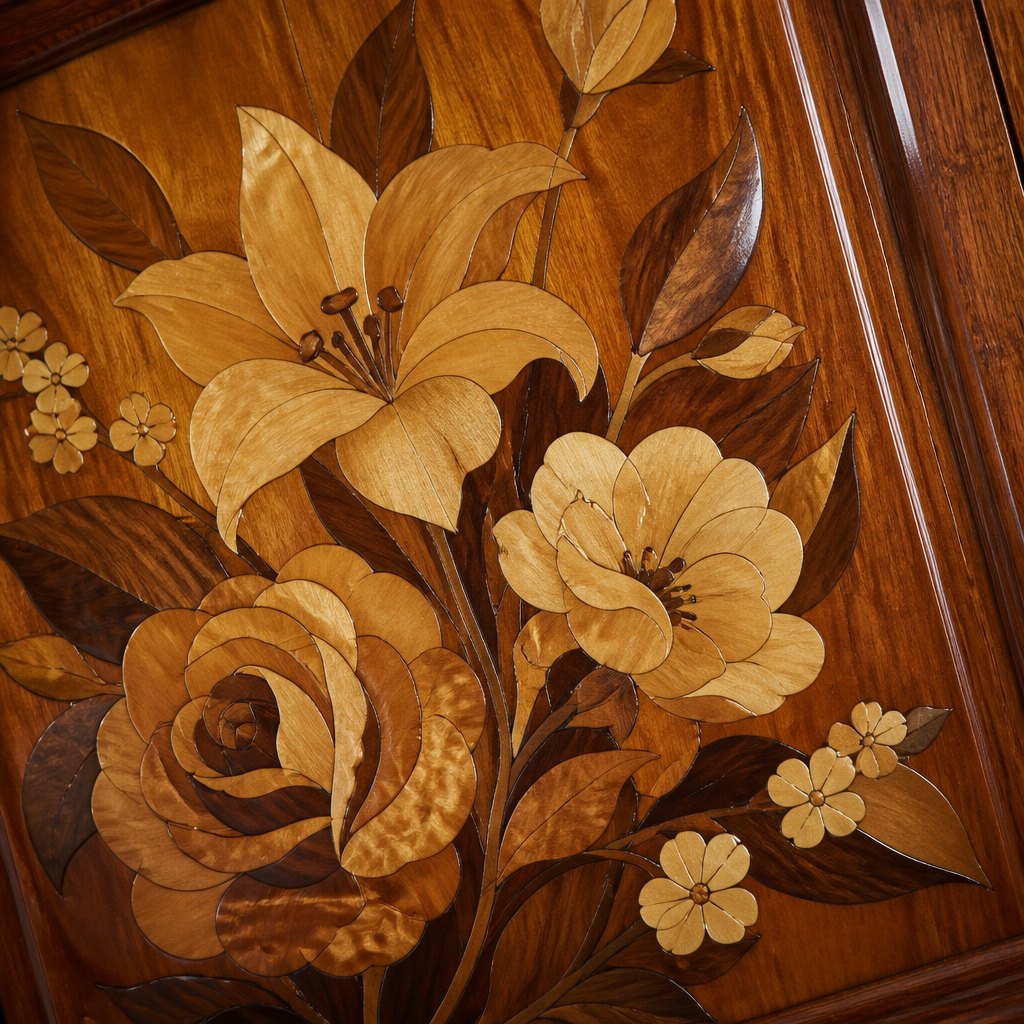 AI-generated
Try the medium
Try marquetry with AI
This example was generated from a prompt like: “A cabinet door inlaid with marquetry veneer showing a bouquet of flowers in contrasting light and dark woods, sand-shaded petals, glossy shellac finish, warm honey and walnut tones, close macro detail of the joins.”
Open the Marquetry Art Style generator →The medium today
Marquetry survives today mainly through furniture conservation, restoration workshops, and specialist cabinetmaking schools that train new veneer cutters using the same fret saws and sand-shading methods developed centuries ago. High-end furniture makers and restoration studios still produce Boulle-style brass and tortoiseshell work for period reproductions and museum conservation. Contemporary hobbyists work at smaller scale, applying marquetry to jewelry boxes, guitar bodies, and wall panels, often using a scroll saw or laser cutter instead of a hand fret saw to cut veneer patterns.
Compose your own
Beginners start with a simple geometric pattern rather than a pictorial scene, using two contrasting veneers taped together and cut with a hand fret saw or a jeweler's coping saw. A cutting board with a slotted bird's mouth support holds the work steady while sawing along traced lines. After cutting, pieces are test-fitted, glued to a plywood backing with woodworking glue, and pressed flat under weights or in a veneer press overnight. Once dry, the surface is scraped level with a cabinet scraper, sanded through several grits, and finished with shellac or oil to bring up color contrast between species. Practicing straight-line geometric borders before attempting curved floral designs builds the saw control marquetry demands.
Frequently asked questions
What is the difference between marquetry and intarsia?
Intarsia inlays solid pieces of wood directly into a carved recess in a panel, while marquetry assembles thin sawn veneers into a pattern first, then glues the whole assembled sheet onto a flat backing.
What woods are used in marquetry?
Any veneer-cuttable species works; common choices include sycamore and holly for pale tones, ebony and stained pear for dark accents, and burl, satinwood, or kingwood for figured pattern and color.
How is shading created without paint?
Cut veneer edges are pressed into hot sand until they scorch gradually, producing a soft graduated tone that reads as shadow or curvature on leaves, drapery, or fruit without any added pigment.
Is marquetry still used on new furniture?
Yes, though less commonly than in past centuries; specialist cabinetmakers and restoration studios still apply veneer marquetry to reproduction furniture, musical instruments, and decorative boxes.