
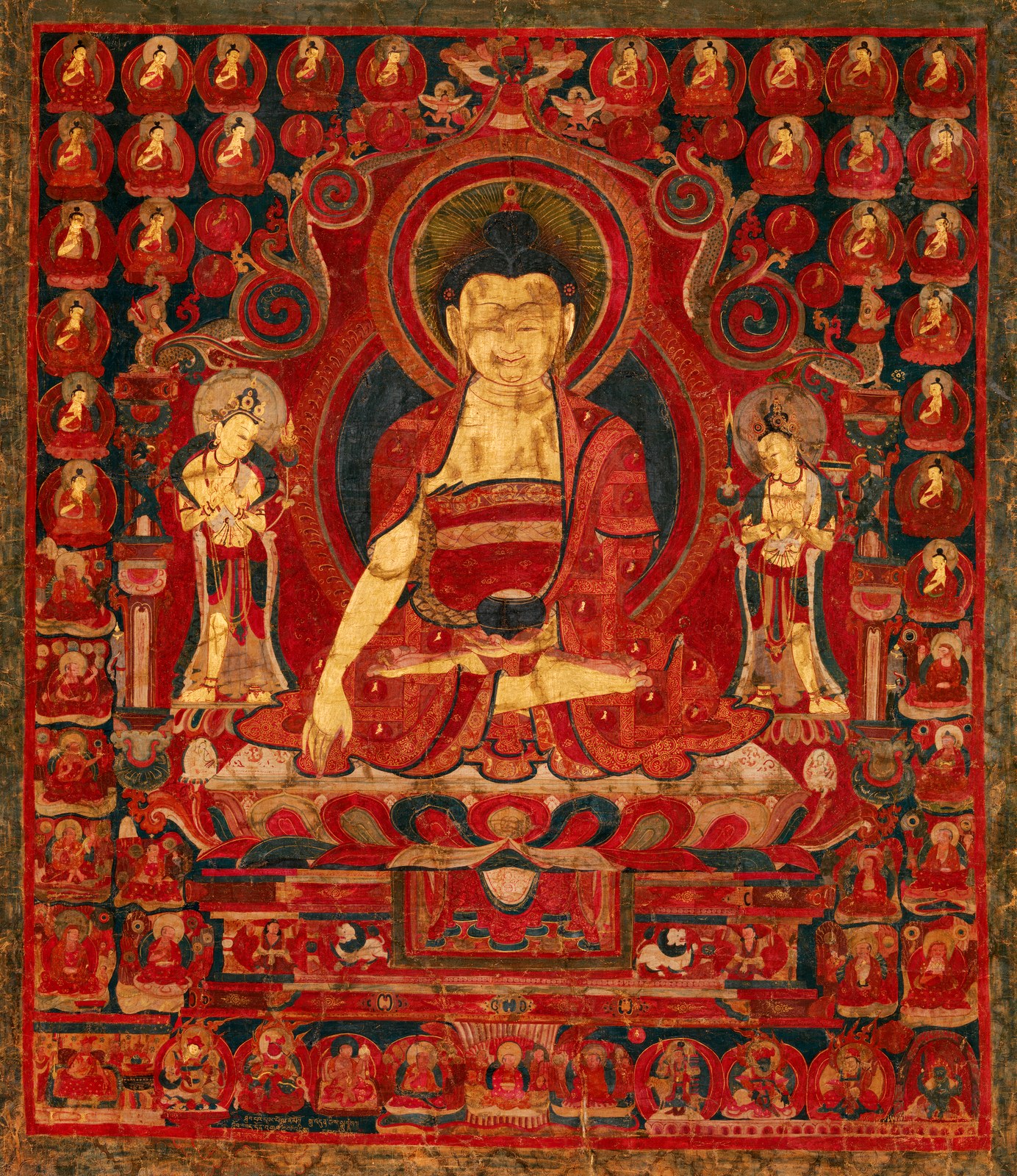
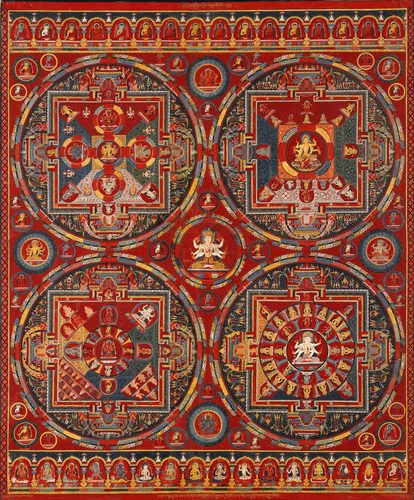
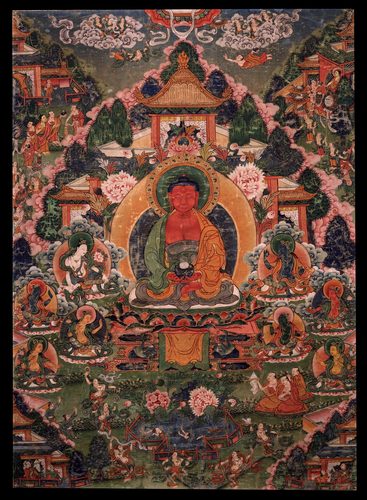
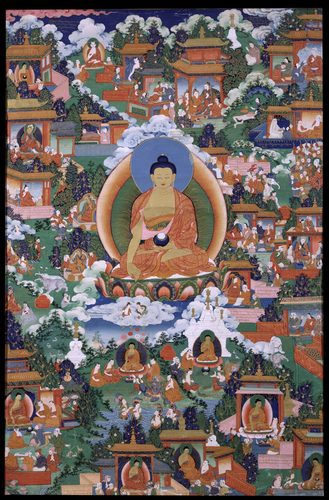
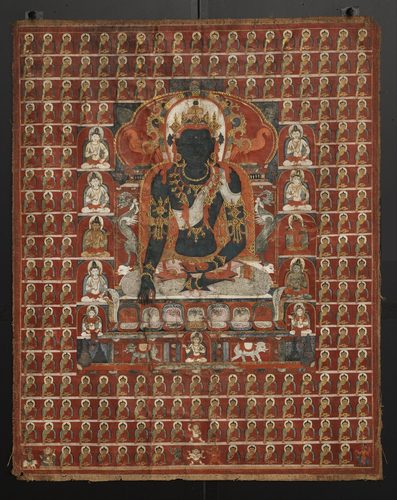
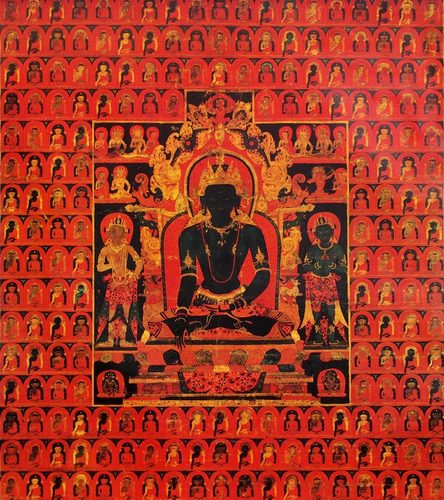
Mandala art is a circular composition built from radial symmetry, expanding outward in concentric rings from a fixed center point. The word comes from Sanskrit for circle, and the form spans Hindu and Buddhist painting traditions, Tibetan sand work, and now a global secular practice of pattern drawing. Makers begin with a compass and straightedge to lay out a precise grid of circles and radiating lines, then fill each ring with repeating geometric or floral motifs rendered in tight bilateral symmetry. Materials range from natural mineral pigment and gold leaf on cotton cloth in painted thangkas, to fine colored sand poured through metal funnels onto a flat platform, to gouache, ink, or colored pencil on paper for smaller devotional or decorative works. The defining look is unmistakable: a perfectly centered circle, divided into nested bands, each band mirrored across every axis, drawing the eye steadily inward toward the middle point.
What defines the medium
Radial symmetry and center point
Every mandala starts from a single fixed center point, with all elements mirrored across multiple axes as they radiate outward. This strict symmetry is drawn first with a compass and ruler before any color or detail is added.
Concentric registers
The design builds in nested rings or squares, each register holding its own repeating pattern or set of figures, moving from a dense outer border toward a simplified core. Viewers read the mandala from edge to center.
Sand mandala process
Tibetan sand mandalas are built by pouring fine colored sand through narrow metal funnels tapped to release grains along pre-drawn lines. Completed sand mandalas are traditionally swept away after public display.
Cloth and paper formats
Painted mandalas, known as thangkas in Tibetan practice, use mineral pigment and gold on cotton or silk that can be rolled for storage and display. Smaller decorative mandalas are drawn on paper with ink, pencil, or gouache.
Color and pattern vocabulary
Traditional mandalas draw on an established vocabulary of lotus petals, geometric gates, and repeating floral bands, with color chosen for visual balance across the composition rather than freehand improvisation.
Compass-drawn geometry
The underlying structure is measured, not sketched loosely: compass arcs, ruled grids, and calculated divisions of the circle keep every ring proportionate before ornamental detail fills the framework.
Materials decoder
The toolkit of mandala art
- compass and ruler grid
- → the measured circles and radiating guide lines drawn before any color, giving every mandala its precise underlying geometry
- sand funnel tool
- → a narrow metal tool tapped to release a thin stream of colored sand along drawn lines in Tibetan sand mandalas
- natural mineral pigment
- → ground stone and mineral color bound for painting on cloth, producing the deep, matte reds, blues, and golds of traditional thangkas
- gold leaf accents
- → thin sheets of gold applied to highlight borders or key motifs, catching light against painted color
- cotton or silk ground
- → the woven cloth support for painted mandalas and thangkas, primed and stretched before pigment is applied
- fine-tipped outlining brush
- → a small brush used for the crisp linework that separates each ring and motif with a clean, unbroken edge
The story
Mandala designs appear in Hindu and Buddhist manuscript and mural traditions across South Asia and Tibet, with painted examples surviving from at least the medieval period and construction techniques recorded in older texts. Nepalese and Tibetan thangka painters developed detailed pigment and gold-leaf mandalas for teaching and devotional use, often depicting a central figure within nested architectural rings. Tibetan Buddhist monasteries also developed the practice of pouring colored sand into large mandala designs for public display, traditionally swept away afterward. Jain cosmological manuscripts used similar concentric diagrams to map the universe. Western psychology and art scholarship examined circular mandala-like drawings during the twentieth century, broadening interest beyond South Asian and Himalayan traditions. Since the later twentieth century, mandala drawing has spread worldwide as a secular pattern-based practice, appearing in art therapy, textile design, and printed coloring books.
Masterpieces of the medium
| Work | Artist | Date | Why it matters |
|---|---|---|---|
| Wheel of Life Thangka | Unknown | 18th century | a Tibetan Buddhist teaching image built as a mandala-format wheel with nested symbolic rings |
| Nepalese Mandala Manuscript | Unknown | c. 14th century | an illuminated manuscript page using precise radial geometry for a devotional diagram |
| Kalachakra Sand Mandala | Unknown | traditional, ongoing practice | a large ritual sand mandala constructed and ceremonially dismantled by Tibetan monks |
| Jain Cosmological Diagram | Unknown | c. 17th century | a manuscript painting mapping the universe as a concentric mandala structure |
| Rubin Museum of Himalayan Art mandala collection | Unknown | founded 2004 | a major Western museum collection dedicated to painted Himalayan mandala and thangka art |
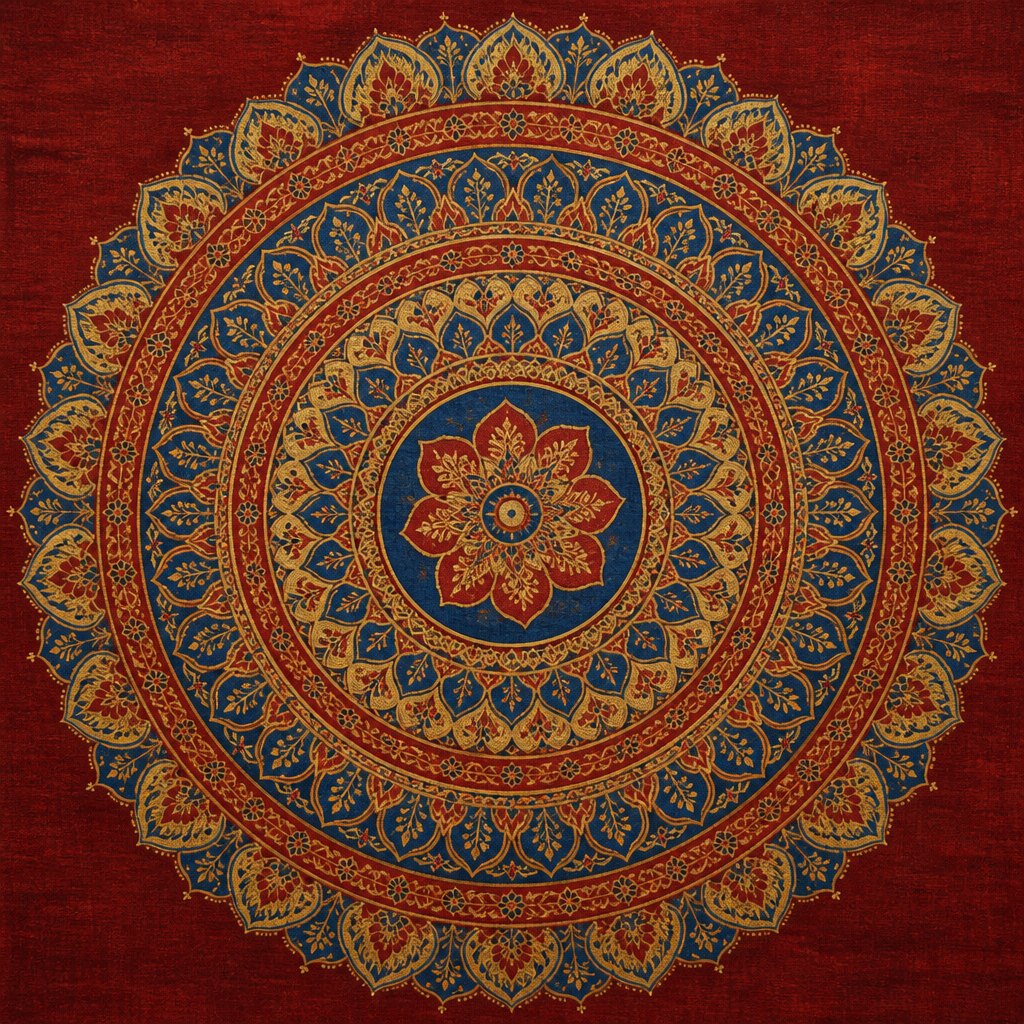 AI-generated
Try the medium
Try mandala art with AI
This example was generated from a prompt like: “A large circular mandala design, concentric rings of repeating geometric and floral pattern radiating from a central point, painted in deep red, gold, and blue on textured cloth, symmetrical fine linework, flat lighting.”
Open the Mandala Art Style generator →The medium today
Mandala art today spans museum-held historical thangkas, public sand-mandala demonstrations, and a vast secular practice of pattern drawing used in coloring books, tattoo design, textile print, and meditation apps. Digital tools let designers generate precise radial symmetry instantly, and mandala motifs appear widely in graphic design and home décor. Museums and cultural centers regularly host public Tibetan sand-mandala demonstrations, drawing audiences to watch the construction and the traditional dispersal of the finished sand.
Compose your own
Start with a compass, a ruler, and a light pencil grid: draw a circle, then divide it into equal sections using radiating lines through the center. Build the design ring by ring, working outward or inward, repeating each shape across every division so the symmetry stays exact. Ink or paint the outlines first, then fill in color, keeping the palette consistent across matching sections. Graph paper or a printed circle template makes the initial geometry easier before freehand pattern skills develop. Digital drawing apps with symmetry or mirror tools let beginners test radial designs quickly before committing to a hand-drawn or painted version.
Frequently asked questions
What does mandala mean?
Mandala is a Sanskrit word meaning circle. In Hindu and Buddhist art it refers to a circular design representing balance and wholeness, built from symmetrical rings radiating out from a central point.
Why are sand mandalas destroyed after they're finished?
In Tibetan Buddhist practice, completed sand mandalas are traditionally swept away and the sand dispersed, a public demonstration tied to teachings on impermanence rather than a flaw in the work.
What tools do mandala artists use?
A compass and ruler establish the circle and grid, then artists fill it with fine brushes for paint or ink, colored pencils, or, in Tibetan practice, metal funnels that release fine colored sand along drawn lines.
Can anyone draw a mandala, or is it a religious practice?
Mandala drawing today is widely practiced as a secular art and mindfulness activity worldwide, separate from the specific religious mandalas used in Hindu and Buddhist ritual and teaching contexts.