
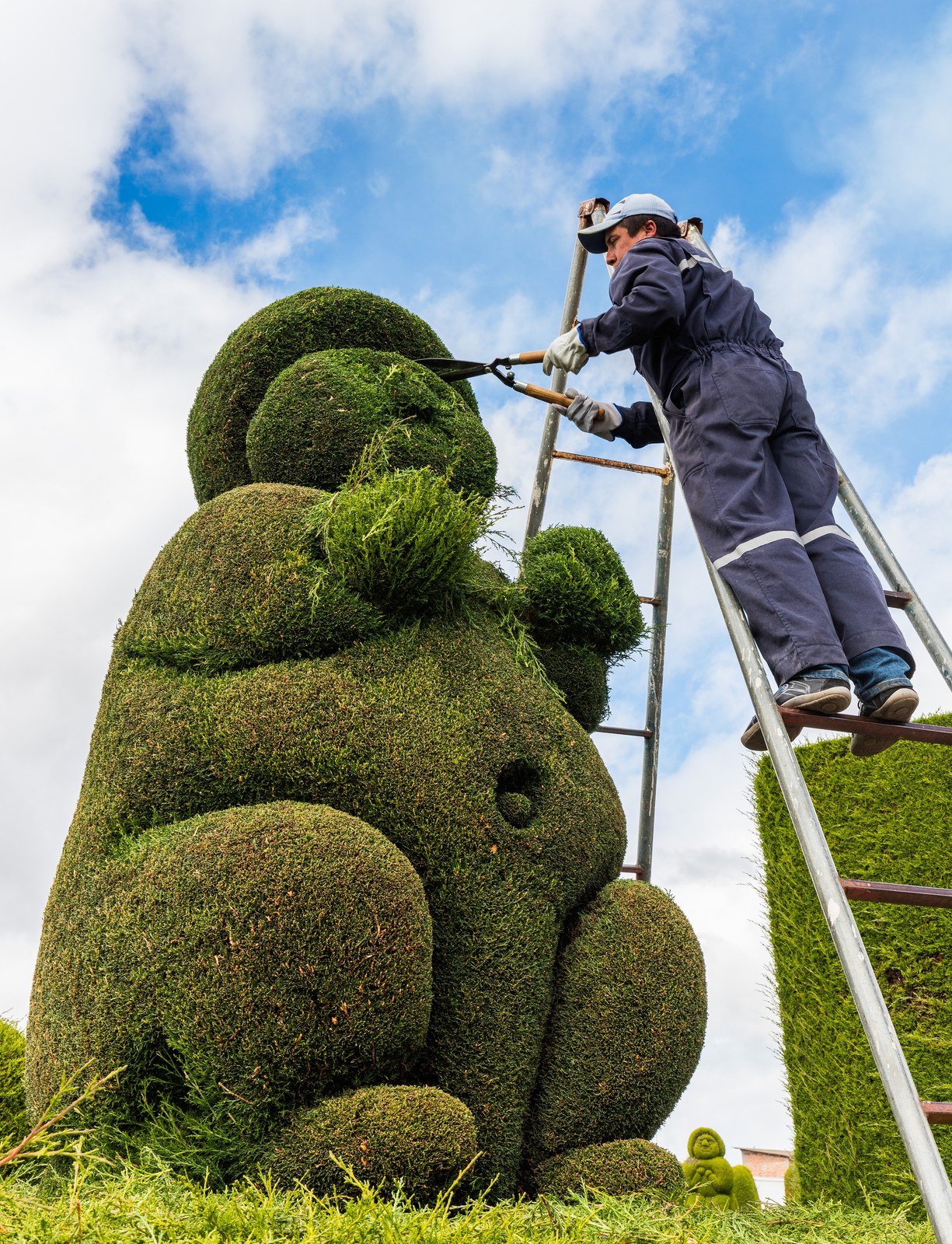
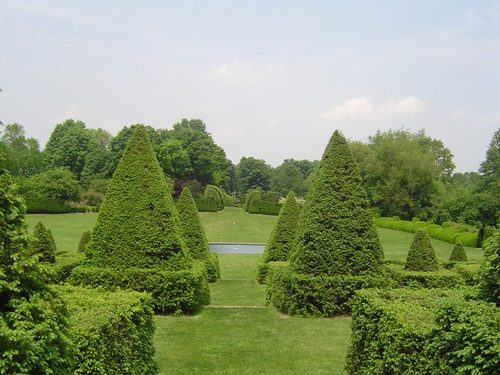

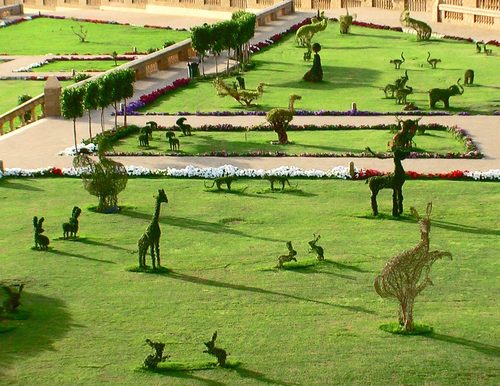
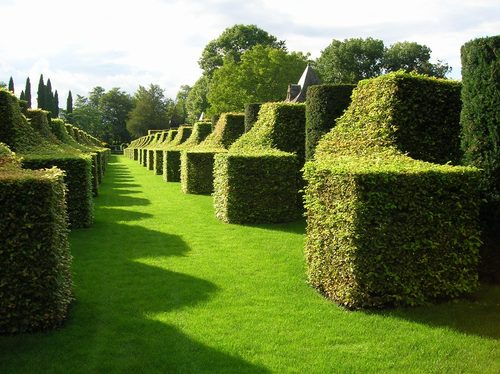
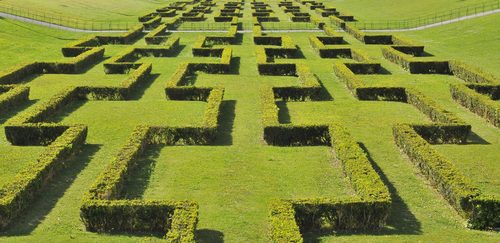
Topiary is the horticultural art of clipping trees and shrubs into deliberate geometric or figurative shapes, using regular pruning rather than carving or casting to hold a living form. Slow-growing, dense-leaved plants such as yew, boxwood, privet, and holly are favored because they tolerate heavy clipping and hold a crisp outline between trims. Gardeners establish a shape early with stakes or wire frames, then maintain it through repeated seasonal clipping with shears or powered hedge trimmers, removing new growth before it can blur the silhouette. Simple forms—cones, balls, spirals, cubes—can be maintained freehand by eye, while complex figurative shapes such as animals or human figures are often trained over a wire armature packed with moss or grown directly through it. Because the material is alive, topiary is never finished; a shape drifts without ongoing maintenance and can take years to mature from young stock into a fully dense, sharply defined form.
What defines the medium
Slow-growing, dense-leaved plants
Topiary favors species like yew, boxwood, and privet that grow slowly, hold dense small leaves, and tolerate repeated hard pruning without dying back. Fast-growing or sparse-leaved plants cannot hold a crisp clipped outline.
Frames for complex shapes
Simple geometric forms are often clipped freehand by eye, but figurative shapes like animals typically start from a wire armature that the plant is trained through or around, giving the gardener a fixed guide to clip against.
Seasonal clipping schedule
Most topiary is trimmed once or twice a year, timed to the plant's growth cycle so new shoots are cut back before they blur the shape, keeping the surface tight and even rather than shaggy between maintenance sessions.
Formal garden placement
Topiary traditionally anchors formal, symmetrical garden design, flanking entrances, lining walkways, or repeating in matched pairs. Its clipped geometry contrasts deliberately with looser planting beds nearby.
Years to maturity
A topiary shape rarely looks finished when first planted; dense, sharply defined form takes years of steady clipping as the plant fills out. Established topiary gardens are valued partly for their age and long maintenance history.
Tools of the trade
Hand shears give the fine control needed for detailed figurative work, while powered hedge trimmers handle large geometric hedges faster. Both require a steady hand and a clear sense of the intended silhouette from multiple angles.
Materials decoder
The toolkit of topiary art
- clipped yew cone
- → a dense, dark-green cone shape, one of the most common basic topiary forms found in formal gardens
- wire armature
- → a metal frame used to guide figurative topiary shapes like animals, hidden inside foliage as the plant grows through it
- boxwood parterre
- → low clipped boxwood hedges arranged in geometric or scrollwork patterns, a hallmark of formal French and Italian garden design
- spiral hedge
- → a shrub trained into a rising spiral silhouette, a common decorative topiary shape for entrances and containers
- hand shears
- → long-bladed hand tool for precise, detailed clipping on figurative or fine topiary work
- hedge trimmer
- → a powered blade tool used to maintain large geometric hedges and screens quickly and evenly
The story
Ornamental hedge clipping is recorded in ancient Rome, where the writer Pliny the Elder described gardens shaped by a topiarius, a gardener skilled in training plants into decorative forms. The practice faded after the Roman period and revived during the Italian Renaissance, when gardens such as Villa Gamberaia near Florence used clipped boxwood parterres as part of formal garden design. French garden design under André Le Nôtre extended topiary into vast geometric parterres at Versailles in the later seventeenth century. English formal gardens adopted the style, and Levens Hall in Cumbria, laid out from 1694 by gardener Guillaume Beaumont, preserves some of the oldest continuously maintained topiary in the world. Figurative animal topiary became popular in American gardens in the nineteenth century, exemplified by Green Animals Topiary Garden in Rhode Island, established in 1872. Topiary has remained a fixture of formal garden design into the present.
Masterpieces of the medium
| Work | Artist | Date | Why it matters |
|---|---|---|---|
| Levens Hall Topiary Garden | Guillaume Beaumont | from 1694 | one of the world's oldest continuously maintained topiary gardens, with mature clipped yew and box forms in Cumbria, England |
| Gardens of Versailles | André Le Nôtre | 1661-1700 | vast formal French parterres and clipped hedge geometry designed for King Louis XIV |
| Villa Gamberaia | Unknown | 16th-17th century | Italian Renaissance garden near Florence known for clipped boxwood parterres and geometric hedge rooms |
| Green Animals Topiary Garden | Thomas Brayton | established 1872 | American topiary garden in Rhode Island noted for animal-shaped privet and yew figures |
| Roman topiarius gardens | Unknown | 1st century CE | earliest recorded ornamental hedge clipping, described by the writer Pliny the Elder in Roman garden accounts |
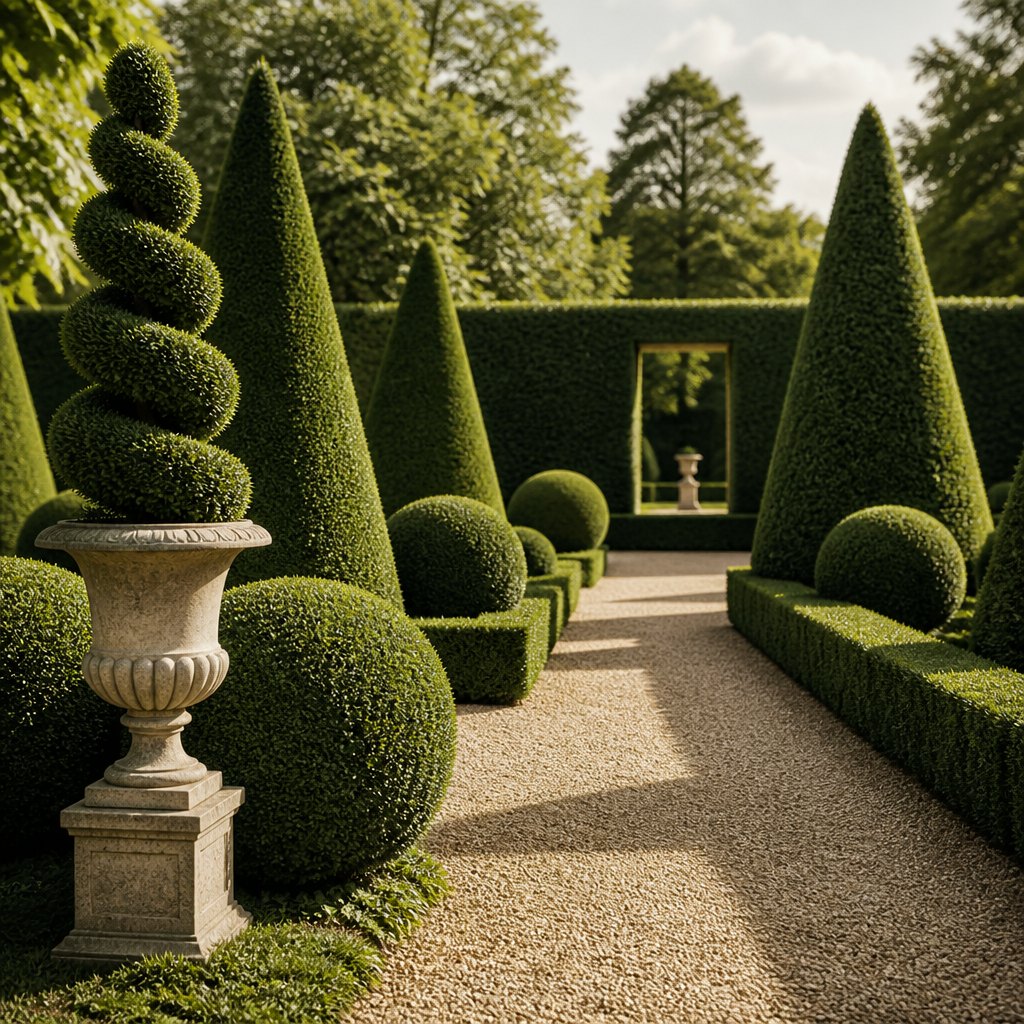 AI-generated
Try the medium
Try topiary art with AI
This example was generated from a prompt like: “A formal garden with dense dark-green yew hedges clipped into perfect geometric cones and spheres, a spiral topiary shrub in a stone urn, gravel path, soft afternoon sunlight, crisp sharply defined clipped foliage edges.”
Open the Topiary Art Style generator →The medium today
Topiary today appears in historic estate gardens, public parks, and private landscaping, ranging from simple clipped balls and cones to elaborate figurative animals maintained by professional gardeners. Some public gardens host topiary festivals and competitions showcasing elaborate figurative work. Faster techniques using foam or wire mesh frames covered in trailing plants, sometimes called mosaiculture, let designers achieve figurative shapes more quickly than traditional slow-clipped shrubs. Topiary also appears in miniature form in container gardening and as a decorative feature in event and hospitality landscaping.
Compose your own
Beginners start with a fast, forgiving species like boxwood or privet grown in a container, since a contained plant is easier to shape and correct than one already in the ground. Choose a simple geometric target—a ball or cone—rather than a figurative shape, and use a wire hoop or simple frame as a visual guide rather than freehanding from the start. Clip a little at a time, working around the whole plant rather than finishing one side, and step back often to check the silhouette from multiple angles. Trim after the plant's main growth flush rather than constantly, since over-clipping stresses the plant. Expect the shape to take one or more growing seasons to fill in densely, and be patient with slow, steady correction rather than aggressive cutting.
Frequently asked questions
What plants are best for topiary?
Slow-growing, small-leaved evergreens like boxwood, yew, privet, and holly work best because they tolerate frequent hard pruning, hold dense foliage, and recover from clipping without dying back or looking sparse.
How long does it take to grow a topiary shape?
Simple geometric shapes can look reasonably defined within one to two growing seasons, but dense, sharply detailed figurative topiary often takes several years of steady clipping to fill out fully and hold a crisp outline.
Do all topiary shapes use a frame?
Simple forms like balls and cones are usually clipped freehand by eye, but complex figurative shapes, like animals, typically use a wire armature the plant is trained around or through to keep the silhouette accurate.
How often does topiary need trimming?
Most established topiary is clipped once or twice a year, timed after the plant's main growth flush, though highly detailed figurative shapes near public display may receive more frequent light touch-up trims.