
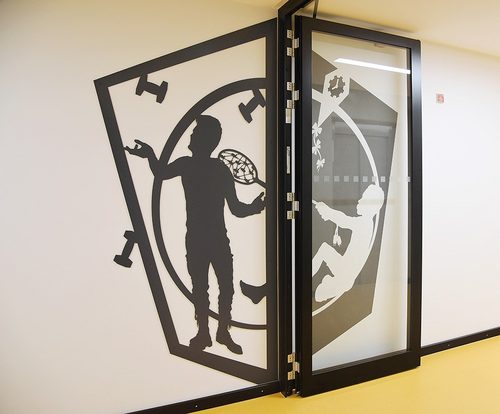
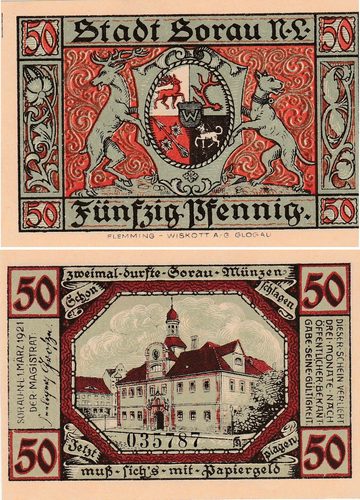
Papercutting is the art of shaping an image entirely by removing paper with scissors or a knife rather than adding pigment. A design is drawn or imagined on a sheet, then cut away so that what remains—or what is removed—forms the picture. Many traditions fold the paper first (in half, quarters, or more) so a single cut produces a mirrored, symmetrical pattern when unfolded, the same principle behind a paper snowflake. Others work freehand on flat paper to render a silhouette portrait or a scene in solid black shape. Materials are simple: thin, strong paper (often colored, dyed, or gilded) and a fine pair of scissors or a scalpel-sharp knife on a cutting surface. The finished cut is usually mounted on a contrasting backing so its negative space reads clearly. Distinct regional traditions—German Scherenschnitte, Chinese jianzhi, Jewish papercuts, Polish wycinanki, Mexican papel picado—share this core method while differing in subject, color, and symmetry style.
What defines the medium
One continuous sheet
Traditional papercuts are cut from a single piece of paper without gluing separate pieces together, so the design must remain physically connected—every shape has to touch another to avoid falling away.
Folding for symmetry
Paper is folded in half or into multiples before cutting, so one set of cuts becomes a mirrored, repeating pattern once unfolded. This is standard in Chinese jianzhi and folk snowflake-style designs.
Positive versus negative space
A cutter decides whether the image is the paper left behind (silhouette, solid shape) or the openings cut through it (lace-like tracery revealing the backing color). Most traditions rely heavily on the second.
Tools and cutting order
Fine embroidery scissors or a sharp craft knife on a cutting mat are standard; cutters work from the center of a design outward and finish the smallest interior details before the outer outline, to keep the sheet stable.
Paper choice
Lightweight but tear-resistant paper is preferred—thin cardstock, specialty papercutting paper, or colored tissue—since it must hold fine cut lines without shredding as the blade moves through it.
Mounting and display
Finished cuts are typically glued or floated onto a backing sheet in a contrasting color so the pattern reads clearly, then framed under glass, since the paper itself is fragile and easily torn once complete.
Materials decoder
The toolkit of papercutting
- fine embroidery scissors
- → small, sharp-pointed scissors used for detailed interior cuts and tight curves in a design
- craft knife or scalpel
- → used on a cutting mat for straight lines and fine openwork that scissors cannot reach cleanly
- folded paper
- → paper folded before cutting to produce mirrored, symmetrical patterns once unfolded
- black silhouette paper
- → solid black paper used for profile portraits and shadow-figure cutouts, popular in 18th-century Europe
- red dyed paper
- → the traditional color for Chinese jianzhi, associated with celebration and pasted on windows or doors
- openwork lacework
- → dense, interconnected cut lines leaving a delicate net-like structure, the hallmark of highly skilled cutting
The story
Papercutting became possible once paper itself existed, and the earliest surviving fragment—a symmetrical circular cutout—dates to 6th-century China, not long after papermaking spread there. From China the practice moved outward, becoming jianzhi window and lantern decoration and later reaching Japan, Southeast Asia, and eventually Europe. In German- and Swiss-speaking regions, Scherenschnitte silhouette cutting flourished from the 16th through 19th centuries. Jewish communities in Eastern Europe developed a parallel papercut tradition from the 18th century for ketubot, mizrach wall decorations, and holiday ornaments. Silhouette portraiture became a popular, affordable alternative to painted portraits across 18th-century Europe, with traveling profile-cutters working fairs and parlors. Polish wycinanki and Mexican papel picado developed as distinct folk styles in the same centuries. In the 20th century, Henri Matisse elevated large-scale cut paper to fine-art status with his late gouache cut-outs, made until his death in 1954.
Masterpieces of the medium
| Work | Artist | Date | Why it matters |
|---|---|---|---|
| The Snail | Henri Matisse | 1953 | gouache-painted paper cut and arranged into a large abstract composition |
| Silhouette portrait series | Auguste Edouart | 1827-1845 | full-length scissor-cut black-paper silhouette portraits made from life |
| Papercuttings made for storytelling | Hans Christian Andersen | mid-19th century | intricate folded paper cutouts the writer produced by hand while narrating tales |
| Jianzhi window papercuts | Unknown | traditional, ongoing since the 6th century | red paper cut into symmetrical folk motifs and pasted on windows for festivals |
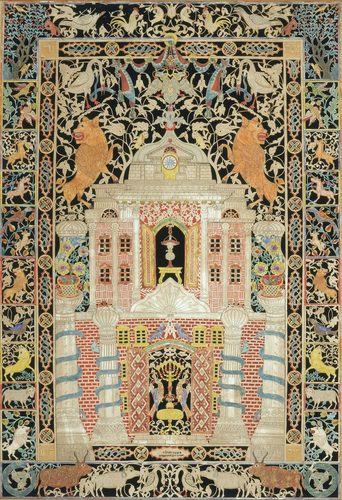
| Mizrach wall papercuts | Unknown | 18th-19th century, Eastern Europe | decorative Jewish papercuts marking the eastward direction of prayer |
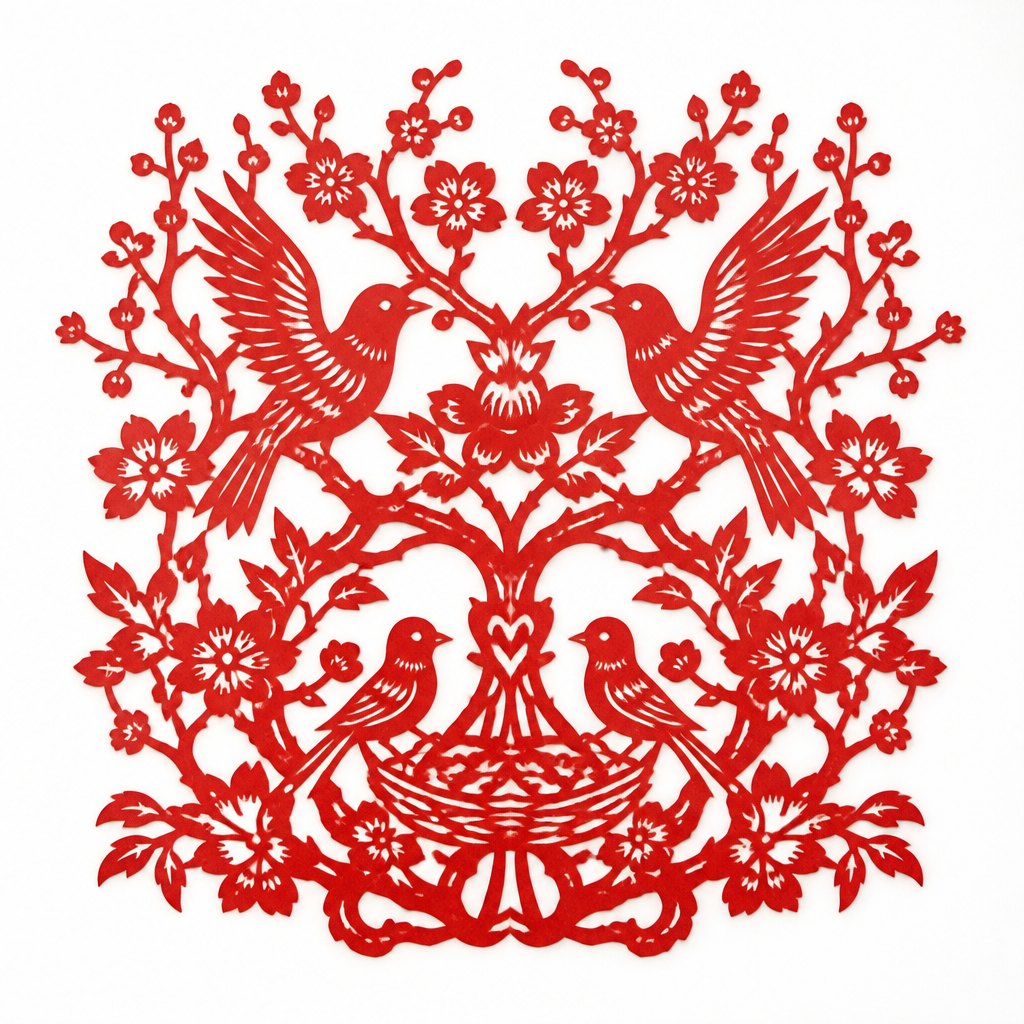 AI-generated
Try the medium
Try papercutting with AI
This example was generated from a prompt like: “An intricate red paper cutout of birds and blossoming branches, symmetrical folded folk design, delicate lace-like negative space, mounted flat on a plain white background, crisp cut edges.”
Open the Papercutting Art Style generator →The medium today
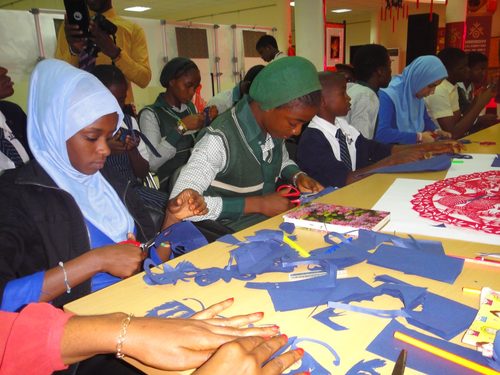
Papercutting continues as both a living folk craft and a contemporary art practice. Community centers and festivals keep regional traditions such as papel picado banners and jianzhi window decorations active, while galleries display large-scale cut-paper installations and book illustrators use fine paper-cut imagery for editorial work. Laser and digital cutters now let designers produce highly precise repeat patterns at scale, working alongside hand-cutting rather than replacing it. Paper-cut styling also appears widely in packaging, greeting cards, and animated title sequences.
Compose your own
Start with a small sheet of lightweight, strong paper and a pair of sharp, fine-pointed scissors or a craft knife with a cutting mat. Sketch a simple design in pencil directly on the paper, keeping every shape connected to at least one other so nothing falls away once cut. Practice a folded design first—fold the paper in half or quarters, cut a basic motif along the fold, then unfold to see the mirrored pattern. Cut interior details before the outer outline, working from the center outward for stability. Mount the finished piece on a contrasting sheet of paper to make the pattern read clearly, then progress to freehand silhouette work as control improves.
Frequently asked questions
What paper works best for papercutting?
Lightweight but tear-resistant paper is ideal—specialty papercutting paper, thin cardstock, or origami paper. Very thick paper is hard to cut cleanly; very thin paper tears before a design is finished.
What's the difference between jianzhi, Scherenschnitte, and silhouette cutting?
They are regional traditions of the same core technique: jianzhi is Chinese folk cutting often in red paper, Scherenschnitte is German/Swiss folded symmetrical work, and silhouette cutting is European freehand profile-portrait cutting.
Do I need special tools?
A small pair of sharp, fine-pointed scissors or a sharp craft knife and cutting mat cover most work. Specialty papercutting scissors with narrow curved blades help with tight interior details.
Is papercutting the same as origami?
No. Origami shapes paper purely by folding without cutting or adding material, while papercutting removes material with scissors or a blade to create the image, sometimes using folds only to set up symmetry.