
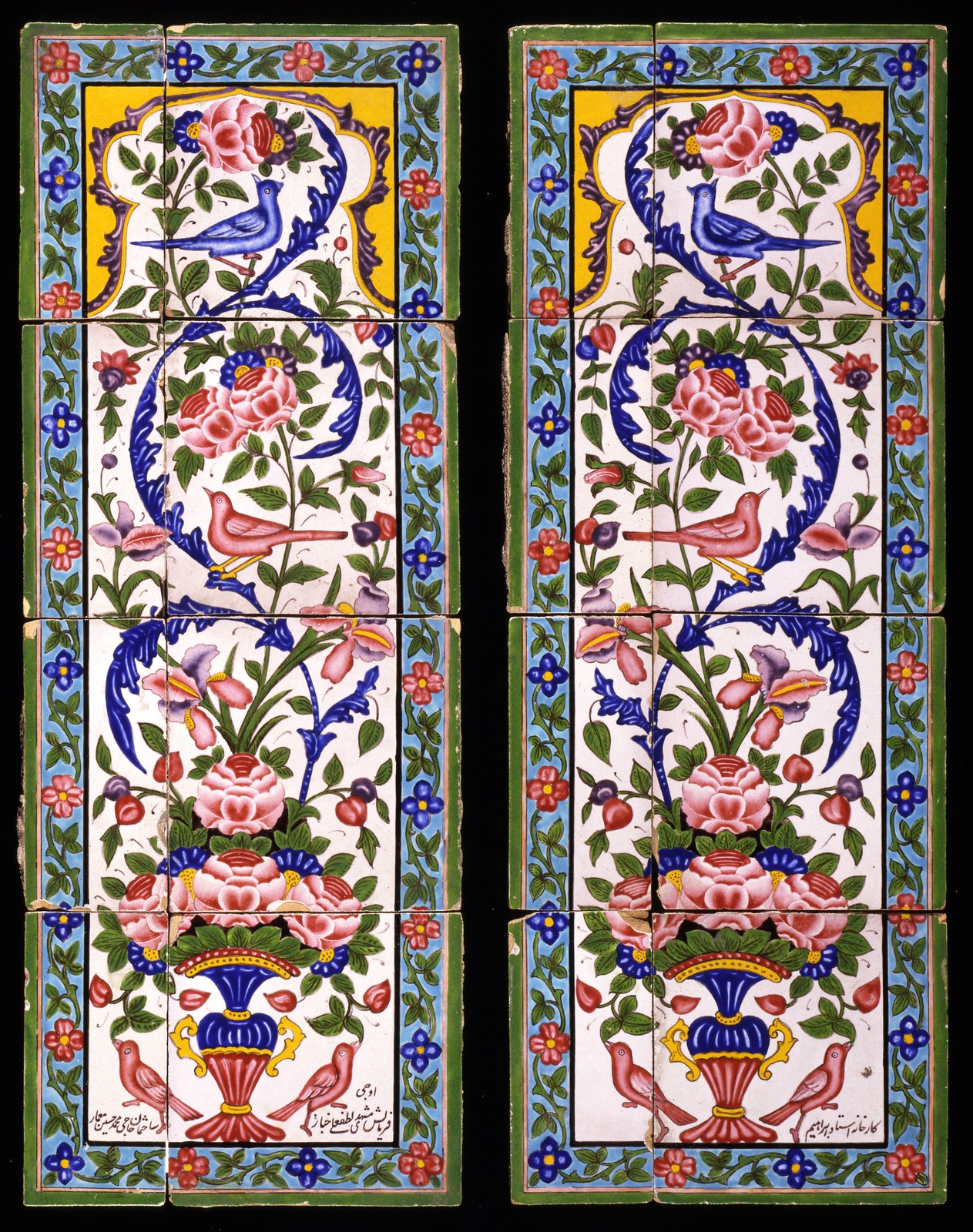
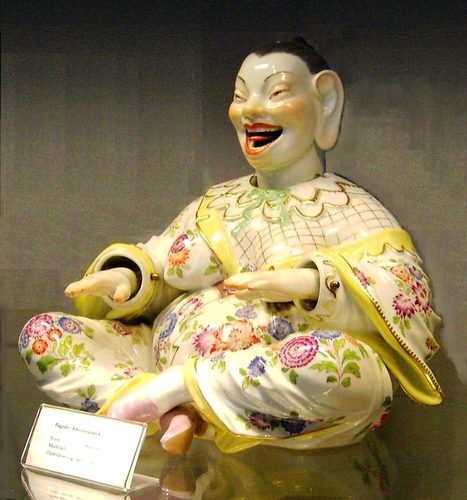
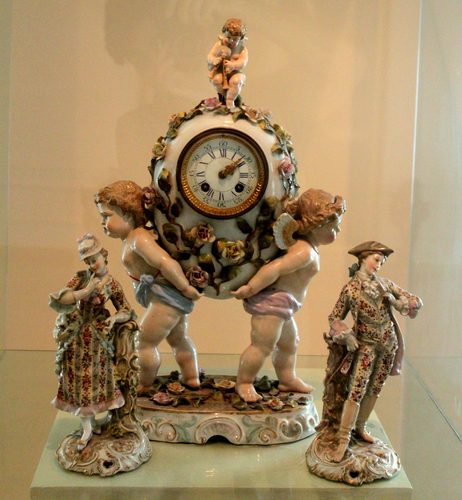
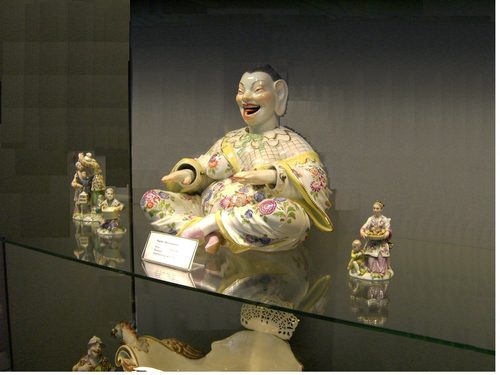
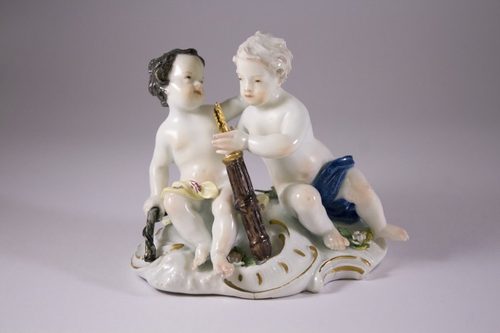
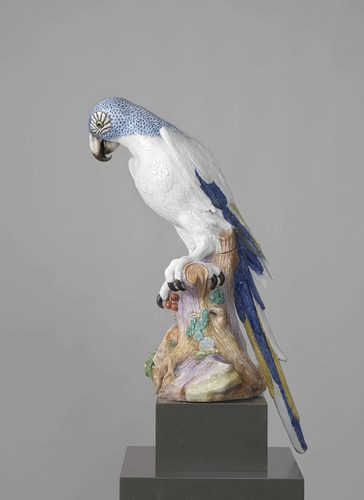
Porcelain is a dense, white, translucent ceramic made by firing a precise mixture of kaolin clay, feldspar, and quartz or petuntse at very high temperatures, often above 1300°C. The intense heat vitrifies the clay body into a glassy, non-porous material that rings when struck and lets light pass through thin walls. Porcelain objects are formed by throwing on a wheel, casting in plaster molds, or hand-modeling for figurines, then fired once as unglazed bisque and again after glazing. Decoration follows two main paths: underglaze painting, most famously cobalt blue brushed onto raw clay before a clear glaze seals it, and overglaze enamel painting, where colored glass pigments are fired a second time at lower heat in a muffle kiln, allowing a wider palette. Sculptors also model figurines and reliefs directly in the clay before firing. The result is a hard, cool, brilliant-white surface that has made porcelain the standard for fine tableware, vases, and decorative figures across Chinese, Japanese, and European traditions.
What defines the medium
Body and firing temperature
True hard-paste porcelain fires above roughly 1300°C, fusing kaolin, feldspar, and quartz into a dense, translucent body. Soft-paste imitations developed in Europe before the true recipe was known fire cooler and stay more porous.
Underglaze versus overglaze
Underglaze colors, chiefly cobalt blue, are painted on raw clay and sealed under a single glaze firing, giving soft, fused edges. Overglaze enamels are painted after glazing and fired again at lower heat, producing crisper, brighter color.
Forming methods
Vessels are thrown on a wheel or cast in plaster molds from liquid clay slip, while figurines are built from separately molded parts—head, limbs, drapery—joined with slip before firing. Hand-modeling adds fine sculptural detail.
Double firing
Porcelain typically passes through a kiln twice: a bisque firing hardens the unglazed form, and a glaze firing melts a glassy coating over it. Enamel decoration adds a third, cooler firing to fix the painted colors permanently.
Whiteness and translucency
Kaolin's purity determines how white and translucent the fired body becomes; thin-walled pieces held to light show a faint glow. Potters prize this quality enough to shave vessel walls thin at the risk of collapse in the kiln.
Marks and workshops
Porcelain pieces are often marked on the base with a factory or reign symbol—an underglaze seal, painted crossed swords, or stamped chop—identifying the kiln, period, or painter's workshop responsible for the piece.
Materials decoder
The toolkit of porcelain art
- kaolin clay
- → the pure white clay mineral that gives porcelain its brightness and lets fired walls glow translucent when held to light
- cobalt blue underglaze
- → deep blue pigment painted on raw clay before glazing, the signature look of blue-and-white porcelain traditions
- crackle glaze
- → a network of fine surface cracks from differing shrinkage rates between glaze and body, prized as a deliberate decorative effect
- famille rose enamels
- → opaque pink-based overglaze palette developed for fine detail painting, fired at low heat after the main glaze firing
- biscuit porcelain
- → unglazed, matte-white fired porcelain left bare to resemble marble, used for figurines and sculptural detail
- factory mark
- → a painted or stamped symbol on the base identifying the workshop, reign, or kiln that produced the piece
The story
True porcelain developed in China, with early forms appearing under the Tang dynasty and mature hard-paste ware perfected by the Yuan and Ming dynasties at kilns in Jingdezhen from the 14th century onward. Blue-and-white porcelain, painted with cobalt imported along trade routes, became China's most recognizable export, reaching the Islamic world and Europe by the 1500s. European makers tried for centuries to reproduce it, achieving only soft-paste imitations until Johann Friedrich Böttger and Ehrenfried Walther von Tschirnhaus discovered a true hard-paste formula in Saxony, leading to the founding of the Meissen factory in 1710. Sèvres, established near Paris in 1740 and moved to its namesake town in 1756, became France's royal porcelain manufactory, known for soft-paste ware and gilded decoration before adopting hard-paste. Porcelain figurines, tableware, and vases spread across European courts through the 18th century and remain a benchmark of fine ceramic craft today.
Masterpieces of the medium
| Work | Artist | Date | Why it matters |
|---|---|---|---|
| David Vases | Unknown | 1351 | earliest known dated pair of Chinese blue-and-white porcelain temple vases |
| Meissen Harlequin figures | Johann Joachim Kändler | c. 1740 | hard-paste porcelain figurines that established European porcelain sculpture |
| Sèvres biscuit figures | Étienne Maurice Falconet | 1757-1766 | unglazed soft-paste porcelain figures with a matte, marble-like finish |
| Ming dynasty blue-and-white vase | Unknown | 15th century | Jingdezhen kiln ware prized for cobalt underglaze painting |
| Fonthill Vase | Unknown | c. 1300-1340 | one of the earliest Chinese porcelains known to have reached medieval Europe |
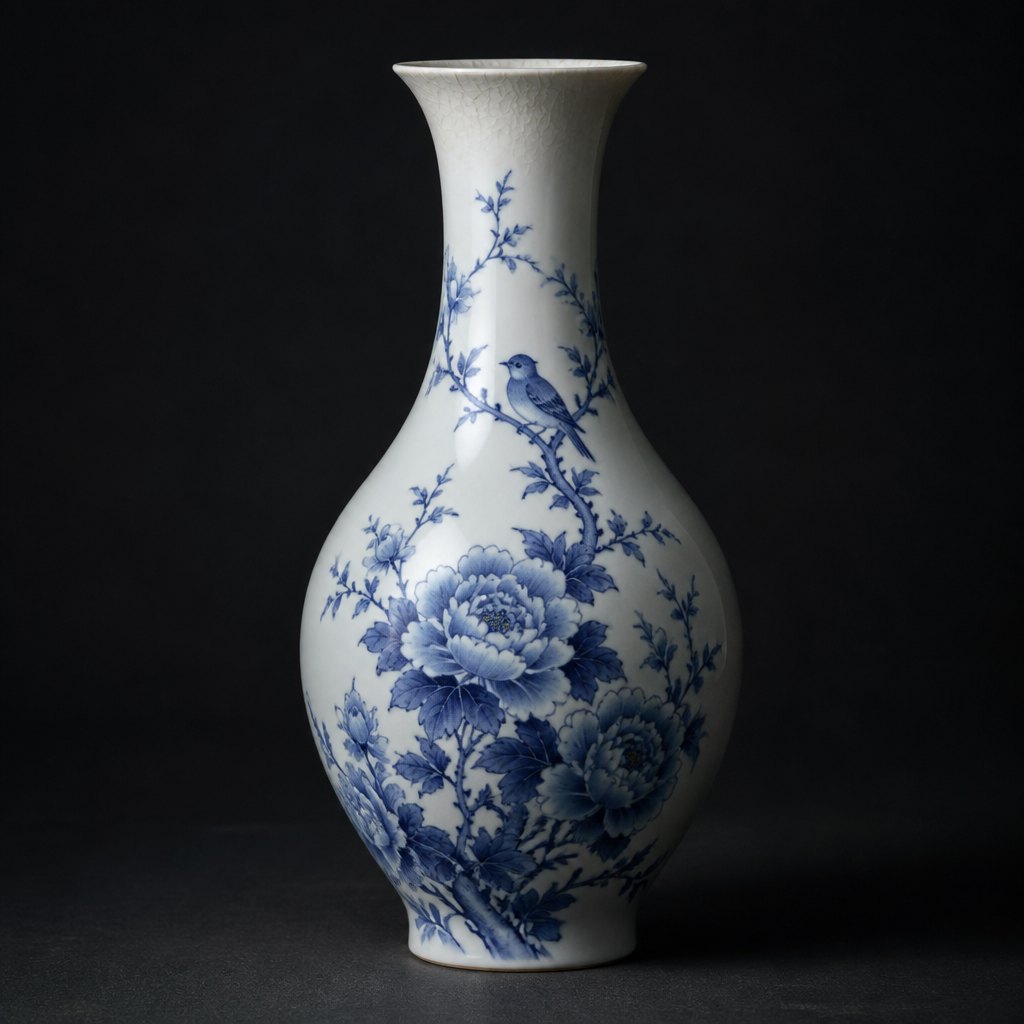 AI-generated
Try the medium
Try porcelain art with AI
This example was generated from a prompt like: “A slender white porcelain vase with delicate cobalt-blue floral underglaze painting, glossy translucent glaze, soft studio lighting on a plain dark background, fine crackle texture visible near the rim.”
Open the Porcelain Art Style generator →The medium today
Porcelain remains central to fine tableware, collectible figurines, and studio ceramics. Historic manufactories including Meissen and Sèvres continue limited production alongside contemporary studios that treat porcelain as a sculptural material, exploiting its translucency and fragility rather than following tableware traditions. Museums display antique blue-and-white and enamel-painted porcelain as some of the most consistently valuable decorative art objects. Digital modeling now helps some workshops prototype porcelain forms before hand-finishing and firing, though the firing process itself remains unchanged by technology.
Compose your own
Beginners usually start with porcelain clay bodies sold pre-mixed for throwing or hand-building, since blending raw kaolin and feldspar accurately is difficult without testing kilns. Small hand-built or wheel-thrown forms are easier to control than large vessels, since porcelain is prone to warping and cracking during its high-temperature firing. Working thin takes practice; walls that are too thick will not achieve the material's signature translucency. A two-stage firing—bisque, then glaze—is standard, and access to a kiln capable of reaching porcelain temperatures is essential. Underglaze pencils or cobalt oxide allow simple painted decoration before the final glaze firing, a good starting point before attempting overglaze enamel work.
Frequently asked questions
What makes porcelain different from other ceramics?
Porcelain is fired at higher temperatures than earthenware or most stoneware, using kaolin, feldspar, and quartz to produce a dense, white, translucent body that rings when tapped, unlike the duller, more porous surface of other clays.
Why is blue-and-white porcelain so common historically?
Cobalt oxide was one of the few pigments that survived porcelain's intense glaze firing without burning out, and it was traded along established routes to Chinese kilns, making blue-and-white the dominant early decorated style.
What is the difference between hard-paste and soft-paste porcelain?
Hard-paste uses true kaolin fired at very high heat, as first made in China; soft-paste is a European approximation using glassy fillers fired at lower temperatures, developed before Europeans discovered the true hard-paste formula.
Why do porcelain pieces often crack or warp in the kiln?
Porcelain's high firing temperature and thin walls leave little margin for error—uneven thickness, trapped air, or moisture can cause warping or cracking, which is why porcelain is a demanding ceramic material to work with.