
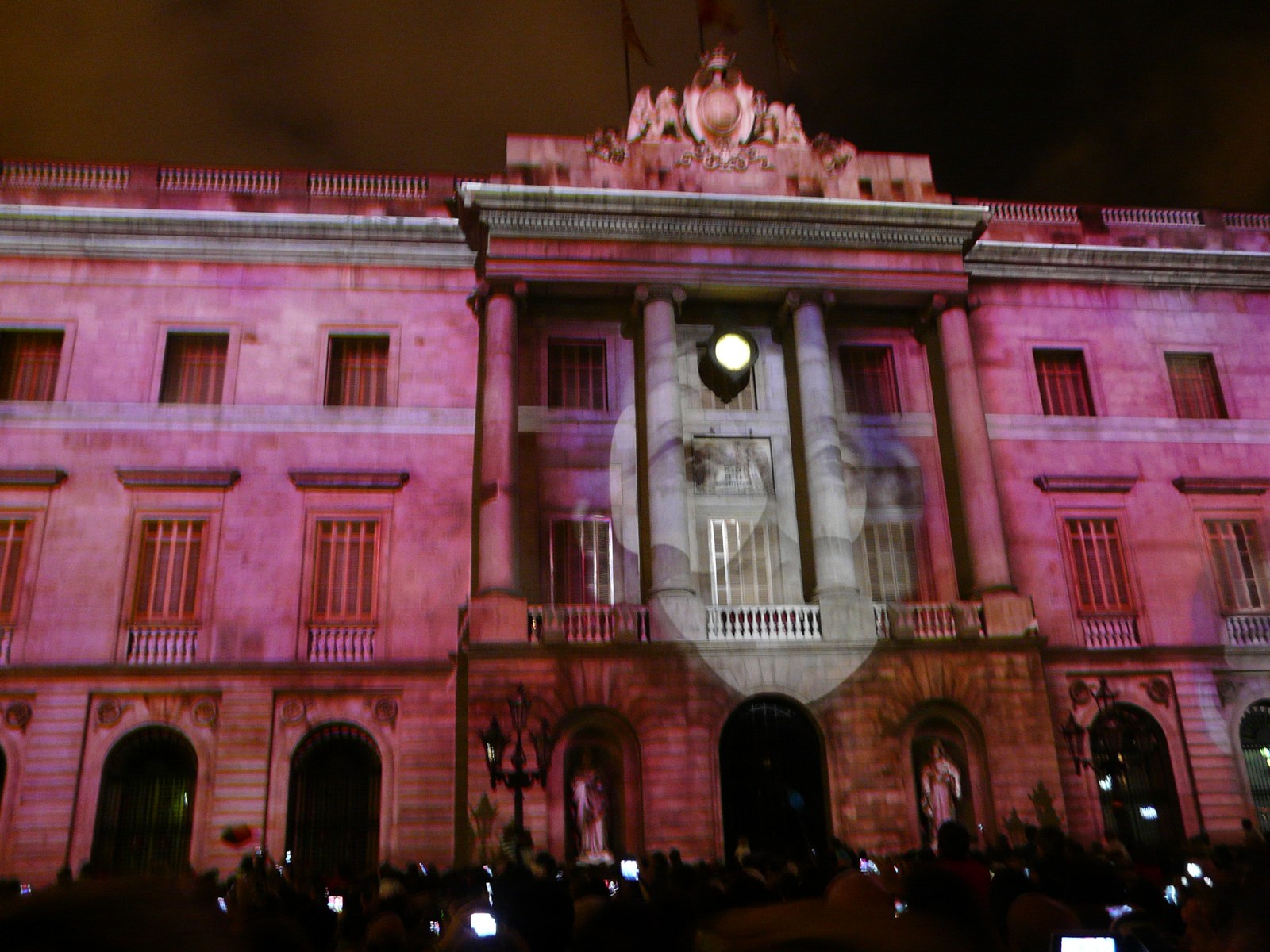
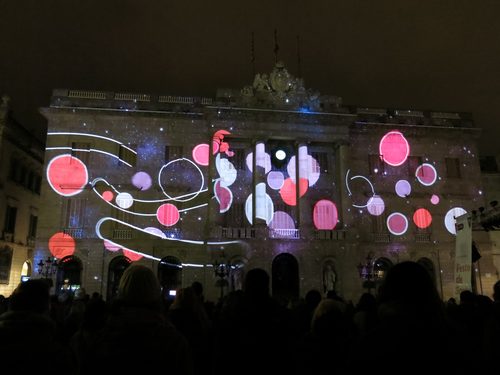
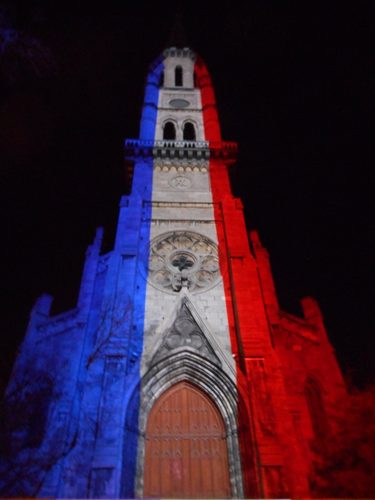
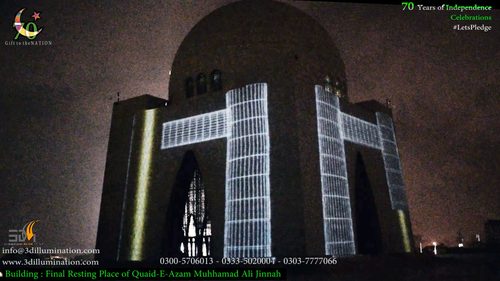
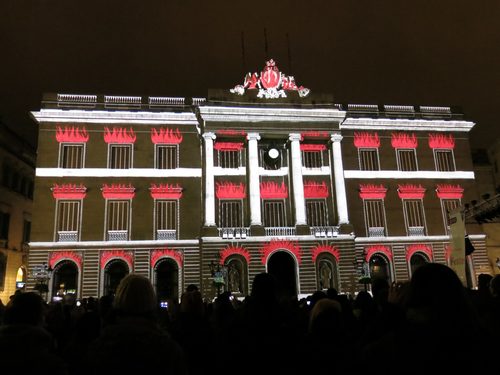
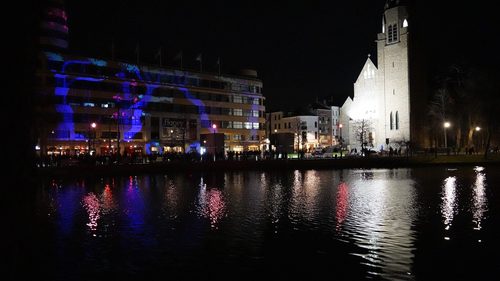
Projection mapping is the practice of aligning video or animated light so precisely with a physical surface—a building facade, a sculpture, a car, a dancer—that the projection appears to belong to the object itself rather than sitting on top of it. Artists model the target surface in 3D or photograph it, then build content in software that matches every window, cornice, and edge. Specialized programs like MadMapper, Resolume, or TouchDesigner warp and mask the video feed pixel by pixel so light lands only where intended. High-lumen projectors, often stacked and edge-blended for large facades, throw the image after dark, when ambient light won't wash it out. The defining look is architecture that seems to crack, dissolve, glow, or grow moving textures, all while the physical structure stays completely unchanged underneath.
What defines the medium
Geometry calibration
Every mapped surface is measured or modeled, then calibration grids align the video frame to real edges and depth so light lands exactly on architectural features rather than spilling past them.
Content built to match the site
Animation is authored in 3D software modeling the actual building or object, so painted cracks, doors, or textures appear to interact convincingly with real corners and surfaces.
Projector stacking and blending
Large facades need multiple high-lumen projectors overlapped and edge-blended into one seamless image, since a single unit rarely covers the brightness or width required.
Darkness and site dependency
The work only exists once ambient light drops low enough after dusk, and it is tied to one specific location, making most projection mapping temporary and event-based rather than a permanent object.
Sound synchronization
Shows are typically timed to a soundtrack, with lighting cues, musical beats, and animated transitions choreographed together for festival or corporate premieres.
Real-time mapping software
Tools such as MadMapper, Resolume, and TouchDesigner handle masking, warping, and live playback, letting artists preview and adjust the fit between video and surface before a public run.
Materials decoder
The toolkit of projection mapping
- haze-lit projector beam
- → fog or haze machines make the light path itself visible, letting audiences see the beam traveling before it lands on the surface
- calibration grid overlay
- → a test grid projected onto the surface to check that video pixels align with real physical edges before the show runs
- edge blend zone
- → the overlapping area where two or more projector images merge into one continuous picture without a visible seam
- trompe l'oeil crumbling facade
- → animated cracks or collapsing brick painted onto a real building to create the illusion that solid stone is breaking apart
- black masking in the video file
- → areas left unlit in the content so light does not spill onto windows, sky, or surfaces outside the intended surface
- long-exposure light trail photo
- → a photograph capturing moving projected animation as streaked color across a facade, the standard way this art form is documented
The story
Large-scale projected imagery on buildings traces back to son-et-lumière shows, which staged light and sound spectacles on historic facades such as Château de Chambord from 1952. Video-based mapping developed through 1980s experimental work projecting moving imagery onto furniture and small objects, aided by early computer graphics. VJ culture in 1990s club and rave scenes pushed real-time projected visuals, and dedicated mapping software followed, with Resolume appearing in the 2000s and MadMapper released in 2011, letting artists warp video to fit irregular architecture accurately. Cities began adopting the form for tourism and civic events: Lyon's centuries-old Fête des Lumières added large architectural projections around the turn of the millennium, and festivals like Vivid Sydney, launched 2009, built entire programs around facade projections on landmarks such as the Sydney Opera House. The technique spread to product launches, concerts, and museum installations worldwide through the 2010s.
Masterpieces of the medium
| Work | Artist | Date | Why it matters |
|---|---|---|---|
| Son et Lumière, Château de Chambord | Unknown | 1952 | early large-scale light-and-sound show projected onto a historic castle facade |
| Fête des Lumières, Lyon | Unknown | annual, projections since c. 2000 | long-running civic light festival that expanded to include architectural video mapping |
| Vivid Sydney festival projections | Unknown | since 2009 | annual mapping of the Sydney Opera House sails and harbor buildings |
| GLOW festival, Eindhoven | Unknown | since 2006 | city-wide light and projection art event across public architecture |
| Empire State Building facade projections | Unknown | various campaigns since 2015 | large commercial and civic mapping displays on a major skyscraper facade |
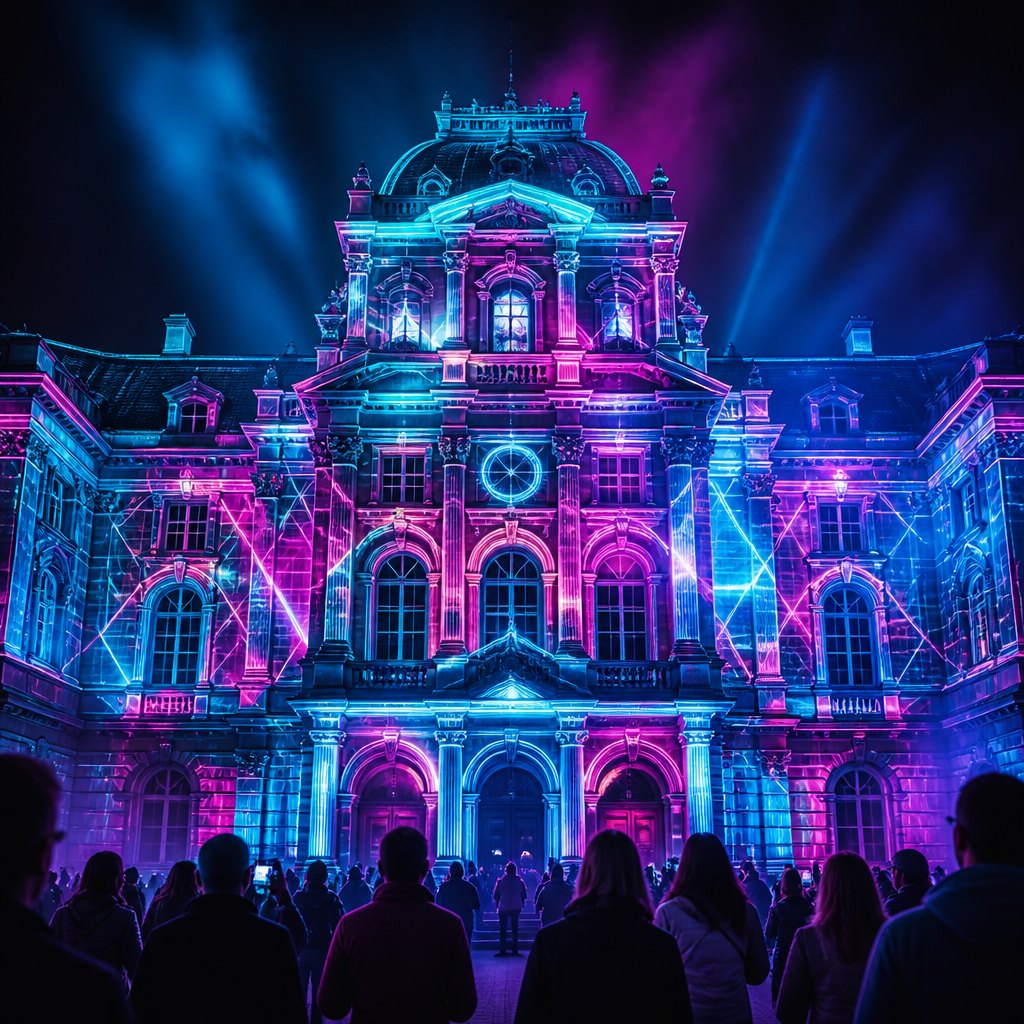 AI-generated
Try the medium
Try projection mapping with AI
This example was generated from a prompt like: “A historic stone building facade at night transformed by animated projection mapping, glowing geometric light patterns tracing its windows and cornices, neon cyan and magenta hues, small crowd watching from below, visible light haze in the air.”
Open the Projection Mapping Style generator →The medium today
Projection mapping now runs on festival stages, museum facades, product launches, and concert productions worldwide, using increasingly compact, bright projectors controlled from laptops. Software has grown accessible enough for hobbyists to map a single room or object with consumer equipment. Drone light shows and programmable LED facades offer daylight-visible alternatives, but projection mapping remains preferred where architecture needs to appear to transform temporarily without altering the physical structure at all.
Compose your own
Start with one projector, a laptop, and free or trial mapping software such as MadMapper or Resolume Arena. Practice on a simple object first—a cardboard box or a room corner—rather than a full building. Photograph or measure the surface, build a calibration mask that matches its real edges, then create content in a video or 3D program sized to those exact proportions. Keep early animation simple: color washes, moving lines, or basic shape reveals that respect the object's actual corners. Test in a dark room before attempting anything outdoors or at scale.
Frequently asked questions
What software do most projection mapping artists use?
MadMapper and Resolume Arena are industry standards for masking and mapping video onto surfaces, while TouchDesigner is popular for generative, real-time visuals synced to sound or sensors.
Do I need an expensive projector to start?
No—a standard consumer projector works for practicing on small objects indoors. Large outdoor facades require high-lumen professional units, often stacked, but beginners can learn the technique on a modest scale first.
Why do most projection mapping shows happen at night?
Ambient daylight overpowers projected light, washing out color and detail. Darkness lets even moderately bright projectors read clearly against a surface, which is why almost all shows run after dusk.
How is projection mapping different from a regular projected video?
A regular projection shows a flat rectangle of video regardless of what it lands on. Mapping specifically warps and masks the content to match the physical shape of the surface, so light appears to belong to the object.