
Silhouette art captures a sitter's likeness as a solid, flat profile—almost always cut from black paper and mounted on a lighter card, though some artists paint the shape directly in black ink or pigment on plaster, ivory, or paper. The form depends entirely on outline: no shading, no interior detail, just the clean edge of a head, shoulders, and sometimes a full figure. Traditional silhouettists worked freehand with small, sharp scissors or a fine knife, sometimes aided by a physiognotrace, a mechanical arm that traced a sitter's shadow or profile onto paper at reduced scale. Two cutting methods dominate: hollow-cut, where the profile is cut out of white paper and backed with black so the hole reveals dark beneath, and cut-and-paste, where a solid black shape is cut and glued onto a light ground. Finished silhouettes were often mounted in oval frames, sometimes touched with gold or bronze highlights. The result is instantly recognizable: a crisp, flat black profile reduced to pure contour.
What defines the medium
Strict profile view
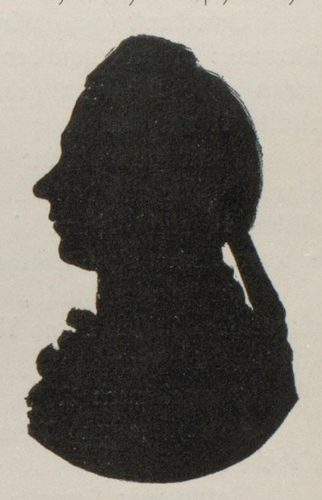
Silhouette portraits are almost always captured in exact side profile, showing forehead, nose, lips, and chin as one continuous edge. Front-facing or three-quarter views are rare because they lose the clean, legible contour the form depends on.
Hollow-cut vs cut-and-paste
Hollow-cut silhouettes remove the profile shape from white paper and back the hole with black, letting the void show a dark shape. Cut-and-paste silhouettes cut a solid black profile and glue it onto a light card instead.
Black-on-light contrast
The form relies on stark value contrast, a solid black shape set against white, cream, or ivory ground with no gradation between the two. This high contrast keeps a silhouette legible even from across a room.
Freehand scissors versus traced machines
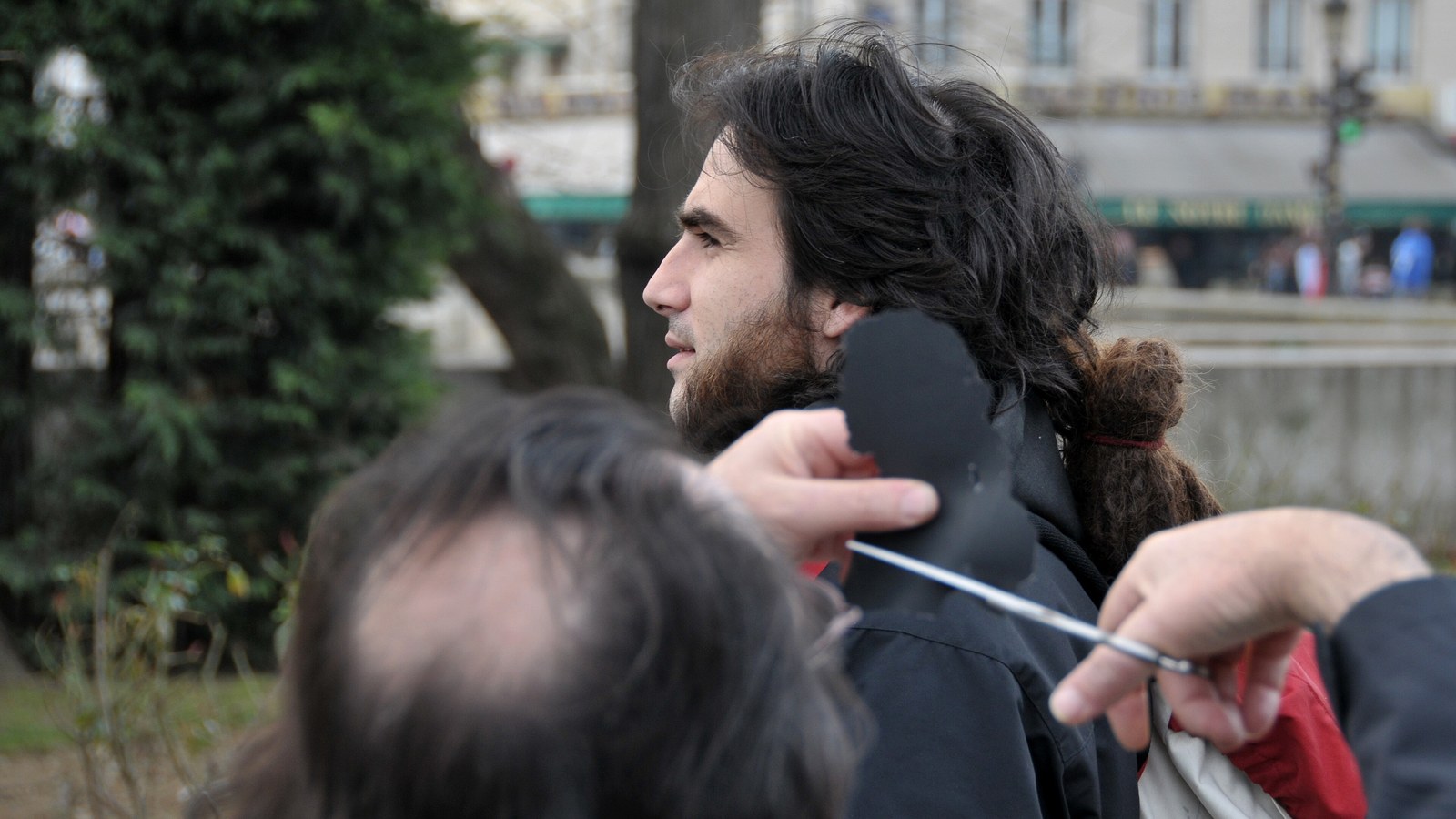
Skilled cutters worked freehand with small, sharp scissors, sometimes finishing a likeness in under a minute. Others used a physiognotrace, a pantograph-like device that traced a sitter's shadow onto paper at a fixed reduced scale.
Mounting, framing, and bronzing
Finished cuttings were pasted onto card or glass and set into small oval or rectangular frames, often no larger than a hand. Some silhouettes received bronze or gold paint on hair, collars, and buttons to suggest texture within the flat shape.
Scale from miniature to full-length
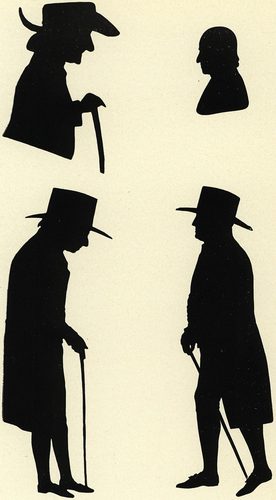
Most silhouettes are small portrait miniatures showing head and shoulders, but some artists cut full-length standing figures or multi-figure family scenes, all rendered in the same flat black profile style.
Materials decoder
The toolkit of silhouette art
- small sharp scissors
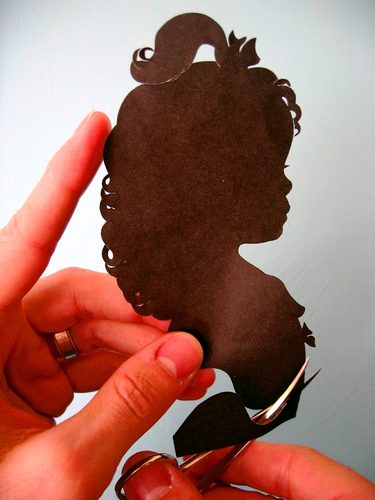
- → the classic freehand cutting tool, capable of shearing a recognizable profile from black paper in a single continuous cut.
- black silhouette paper
- → thin, dense black paper or card used as the cut material, chosen so no light shows through the finished shape.
- physiognotrace
- → a mechanical tracing arm that followed a sitter's profile and reduced it to a small pattern, used for accuracy before photography existed.
- hollow-cut reveal
- → a profile-shaped hole cut from white paper and backed with black, showing the sitter's outline as a dark void rather than a solid cutout.
- bronzing highlights
- → thin gold or bronze paint added over the black shape to suggest hair texture, lace, or buttons without breaking the silhouette's flatness.
- oval frame mount
- → the small oval or rectangular frame typically used to display a finished silhouette, standard through the eighteenth and nineteenth centuries.
The story
The word silhouette comes from Étienne de Silhouette, a French finance minister in 1759 known for austere policies; cheap profile portraits, quick and inexpensive compared to painted miniatures, were mockingly named after him. The practice itself is older, tracing to shadow-tracing traditions described by Pliny the Elder in ancient Rome. Profile cutting became a popular, affordable alternative to painted portrait miniatures across eighteenth-century Europe, requiring no long sitting and costing a fraction of an oil portrait. The physiognotrace, patented in the early 1800s, let itinerant artists trace a sitter's exact profile mechanically. Auguste Edouart, working in Britain and the United States through the 1830s and 1840s, produced thousands of full-length cut silhouettes and is considered the form's most prolific practitioner. Photography's arrival in the mid-nineteenth century largely replaced silhouette portraiture, though the technique survived as a craft into the present.
Masterpieces of the medium
| Work | Artist | Date | Why it matters |
|---|---|---|---|
| Full-length silhouette portraits | Auguste Edouart | 1830s-1840s | thousands of cut-paper full-length figures made during Edouart's tours of Britain and America |
| Physiognotrace-traced profile portraits | Unknown | early 1800s | mechanically traced profile portraits produced by itinerant physiognotrace operators |
| Painted profile portraits on plaster | John Miers | 1790s-1800s | silhouettes painted in black on plaster or card, a hallmark of Miers's studio |
| Hollow-cut portrait from an English spa-town studio | Unknown | c. 1810s | typical of the small studios that flourished in English resort towns |
| Victorian silhouette scrapbook portraits | Unknown | mid-1800s | amateur cut-paper profiles pasted into family albums, a common domestic hobby |
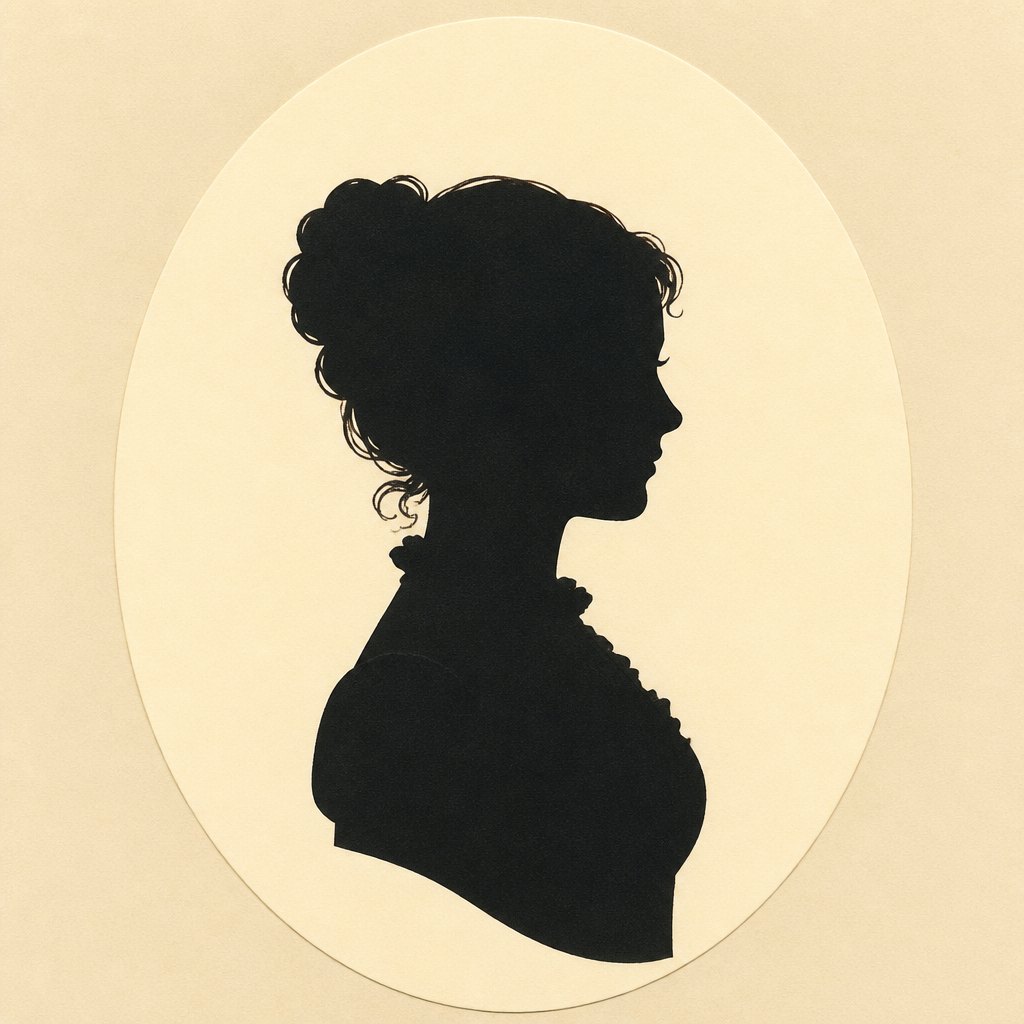 AI-generated
Try the medium
Try silhouette art with AI
This example was generated from a prompt like: “A crisp black paper silhouette of a person's side profile, head and shoulders, mounted on cream card in an oval frame, clean sharp-cut edge, high contrast, vintage portrait style.”
Open the Silhouette Art Style generator →The medium today
Silhouette art survives today mainly as a craft and decorative practice rather than a mainstream portrait medium. Laser and vinyl cutters now produce precise profile shapes for weddings, nurseries, and gift keepsakes, often traced from a photograph rather than cut freehand. Papercraft artists use the same flat black profile in illustration, branding, and packaging design. Digital tools can generate a silhouette outline from any photo in seconds, and the form persists as a design shorthand—instantly recognizable, reduced to pure contour—long after it stopped being the fastest way to record a likeness.
Compose your own
Start with a clear side-profile photo, since accuracy depends entirely on a clean edge. Trace or print the profile at the desired size, then transfer the outline onto black cardstock. Cut just outside the traced line with a small, sharp craft knife or scissors, working slowly around curves like the nose and lips where the line changes direction quickly. Mount the finished cutout onto white, cream, or colored card for contrast, using a thin layer of glue to keep edges flat. Beginners often practice on printed profile templates before attempting a live sitter, since cutting from a projected or traced shadow is an easier entry point than freehand cutting.
Frequently asked questions
What's the difference between hollow-cut and cut-and-paste silhouettes?
Hollow-cut removes the profile shape from white paper and backs the resulting hole with black, so the dark shows through a void. Cut-and-paste instead cuts a solid black shape and glues it onto a lighter background card.
Do silhouette artists still cut portraits by hand today?
Some do, particularly at fairs, markets, and historic sites, cutting a likeness freehand with scissors in a minute or two. Most modern silhouette products, however, are traced from a photo and cut by machine rather than by eye.
Why are silhouettes always shown in profile?
Profile view gives the clearest, most legible outline of a face—forehead, nose, lips, and chin read as one continuous line. A front-facing view loses that sharp contour and becomes hard to identify as a flat black shape.
What materials do I need to try silhouette cutting?
A few basics: black cardstock, a sharp craft knife or small scissors, a pencil for tracing, and a lighter card for mounting. A clear profile photo or a strong side-lit shadow gives the cleanest outline to cut.