
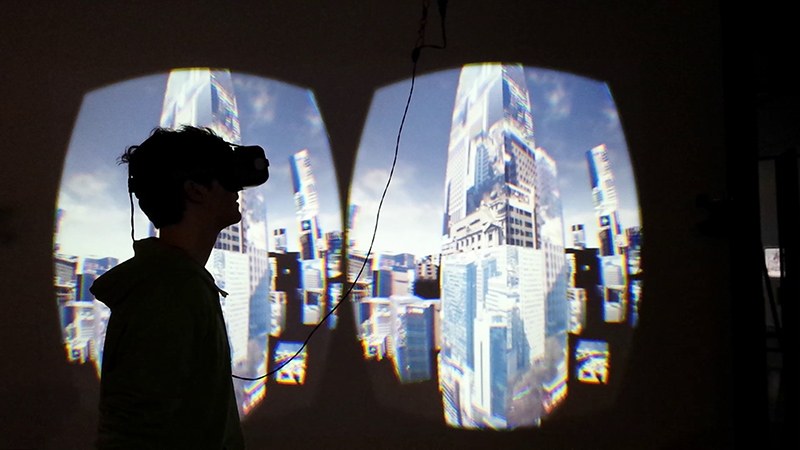
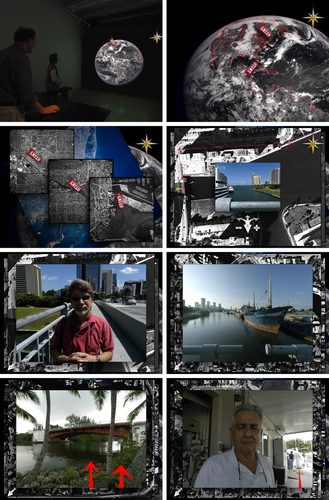
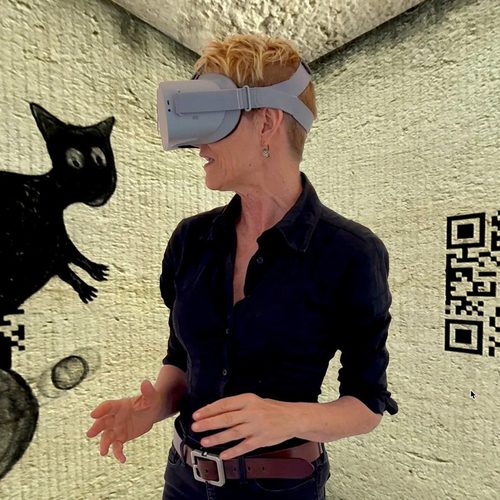
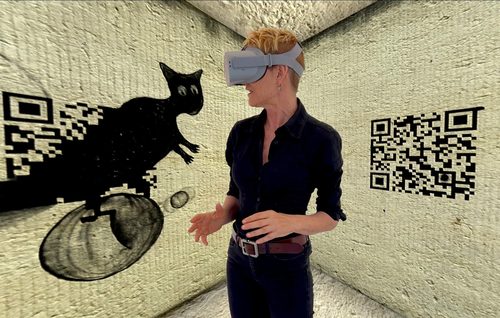
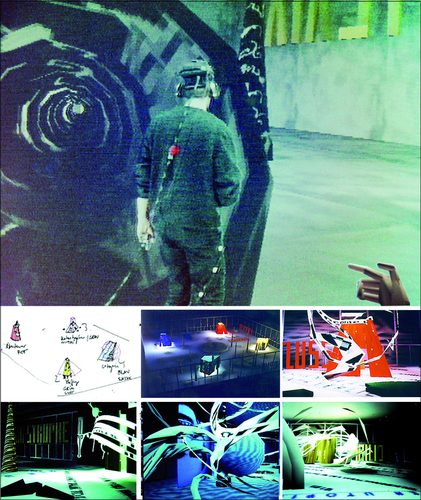
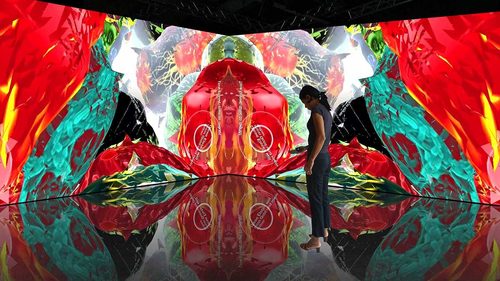
VR art is made and often experienced inside a virtual reality headset, where an artist uses hand controllers to paint, sculpt, or place objects directly in three-dimensional space rather than on a flat screen. Software such as room-scale painting and sculpting applications lets artists draw strokes that hang in mid-air with volume, glow, or particle effects, while other VR tools support full 3D sculpting similar to digital clay. The resulting work can be a still 3D scene captured from a chosen angle, a fully explorable environment installed for gallery visitors wearing headsets, or a recorded performance showing the artist building the piece in real time. Because the canvas is a room-sized volume rather than a rectangle, VR art often surrounds the viewer, uses scale dramatically, and incorporates movement or sound. Finished pieces are frequently documented as flat images, video walkthroughs, or 360-degree captures for audiences without a headset.
What defines the medium
Room-scale drawing
Artists move physically within a tracked space, using the whole body and both hand controllers to draw, rather than working from a fixed seated position with a wrist and a mouse.
Volumetric strokes
VR painting tools produce brushstrokes with thickness, glow, or particle texture in three dimensions, unlike a flat line drawn on paper or canvas, giving marks physical presence in space.
Multiple viewing angles
Because the artwork exists in a 3D volume, it can be walked around and viewed from any angle rather than fixed to one frontal composition the way a painting or print is.
Documentation for flat audiences
Finished VR pieces are usually captured as photographs, video flythroughs, or 360-degree renders so people without a headset can still see and evaluate the completed work.
Live performance drawing
VR art is often created in front of an audience or livestreamed, with the act of drawing in the air treated as a visible, theatrical part of the artwork itself, not a hidden process.
Cross-media output
A VR sculpture or scene can be exported and 3D printed, rendered into animation, or rebuilt as a physical installation, moving the work beyond the headset it was created in.
Materials decoder
The toolkit of vr art
- glowing brushstroke
- → a luminous, ribbon-like line with volume and light, the signature mark of VR painting software
- hand controller trail
- → a gesture-drawn line that follows the artist's physical hand movement through tracked space
- particle and light effects
- → shimmering, sparking, or smoke-like brush textures unique to digital VR tools with no physical-world equivalent
- 360-degree environment
- → a fully surrounding scene meant to be viewed by turning the head in every direction inside a headset
- head-mounted display
- → the goggle-like headset worn to see and enter the three-dimensional artwork
- room-scale boundary
- → a marked floor area showing the physical space an artist or viewer can safely move through while wearing the headset
The story
Immersive computer-generated art predates consumer VR headsets: the CAVE Automatic Virtual Environment, built at the University of Illinois at Chicago in 1992, projected 3D imagery onto the walls of a room-sized cube for early virtual art and science experiments. Artists worked with bulky, expensive VR hardware through the 1990s to produce immersive installations for gallery and festival audiences. Consumer VR returned in force with the Oculus Rift's 2016 release, followed quickly by room-scale painting applications that let ordinary users draw three-dimensional strokes in mid-air. These tools and related sculpting applications popularized VR as a drawing and modeling medium beyond specialist labs. Major museums and galleries began hosting VR art exhibitions and artist residencies through the later 2010s, and VR pieces have since been shown alongside traditional media at international art fairs and biennials.
Masterpieces of the medium
| Work | Artist | Date | Why it matters |
|---|---|---|---|
| CAVE Automatic Virtual Environment installations | Unknown | 1992 | room-sized projected 3D environment at the University of Illinois, an early immersive art space |
| Room-scale VR painting application, public release | Unknown | 2016 | software that popularized drawing three-dimensional strokes in mid-air for general users |
| Osmose | Unknown | 1995 | an early immersive VR installation exploring breath-controlled navigation through abstract 3D space |
| Consumer VR sculpting software, public release | Unknown | 2016 | brought digital clay modeling into headset-based art practice |
| Museum VR art exhibitions | Unknown | 2016-2019 | major institutions began hosting headset-based exhibitions and artist residencies devoted to VR work |
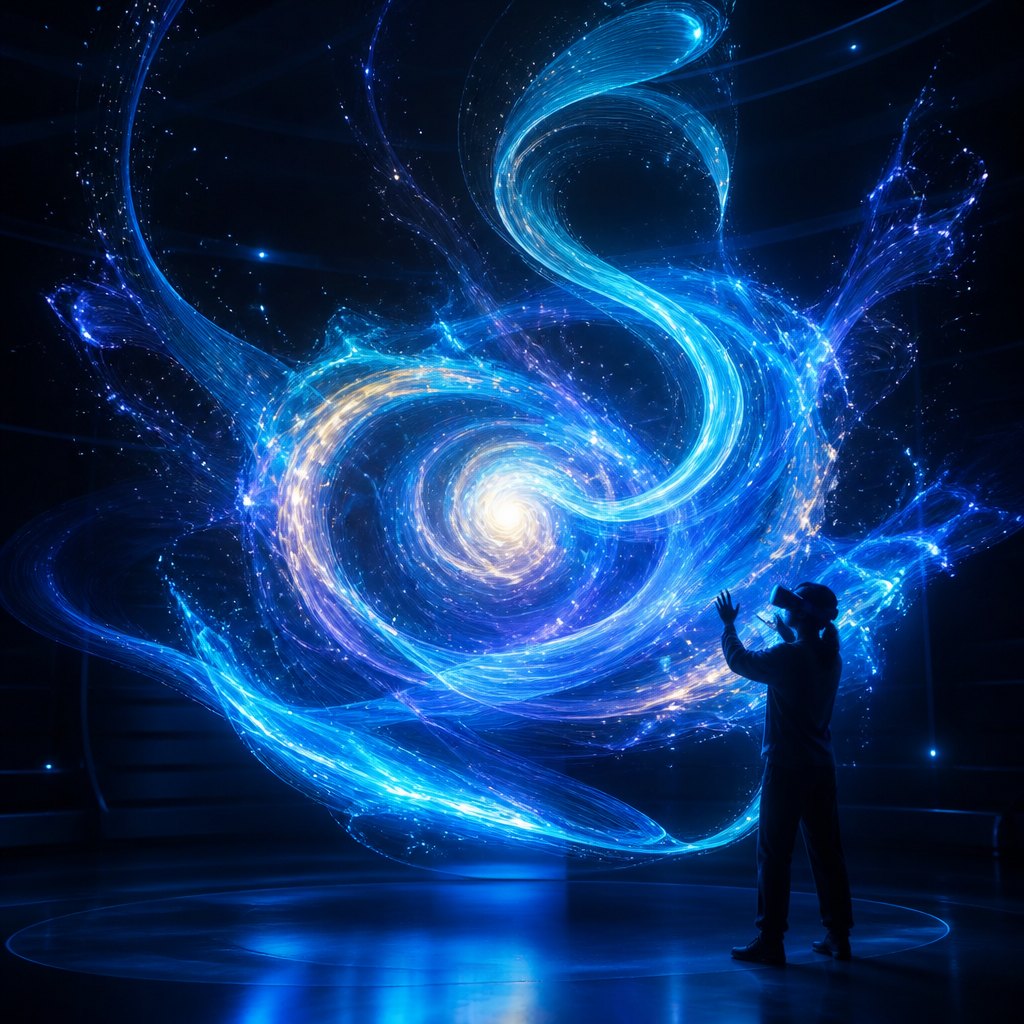 AI-generated
Try the medium
Try vr art with AI
This example was generated from a prompt like: “A glowing three-dimensional sculpture of a swirling nebula painted in mid-air with luminous ribbon-like brushstrokes, viewed inside a dark virtual reality room, particle sparkles, deep blue and cyan light trails.”
Open the VR Art Style generator →The medium today
VR art today spans quick sketchbook-style painting sessions in consumer headsets to elaborate multi-room installations shown at galleries and festivals. Artists increasingly combine VR sculpting with 3D printing, animation, and game engines to move work between virtual and physical form. Livestreamed VR drawing has become a popular way to share the process, since viewers can watch a piece take shape in real time even without owning a headset. As headsets grow lighter and cheaper, VR art tools are also used in education and design alongside fine-art practice.
Compose your own
Getting started in VR art requires a virtual reality headset with room-scale tracking and hand controllers, plus a free or low-cost painting or sculpting application. Beginners typically start with simple gesture drawing, learning how brush size, color, and stroke type behave in three-dimensional space before attempting a full scene. Walking around a piece while building it, checking it from multiple angles, is essential since VR art has no single fixed front. Recording a flythrough video or 360-degree capture lets a finished piece be shared with people who do not own a headset. Watching recorded VR drawing sessions online is one of the fastest ways to learn the movement and pacing the medium rewards.
Frequently asked questions
Do I need expensive equipment to make VR art?
A consumer VR headset with hand controllers and room-scale tracking, along with free or inexpensive painting software, is enough to start. High-end galleries may use more advanced rigs, but entry-level VR art requires no specialized gear.
How do people see VR art without a headset?
Artists typically record their work as flat video walkthroughs, still images captured from chosen angles, or 360-degree videos that let viewers pan around the scene on a phone or computer without headset hardware.
Is VR art the same as 3D modeling?
They overlap but differ in process. Traditional 3D modeling happens through a mouse and flat screen with precise numeric controls, while VR art is drawn or sculpted through direct hand gesture inside the space itself.
Can VR artwork be turned into a physical object?
Yes—many VR sculpting tools export standard 3D file formats that can be sent to a 3D printer or refined further in traditional 3D software, letting a piece move from virtual space into a tangible object.